Terra · Skyline Blog
Booking Software for a Kayak Operator with Several Guides
Fabián Alvarez6 min read
TL;DR
- Terra puts bookings, guides, departures and payments in one multi-user calendar.
- Automatic WhatsApp reminders the day before and day of the tour cut down no-shows.
- Every departure closes with its own settlement panel: cash, automatic drafts and receipts.
- The same data connects the calendar, reminders and settlement, with no copying between systems.
A kayak operator with several guides needs one calendar to see bookings and assign guides, automatic reminders that prevent no-shows, and a settlement for every departure to close the cash without guessing. Terra, Skyline's AI booking engine, brings the three pieces together on the same operations data.
What does a kayak operator with several guides actually need?
An activities operator running kayak, rafting or paragliding trips has a different problem than an agency that only sells packages: every departure depends on who is guiding, how many spots are left in the van or in the gear, and what happened with the cash at the end of the day. When that information lives split between a spreadsheet, WhatsApp screenshots and the owner's memory, mistakes show up fast: two guides assigned to the same group, a traveler who never got the reminder and didn't show, or a settlement that never quite adds up.
Terra, Skyline's AI booking engine, solves this with three pieces that work together: a single operations calendar, automatic reminders and a settlement panel for every departure. These aren't three separate tools — they're the same underlying data seen from three angles, so the owner, the guides and whoever is selling don't have to chase each other over chat to know what's happening today.
Let's walk through Kayak Río Claro, a generic operator with daily departures, three guides (Camilo, Sara and Andrés) and one shared vehicle for three groups a day.
How do you organize departures for several guides in one calendar?
The first pain point for an operator with a team is simple: who knows everything that's happening today? Terra puts bookings, guides, departures, travelers and payments in a single operations calendar, and it's multi-user, so Camilo, Sara, Andrés and the owner can all see it at the same time from their own phone or computer.
What this looks like in practice
At Kayak Río Claro, each departure of the day shows up as a block on the calendar with:
- The departure time and meeting point.
- How many travelers are confirmed and how many spots are left.
- Which guide is assigned to that departure.
- The payment status of each booking (deposit paid, paid in full, pending).
When a new booking comes in — by chat, from the web storefront, or through a network partner — the owner of Kayak Río Claro opens the calendar and decides in seconds whether it goes to Camilo (already has two departures that morning), Sara (has the smaller group), or Andrés (just back from vacation). No calls needed to check availability: the calendar already shows each guide's load.
Why this matters more with several guides
With a single guide, a spreadsheet can survive for a while. With three, manual coordination starts to break down: someone forgets to update the cell, two people write at the same time, and on Sunday night nobody knows for sure how many departures are scheduled for Monday. A single calendar removes that friction because everyone looks at the same source of truth, not an outdated copy.
How do you prevent a traveler from missing the departure?
The second typical pain point for outdoor activities is the no-show: someone books, pays or doesn't pay, and simply doesn't show up. With kayaking this is costlier than with an urban tour, because it means gear already reserved, transport already mobilized, and a spot that can't be recovered on the spot.
Terra tackles this with automatic WhatsApp reminders the day before and the day of the tour, plus confirmation templates via WhatsApp and email. The system doesn't depend on someone from the team remembering to write: the reminder goes out on its own, at the right moment, with the departure information already loaded.
Kayak Río Claro's example
Sara has a 7:00 a.m. departure with six travelers. The night before, each one gets an automatic WhatsApp reminder with the time, the meeting point and what to bring. On the morning of the departure, another reminder confirms everything is still on. The practical result: fewer last-minute calls, fewer people lost looking for the meeting point, and a guide who can focus on the river, not on the phone.
What this frees up for the team
Before automating this part, someone on the Kayak Río Claro team had to manually write each traveler, check who had replied, and write again to those who hadn't. With automatic reminders, that task disappears from the daily routine, and the time can go into taking good care of whoever is already on site or closing new bookings.
How do you track the money for each departure?
The third pain point is the quietest but the most expensive: the cash for each departure. When three guides are collecting cash, paying for gas, buying something for the group, or receiving tips, reconciling accounts at the end of the month becomes a guessing game.
Terra has a per-departure settlement panel: each tour's cash, automatic drafts, receipts and AI reading of the guide's report. This means every departure — not every month, not every week — closes with its own balance: how much came in, how much the guide spent, what commission applies, and what's left for the operator.
How Andrés closes his departure
Andrés finishes his route, writes or dictates a short report of the departure (how much he spent on gas, whether he bought something for the group, whether there were any tips or extra expenses), and Terra reads that report with AI to build an automatic draft of the settlement. Andrés or the owner review it, adjust it if something's missing, and it closes with its receipt. There's no need to wait until the end of the month to know if that departure was profitable.
Why this changes the operation with several guides
With a single guide, the owner can keep the cash box in their head. With three guides operating in parallel, each with their own flow of expenses and collections, per-departure settlement is what makes it possible to compare: which guide has more profitable departures? On which departures do expenses run higher than normal? How much is owed to each guide this month? That visibility, departure by departure, is what avoids the "the money doesn't add up" arguments at month's close.
How does all of this connect in day-to-day operations?
The strength of this flow isn't in each piece separately — it's in the fact that they share the same data. The booking that shows up on the calendar is the same one that triggers the automatic reminder, and it's the same one that feeds the settlement when the guide closes their departure. Nobody at Kayak Río Claro has to copy information from one place to another.
Here's what a full day looks like:
- A traveler books a kayak departure for Saturday.
- The booking enters the operations calendar and the owner assigns a guide based on who has the lightest load that day.
- The day before and the day of the departure, the traveler gets automatic WhatsApp reminders.
- The guide runs the departure and reports expenses and income at the end.
- Terra generates the settlement draft for that departure with AI, and the owner approves it.
This same flow works whether the operator has one guide or ten: what changes is that with several guides, having a single calendar, reminders that don't depend on anyone, and a per-departure settlement stops being a nice-to-have and becomes the only way to not lose control of the operation.
What to do if your activities operation already has several guides
If your kayak, rafting, paragliding or similar activity business already runs with more than one guide, and coordinating departures over chat and reconciling cash by hand is costing you time or money, the next step is to go to terra.skyln.co and see what your operations calendar looks like with your own departures loaded in.
Frequently asked questions
Does Terra work if I only have one guide for now?
Yes, the same operations calendar works with one guide or several; the difference is that with more guides, per-departure assignment and settlement become more necessary to keep control.
How do you assign a guide to a departure in Terra?
From the operations calendar you see each guide's load for the day and assign the departure right there; bookings, guides, departures, travelers and payments stay on the same multi-user calendar.
What happens if a traveler doesn't reply to the reminder?
The automatic WhatsApp reminders still go out the day before and the day of the tour; the team can check the calendar to see who confirmed and follow up manually only on specific cases.
How does settlement work when the guide collects cash?
The guide reports the expenses and income for their departure, and Terra uses AI reading of that report to build an automatic settlement draft, which is then approved along with its receipt.
Is settlement monthly or per departure?
It's per departure: each tour has its own cash panel, with automatic drafts and receipts, instead of waiting for a monthly close to know if it was profitable.
Terra
See Terra in action
The AI booking engine for tour operators: bookings, itineraries, packages and payments, operated by chat via MCP.
Request a Terra demo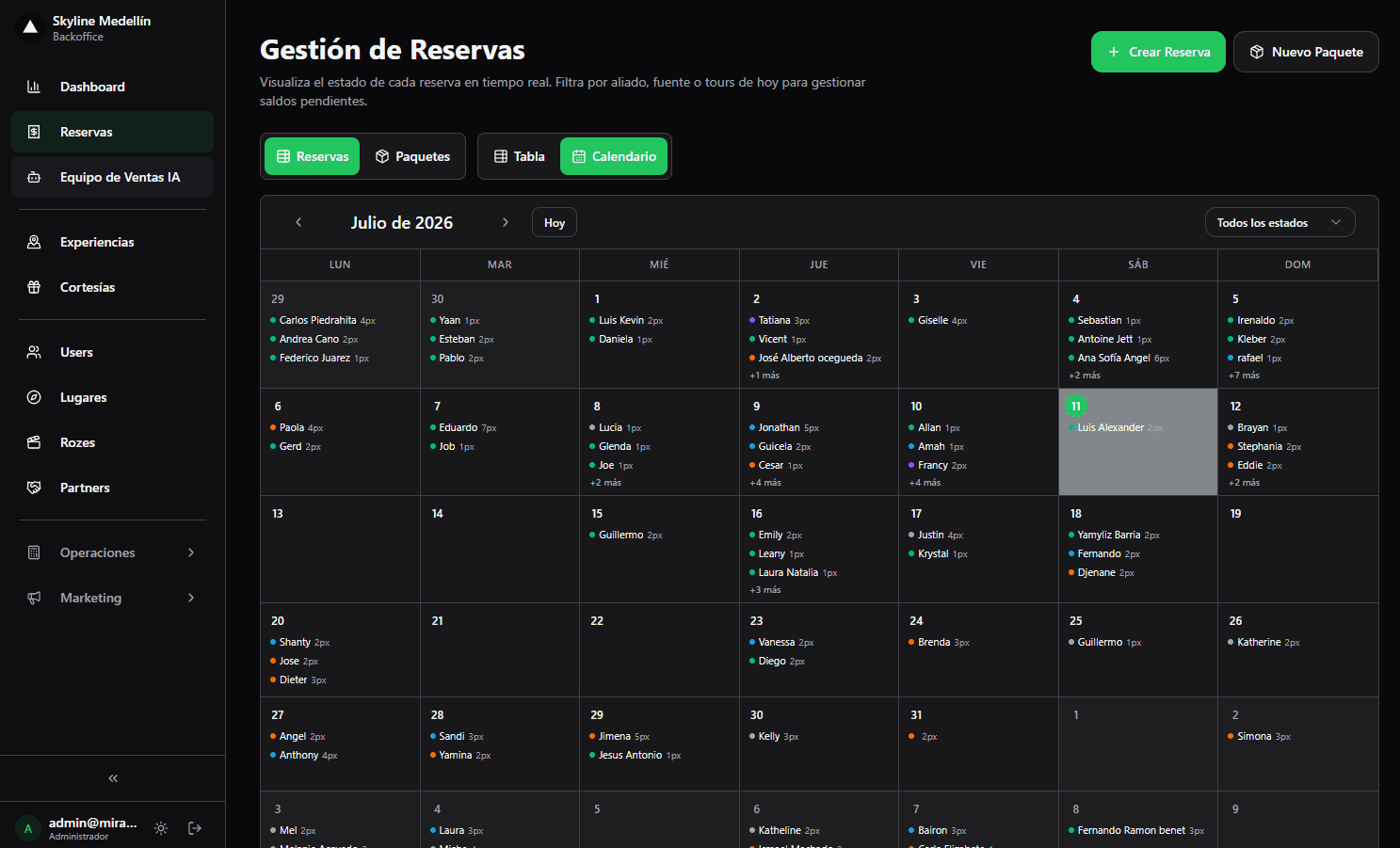
Related · Terra
How to Connect Your Booking Engine to Claude, Step by Step
Generate a URL in Terra → Integrations and paste it into Claude to connect your booking engine.
ReadHow to Build a 3-Day Itinerary by Chat With Real Prices
Terra builds day-by-day itineraries with a public link straight from a chat with the client.
ReadWhat Is a Booking Engine and What Tours Need
A booking engine manages availability, dates, payments and confirmations, not just charges.
Read