Draco · Skyline Blog
What Is Lead Scoring and How It Works With AI
Fabián Alvarez5 min read
TL;DR
- Lead scoring means giving each conversation a temperature (cold, warm, hot) based on how close it is to buying.
- In Draco, the agent Kai is the one who assigns that temperature, tags leads and moves them between funnel stages.
- Vega generates the sales signals, Leo acts based on the temperature, and Iris reviews quiet conversations.
- Response intensity is adjustable per funnel, and Draco can run in copilot mode before going autonomous.
Lead scoring is assigning each conversation a temperature (cold, warm, hot) based on how close it is to buying, to prioritize the team's work. In Draco, Skyline's AI CRM, this job is done by Kai, one of five AI agents, who automatically tags and moves each lead between funnel stages.
What is lead scoring?
Lead scoring is assigning each conversation a temperature (cold, warm, hot) based on how close it is to buying, to prioritize the team's work. That's a textbook sales definition, but for a travel agency with hundreds of chats coming in through WhatsApp, Instagram and TikTok, doing it by hand becomes impossible. Someone has to review every thread, decide whether it's worth pursuing, and write it down somewhere before it gets buried under the next batch of messages.
That's where Draco, Skyline's AI CRM, comes in. Draco brings an agency's channels into a single inbox and organizes the work with a team of five AI agents with distinct roles: Vega, Kai, Axel, Leo and Iris. Each one handles a specific task inside the funnel. Lead scoring, specifically, is Kai's job.
Who assigns the temperature in Draco?
Kai is the agent in charge of scoring: it gives each lead a temperature, applies automatic tags, and moves it between funnel stages. Kai doesn't talk to the customer directly — that's Vega's job — but it watches every exchange and decides where in the buying process that person stands.
To do that work with judgment instead of rigid rules, Kai relies on the context Draco already has: a business can run multiple funnels, and each one has its own knowledge, mission and buyer persona. The AI classifies and responds based on the funnel a lead is in, not with one generic formula applied to everyone.
An example with three conversations
Picture a travel agency selling beach packages and diving tours. On a single day, three chats come in:
- Lead A, via Instagram: writes "how much is the diving tour?", gets the price, and never replies again. Kai marks it cold: there's initial interest but no sign of progress.
- Lead B, via WhatsApp: asks about available dates, mentions how many people are traveling, and requests the itinerary. Kai bumps it to warm: there's concrete intent and real trip details.
- Lead C, also via WhatsApp: already received a quote from Vega, asks for the payment link, and confirms they want to book this week. Kai marks it hot and moves it to the closing stage.
None of these calls require a human on the team to review them one by one. Kai makes them in real time, based on what the lead says and what stage of the funnel they were in before.
How does scoring connect with the rest of Draco's team?
Scoring doesn't live in isolation. Every Draco agent either feeds or consumes the temperature Kai assigns:
- Vega handles attention, prequalification and closing in real time; it recommends from the catalog, quotes, builds packages and takes the sale through to payment. Vega is the one generating the signals Kai interprets.
- Leo runs proactive follow-ups: it reactivates cold leads, sends reminders and asks for reviews. Leo acts differently depending on whether Kai marked the lead as cold or warm.
- Iris reviews quiet conversations and decides whether the lead is still alive, whether it's sitting in the wrong funnel, or whether it needs a human; everything it does is auditable and reversible, and it never writes to customers directly.
- Axel analyzes every night how the team — humans and Vega — handled conversations, and turns that into metrics and coaching; it also doesn't talk to customers.
In practice, Kai's scoring is the piece of data that organizes everything else: without knowing how hot a lead is, Leo wouldn't know who to follow up with or how intensely, and Iris wouldn't have a basis to decide whether a quiet conversation is worth reviving.
Can you adjust how the AI acts based on temperature?
Yes. Vega's intensity (low, medium, high) and Leo's (soft, medium, hard) are set per funnel, with a hard cap of messages per reply and a fixed stance of never chasing the customer. That means an agency can decide that, for hot leads, Vega should respond with high intensity and close fast, while for cold leads, Leo reactivates with a soft tone and without flooding the person with messages.
Draco also doesn't start blind: it begins in copilot mode, where the AI proposes and a person approves or corrects, and moves to autonomous only once the team trusts the decisions; it can be reverted at any time. This applies to scoring too: at first, the human team can review how Kai is classifying leads before letting the system run on its own.
Why does this matter for an agency and not just a small tour operator?
An agency usually handles a much higher volume of leads than a small operator, and with that volume comes more noise: curious questions, quotes that never move forward, customers asking about two different destinations in the same chat. Without an automatic sense of temperature, the sales team ends up replying in order of arrival instead of by likelihood to close, and hot leads go cold while someone answers an old message.
With Kai's scoring, an agency can filter its inbox by temperature and decide where to put a human salesperson first, while letting Leo handle reactivating cold leads without anyone having to remember manually. The agency from the example above, with three open conversations at once, doesn't need someone to manually decide which one to answer first — the temperature already tells them.
What to do next
If your agency already gets leads across several channels and you want to see how Kai assigns temperature without anyone doing it by hand, check out how Draco works at draco.skyln.co.
Frequently asked questions
Which Draco agent does lead scoring?
That's Kai. Its role is to assign a temperature to each lead, apply automatic tags, and move it between funnel stages based on how close it is to buying.
Does Kai talk directly to customers?
No. Kai only classifies and moves leads; the agent that converses and closes sales in real time is Vega, another of Draco's five agents.
Is the temperature calculated the same way for every business?
No. Draco supports multiple funnels per business, each with its own knowledge, mission and buyer persona, so Kai classifies based on the context of that specific funnel.
What happens to a lead marked as cold?
Leo, another Draco agent, handles reactivating it through proactive follow-ups, reminders or review requests, with intensity that's configurable per funnel.
Can I review Kai's decisions before trusting them?
Yes. Draco starts in copilot mode, where the AI proposes and a person approves or corrects, and only moves to autonomous once the team trusts the system; it can be reverted at any time.
Draco
See Draco in action
The AI CRM for agencies and tour operators: WhatsApp, Instagram, Messenger and TikTok in one inbox, handled by five AI agents.
Try Draco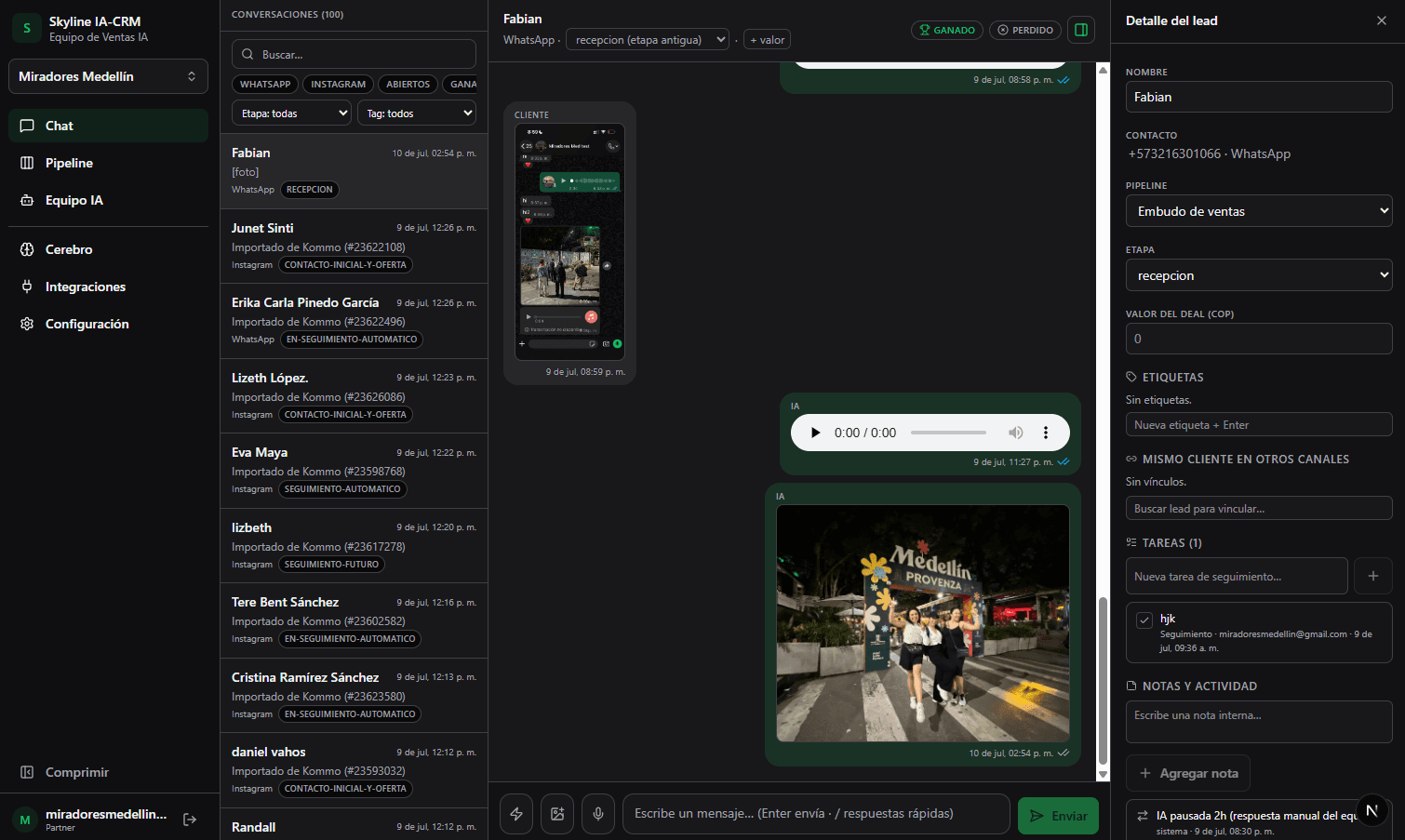
Related · Draco
Generic CRM vs AI CRM for Tourism: The Differences
A generic CRM doesn't know your catalog; an AI CRM for tourism quotes with real prices and availability.
ReadHow to Set Up a Team of AI Agents for Your Agency
Draco has five AI agents with fixed roles: Vega, Kai, Axel, Leo and Iris.
ReadCan My WhatsApp Get Banned If an AI Replies?
The ban risk depends on how the AI connects to WhatsApp, not on whether an AI replies at all.
Read