Draco · Skyline Blog
AI CRM for Travel Agencies and Tour Operators
Fabián Alvarez10 min read
TL;DR
- An AI CRM for travel centralizes WhatsApp, Instagram, TikTok and email, and uses AI to qualify and reply to every lead.
- Draco does this with a team of five agents (Vega, Kai, Axel, Leo and Iris), each with a distinct role.
- WhatsApp connects through Meta's official coexistence API, with no ban risk to the number.
- Rollout starts in copilot mode: the AI proposes and a person approves before moving to autonomous.
- Draco costs COP $300,000 per month, all-inclusive, with 1,000 AI replies.
An AI CRM for travel unifies WhatsApp, Instagram, TikTok and email into one inbox and uses AI agents to qualify, sell to and follow up with every lead. Draco, Skyline's AI CRM, does this with five agents (Vega, Kai, Axel, Leo and Iris), a real connected catalog, official WhatsApp access and a copilot mode to roll it out risk-free.
What is an AI CRM for travel?
An AI CRM for travel is a system that centralizes a travel agency's or tour operator's conversations (WhatsApp, social channels, email) and uses artificial intelligence to qualify, answer and follow up on every lead without a human having to sit behind each message. It's not just a pretty inbox: it's a team that attends, prioritizes and persists, while people focus on closing complex sales or handling what AI can't.
Draco, Skyline's AI CRM, is an example of this category: a unified inbox for WhatsApp, Instagram, Messenger and TikTok, handled by a team of five AI agents with a human tone. Throughout this guide you'll understand what problem an AI CRM solves, why generic tools fall short in travel, how each agent works, how to roll it out without risking your current operation, and what it costs.
Picture an agency in Cartagena selling boat tours and beach plans. It gets messages on WhatsApp, comments on Instagram, and the occasional lead from TikTok. Without a system that centralizes and prioritizes, every channel becomes its own inbox, and hot leads get lost among cold ones. That's exactly where an AI CRM for travel changes the operation.
Why doesn't a generic CRM work for a travel agency?
Generic CRMs were built for long-cycle B2B sales, with forms, custom fields and flows designed for software or professional services. Travel moves differently: the buying decision happens in minutes or hours, over chat, with repetitive questions about prices, availability and dates, and the customer expects an almost immediate reply.
These are the most common friction points when an agency tries to force a generic CRM or a spreadsheet into this rhythm:
- They don't connect natively to WhatsApp Business without risking the number or depending on unstable integrations.
- They don't know the real catalog of experiences, prices and availability, so any AI layered on top can make things up.
- They don't prioritize leads automatically: everything lands in the same inbox, with no distinction between who's ready to pay and who was just curious.
- They don't follow up proactively: if the lead doesn't reply, it goes cold until someone remembers to write back.
- Rule-based chatbots repeat rigid scripts and break on any question they didn't anticipate, creating a robotic experience that pushes the customer away.
An AI CRM built for travel, like Draco, exists precisely to solve these points: a native inbox on the channels where travelers actually live, a real catalog connected, and an attention logic designed for the pace of a chat-based sale.
How does Draco connect WhatsApp without risking the number?
This is one of the most common fears for any agency: connecting the business's WhatsApp to an external platform and having Meta ban the number. Draco solves this by connecting through Meta's official coexistence API: the number keeps working in the usual app and there is no ban risk from unofficial bridges.
This means the team can keep using WhatsApp Business on the phone exactly as before, while Draco handles conversations in parallel from the platform. There's no need to choose between "the agency's phone" or "the system": both coexist on the same number, officially.
Beyond WhatsApp, Draco's unified inbox brings together Instagram, Messenger and TikTok in one place, and email also comes in as a channel. For an agency that today checks four or five different apps to avoid missing a message, this removes the fragmentation: the whole team works from a single inbox, no matter where the traveler wrote from.
What does each of Draco's five agents do?
Draco isn't a single generic chatbot: it's a team of five AI agents with distinct roles, called Vega, Kai, Axel, Leo and Iris. Each one covers a specific part of the attention and sales cycle, so no task is left without an owner.
Vega: attention, pre-qualification and closing
Vega is the agent that faces the customer in real time. It recommends experiences from the catalog, quotes, builds packages and carries the sale through to payment. It's the one who answers when a traveler asks about a tour, compares options and wants to close the booking without waiting for a human to be available.
Kai: lead scoring
Kai watches every conversation and assigns it a temperature: cold, warm or hot. It also applies automatic tags and moves the lead between funnel stages. This is what lets the human team know, without checking chat by chat, who to attend first.
Axel: nightly attention review
Axel doesn't talk to customers. Every night it reviews how the team handled attention, both humans and Vega, and turns that review into metrics and coaching. It's the agent that spots patterns: slow replies, missed opportunities, messages that worked well and deserve repeating.
Leo: proactive follow-up
Leo is in charge of re-engaging cold leads, sending reminders and asking for reviews after the service. It's the agent that keeps a warm lead from going cold for lack of follow-up, something that in most agencies depends on one person remembering to write back.
Iris: board triage
Iris also doesn't write to customers. It reviews quiet conversations and decides whether the lead is still alive, whether it's stuck in the wrong funnel, or whether it needs a human. Everything Iris does is auditable and reversible, so the team can always see why a decision was made and undo it if needed.
The table below sums up the division of labor:
| Agent | Main role | Talks to customers? |
|---|---|---|
| Vega | Attention, pre-qualification and closing | Yes |
| Kai | Lead scoring and funnel stages | No |
| Axel | Nightly review of team attention | No |
| Leo | Proactive follow-up and reviews | Yes |
| Iris | Board triage and lead status | No |
This separation of roles is what sets a team of agents apart from a single chatbot trying to do everything: each function has its own dedicated agent, with a clear, measurable task.
Can Draco recommend real experiences, or can it make up prices and availability?
One of the most common risks of connecting generic AI to a business's customer service is that it "hallucinates" information: prices that don't exist, availability when there's none left, experiences the business doesn't even offer. Draco avoids this because it's connected to the real Skyline Partner catalog: the AI only recommends experiences that exist, with real prices and availability.
For an agency this means Vega, the agent that quotes and closes sales, is never improvising. If the catalog says a kayak tour has room for six people on Saturday, that's exactly what Vega tells the traveler. If the price changed this week, Vega uses the updated price, not an outdated one from memory.
This matters especially for agencies working with several operators or routes: the AI isn't memorizing static information, it's checking the catalog at the moment of each conversation.
How do you roll out an AI CRM without risking your current service?
The most reasonable concern any agency has before putting AI into its customer service is: "what if it replies badly and I lose a customer?" Draco is designed so that question isn't a real risk, because it starts in copilot mode (the AI proposes, a person approves or corrects) and moves to autonomous when the team trusts it; it can be reverted at any time.
The typical rollout steps
- Connect the channels: WhatsApp through the official coexistence API, plus Instagram, Messenger, TikTok and email.
- Load the real catalog: experiences, prices and availability that Vega is going to recommend.
- Define funnels, each one with its own knowledge, mission and buyer persona.
- Operate in copilot mode: the team reviews and approves or corrects every AI proposal.
- Move to autonomous mode gradually, funnel by funnel, once the replies already build trust.
This gradual approach is key for an agency that doesn't want to switch off its current attention overnight. The human team keeps seeing every reply before it goes out, and the Approve/Correct buttons feed the AI, training it on the business's real tone. Nobody has to "trust blindly" from day one.
An agency with three advisors, for example, can start with Vega in copilot mode just for the day-tour quoting funnel, while the rest of the attention stays manual. Once that funnel works well, it can expand to full package bookings, and so on.
What happens outside WhatsApp's 24-hour window?
WhatsApp only lets a business reply freely during a period after the customer's last message: the 24-hour window. Outside that period, a business can only initiate contact using Meta-approved templates. Draco uses exactly this official mechanism for proactive follow-up: Leo reactivates cold leads using Meta-approved WhatsApp templates to reach out first outside the 24-hour window.
This matters because many agencies lose leads simply because nobody picks the conversation back up after the day passes. With Leo, that follow-up happens automatically and within Meta's official rules, without risking the number by sending messages outside allowed policies.
What does an AI CRM like Draco cost?
Draco costs COP $300,000 per month, all-inclusive, with 1,000 AI replies. The price is all-inclusive: there are no hidden costs per channel or per number of team seats.
To get a sense of how far those replies go, it helps to think about how many leads that represents: if each lead needs about 7 replies on average to move toward a sale or a discard, about 140 leads per month (at 7 replies per lead) is roughly what 1,000 replies cover. An agency with higher conversation volume can move up the volume ladder: up to 2,000 replies COP $500,000, up to 4,000 $950,000, up to 8,000 $1,800,000 per month.
This price-per-reply model, rather than per seat or per channel, differs from many generic CRMs that charge per team user regardless of how many conversations are actually handled by AI.
What sets a team of agents apart from a single chatbot?
It's tempting to think "more AI" just means a smarter chatbot. The real difference is specialization. A rule-based chatbot tries to answer everything with the same script, without distinguishing between qualifying a lead, closing a sale, or following up three days later.
A team of five agents, on the other hand, separates those responsibilities: Vega sells, Kai prioritizes, Leo persists, Axel improves the process from behind the scenes, and Iris reviews what nobody else is watching. Each agent has a bounded task, which makes its decisions more predictable and easier to audit than those of a monolithic system trying to do everything at once.
For an agency comparing options, this is a useful question to ask when evaluating any AI CRM: does the system have differentiated roles for qualifying, selling, following up and auditing, or is it a single generic model trying to cover the whole cycle?
What to do now
If your agency or operator already gets leads through WhatsApp, Instagram or TikTok and feels they're slipping between channels, the next step is to go to draco.skyln.co and see what your unified inbox would look like with the five agents working in copilot mode before deciding whether to move to autonomous.
Frequently asked questions
Does an AI CRM replace the agency's human team?
No. Draco starts in copilot mode, where the AI proposes replies and a person approves or corrects them. The human team keeps deciding, and it only moves to autonomous mode once there's trust in how the AI responds.
Is it risky to connect the agency's WhatsApp to an AI CRM?
Not with Draco, because the connection uses Meta's official coexistence API. The number keeps working in the normal WhatsApp app, and there's no ban risk from unofficial bridges.
Can the AI offer prices or availability that no longer exist?
It shouldn't, because Draco is connected to the real Skyline Partner catalog. The Vega agent only recommends experiences, prices and availability that are actually available at that moment.
What sets the five agents apart from a regular chatbot?
Each agent has a bounded task: Vega sells, Kai prioritizes leads, Leo follows up, Axel reviews the team's attention every night, and Iris checks quiet conversations. A rule-based chatbot tries to cover everything with the same script, without that specialization.
How much does it cost to roll out Draco in a small agency?
The base plan costs COP $300,000 per month, all-inclusive, with 1,000 AI replies, roughly equivalent to about 140 leads per month (at 7 replies per lead). If volume grows, there's a volume-based pricing ladder for AI replies.
Draco
See Draco in action
The AI CRM for agencies and tour operators: WhatsApp, Instagram, Messenger and TikTok in one inbox, handled by five AI agents.
Try Draco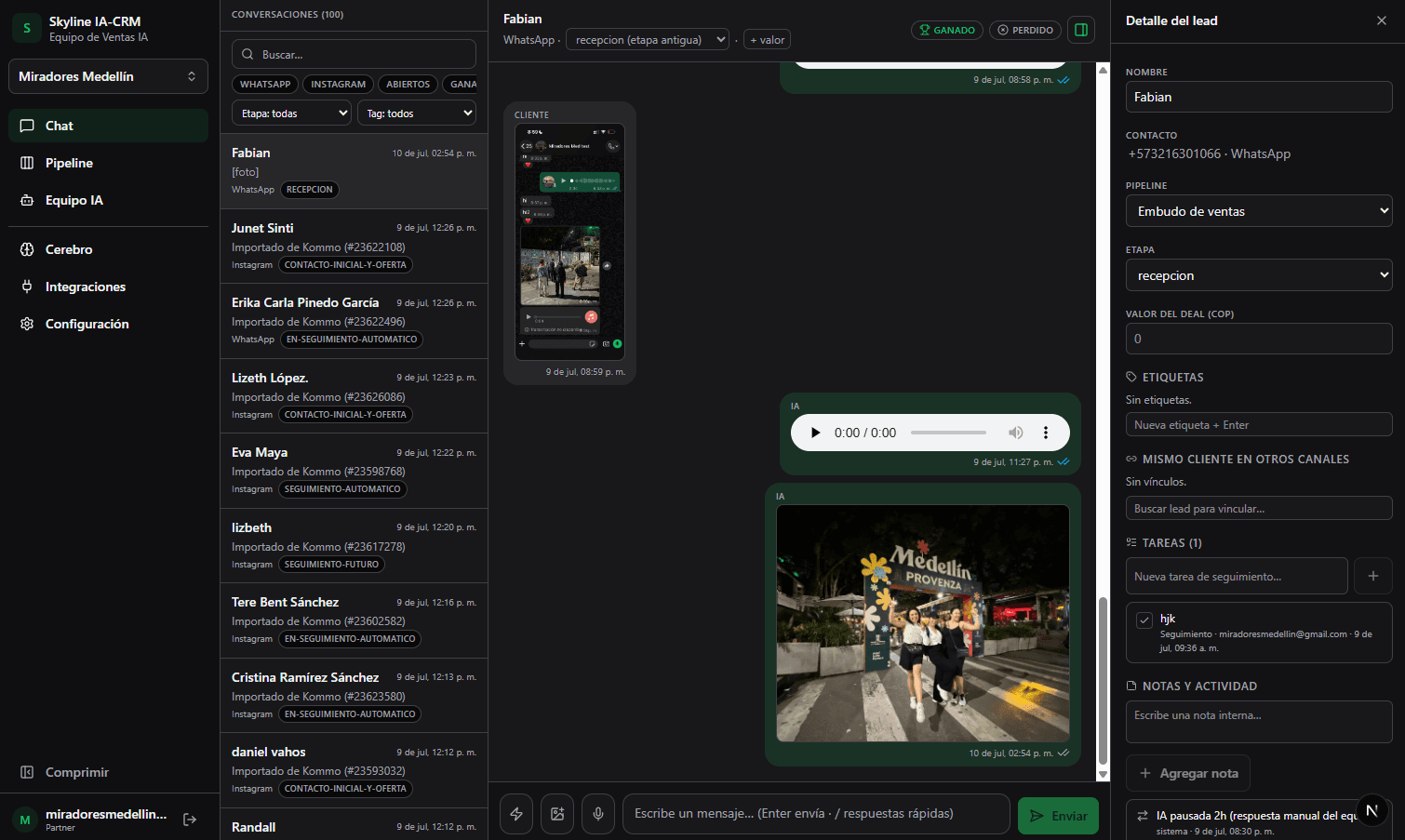
Related · Draco
What Is an AI CRM? Definition and the Real Difference
An AI CRM executes complete funnel tasks, not just suggests replies for a human to copy.
ReadWhatsApp as a Sales Channel for Agencies: Complete Guide
Meta's official coexistence API avoids the ban risk that unofficial bridges carry.
Read