Terra · Skyline Blog
Booking Software for a Paragliding Company with Limited Seats
Fabián Alvarez6 min read
TL;DR
- Terra organizes bookings, pilots, departures and payments in a single multi-user operations calendar.
- The 30% deposit secures a flight window's seat even if the customer pays the balance later.
- Automatic WhatsApp reminders keep the channel ready to notify weather changes.
- The per-departure settlement panel builds cash drafts per pilot, with receipts and AI reading of the report.
Terra, Skyline's AI booking engine, controls seats per flight window with a multi-user operations calendar, 30% deposits that secure a seat before flying, automatic WhatsApp reminders for weather changes, and a per-departure settlement panel that builds each pilot's cash close with receipts.
Why does paragliding need more than a generic calendar?
A paragliding company doesn't sell a generic slot: it sells a flight window with an assigned pilot, a maximum weight per tandem, and weather that can turn in minutes. If a paragliding company in Jardín uses a spreadsheet or a scattered WhatsApp log to track who's on the 7 a.m. flight and who's on the 2 p.m. one, double-booking a seat is just a matter of time. Add three pilots operating the same day, each with their own cash box and commission, and manual control stops being sustainable.
Terra, Skyline's AI booking engine, was built for tour operators that work with departures, limited seats and guides, and that includes activity operators like paragliding companies. It isn't a generic agenda: it understands that a booking has a departure, a hard seat limit, someone responsible for running that departure, and a cash settlement at the end of the day.
How does Terra control seats per flight window?
Bookings, guides (in this case, pilots), departures, travelers and payments live in a single operations calendar, and that calendar is multi-user. That means if the paragliding company has windows at 7 a.m., 9 a.m., 11 a.m. and 2 p.m., each window is its own departure with its own seat limit, its own assigned pilot and its own traveler list.
An example with real flight windows
Picture a paragliding company in Jardín with three active pilots and four daily flight windows, each capped at six people because of gear weight and launch-point conditions.
- The front-desk person sees in the calendar that the 7 a.m. window already has five confirmed bookings and one seat left.
- She confirms the sixth booking directly in that window, without touching a separate sheet or messaging anyone to ask "is there still room?"
- The pilot assigned to that window sees his passenger list for the day, with weights and contact details, from the same calendar.
- If someone cancels, the seat opens back up in the calendar and is visible to whoever is handling another booking at that moment.
Because the calendar is multi-user, the owner, the customer-service person and the pilots can all be looking at the same information for the same departure at the same time, without anyone stepping on another's booking.
How does it stop a customer from booking and not showing up?
Paragliding has a particular problem: the customer pays in advance but doesn't fly the same day they bought. They might buy on Tuesday to fly on Saturday. Between those days, the risk of a no-show is real, especially if nothing commits them to it.
Terra offers online payments with its own checkout, with the option to charge a 30% deposit and leave the balance to be paid later. For a paragliding company this solves two things at once:
- It secures the seat without asking the customer for full payment up front, which lowers the friction of buying for someone still deciding between several activities in town.
- It commits the customer with a real payment, not just a verbal reservation or a WhatsApp message that's easy to forget.
If the company prefers not to use online payments, Terra also lets a booking be confirmed via WhatsApp with the same link, for cases where the customer wants to pay cash on arrival or the business hasn't turned on checkout yet.
The case of the seat that was almost lost
Back to the paragliding company in Jardín. A traveler books the Saturday 2 p.m. window, pays the 30% deposit on Tuesday, and leaves the balance pending. On Thursday, someone else tries to book that same window: the system shows the seat already taken by the first traveler, even though they haven't paid the full balance yet. The deposit already secured their spot. Without that mechanism, the operator would have to decide by hand whether that seat counts as "really booked" or not, and that kind of ambiguity is exactly what causes overbooking in high season.
How do you notify customers when the weather changes?
Weather is the variable that hurts a paragliding operation the most. A scheduled departure can get cancelled or rescheduled due to wind or rain with just a few hours' notice, and notifying each traveler one by one is one of the most tedious jobs any operator faces.
Terra sends automatic WhatsApp reminders the day before and the day of the tour, plus confirmation templates via WhatsApp and email. This doesn't decide for the operator whether a flight gets cancelled for weather — that's still a human call, made by the pilot or the operations lead who knows the launch-point conditions. What it does do is leave the contact channel ready: when the pilot decides to reschedule the 7 a.m. window because of strong wind, the operator already has every traveler's contact info for that window organized in the calendar, ready to notify, instead of hunting for it booking by booking across different chats.
Example of a day with a weather change
The paragliding company in Jardín wakes up on a Saturday to a forecast of strong wind for the 7 a.m. window. The pilot decides to cancel that departure and reschedule it for 9 a.m. Since Terra's calendar already has the six travelers for that window organized with their contact info, whoever runs operations can notify all of them in minutes using the same reminders and templates, instead of scrolling through separate conversations to track down each person.
How is each pilot's cash settled at the end of the day?
With several pilots running different windows, each one handles their own cash: what they collect in cash, the day's expenses (gas to get up to the launch point, lunch, gear) and what they're owed in commission. Rebuilding this by hand, window by window and pilot by pilot, is the kind of work that eats up the owner's afternoons.
Terra has a per-departure settlement panel: each tour's cash, automatic drafts, receipts and AI reading of the guide's report. In practice, instead of asking each pilot to hand in a paper report or a text message someone has to transcribe, the system already builds a draft settlement for that specific departure based on what was reported.
Closing out the day at the paragliding company
After the last window on Saturday wraps up, each of the three pilots reports their departure. The settlement panel builds a draft for each window: how much came in cash, how much was spent on fuel and gear, and what's left for the pilot after commission. The operations owner reviews the three drafts, confirms the receipts, and closes the day without having to build a spreadsheet from scratch or chase each pilot to hear how it went.
What does a paragliding company need before booking with Terra?
The operation doesn't need to be fully digitized to get started. What matters is having the day's flight windows clear, the maximum seats for each one (by weight, by gear, or by launch point), and the pilots who'll run them. With that, Terra's calendar can already organize bookings, payments and settlements from day one of use.
What to do now
If your paragliding company — or your diving, rafting, kayak or any activity with limited seats per departure — is still tracking flight windows on a spreadsheet or scattered WhatsApp chats, the next step is to organize your windows and seat limits in Terra before the next high season, when the risk of double-booking multiplies.
Frequently asked questions
Does Terra work if I have several flight windows on the same day?
Yes. Each window is a separate departure inside Terra's operations calendar, with its own seat limit, its own assigned pilot and its own traveler list, and the calendar is multi-user so several people can check it at once.
What happens if a customer pays the deposit but cancels due to weather?
The call to cancel or reschedule for weather is still made by the pilot or whoever runs the departure. Terra doesn't decide that; what it does is keep each window's traveler contact details organized so you can notify them fast via WhatsApp and email.
Do I need online payments to use Terra for my paragliding company?
No, it's not required. If you don't use online payments, a booking can be confirmed via WhatsApp with the same link, though the 30% deposit helps reduce no-shows when the flight is days after the purchase.
How does Terra settle cash for several pilots working the same day?
The settlement panel builds a draft per departure with that window's cash, reported expenses and receipts, including AI reading of the pilot's report, so closing the day doesn't depend on a hand-built spreadsheet.
Does Terra work for other limited-seat activities, not just paragliding?
Yes, the same scheme of windows, seats, pilots or guides and per-departure settlement applies to diving, rafting, kayaking or any activity that runs in shifts with someone assigned to each one.
Terra
See Terra in action
The AI booking engine for tour operators: bookings, itineraries, packages and payments, operated by chat via MCP.
Request a Terra demo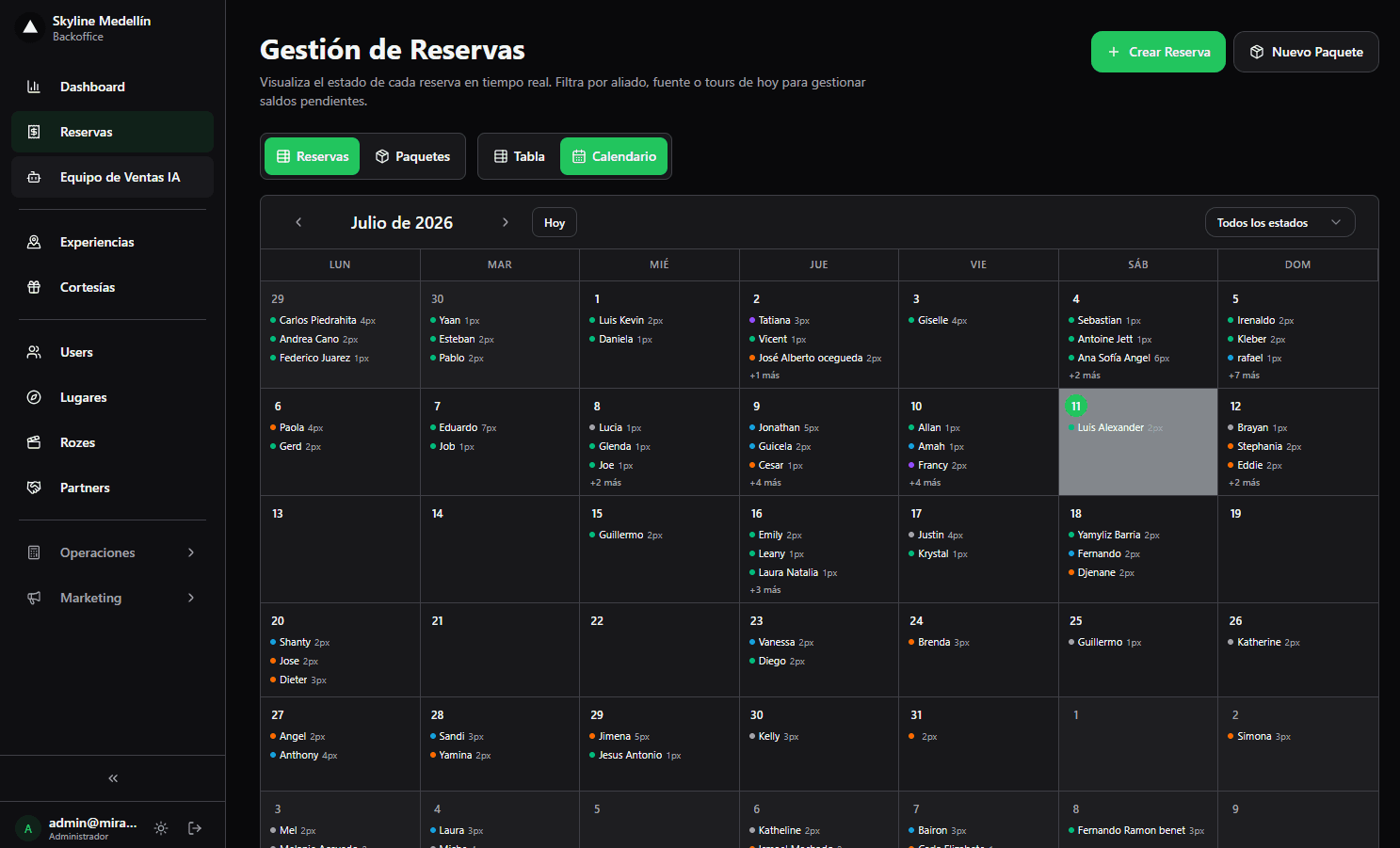
Related · Terra
Partial Payments and Chat Confirmation: Where Tour Payments Go
Inbound tourism buys in minutes, inside chat, not through web forms built for weeks-ahead planning.
ReadHow to Settle a Tour Departure Without Spreadsheets
Departure settlement is the cash close of a tour: income, guide expenses, commissions and what remains for the operator.
ReadSoftware for a Daily-Departure Guatapé Tour Operator
Terra brings bookings, guides, departures, travelers and payments into one multi-user calendar.
Read