Draco · Skyline Blog
Hiring a Salesperson vs AI Agents: Which and When
Fabián Alvarez6 min read
TL;DR
- Draco costs COP $300,000 per month, all-inclusive, with 1,000 AI replies, against the variable cost of hiring a salesperson.
- Draco's first reply arrives in under 30 seconds; it doesn't promise round-the-clock coverage.
- Five AI agents (Vega, Kai, Axel, Leo and Iris) split roles: handling, scoring, analysis, follow-up and triage.
- Copilot mode lets a person approve or correct every reply before it's sent.
- Complex negotiations and sensitive conflicts stay a human's job.
Add a team of AI agents like Draco when the problem is volume and reply speed: it costs COP $300,000 per month with 1,000 replies included and replies in under 30 seconds. Hire a salesperson when the bottleneck is negotiation, commercial judgment, or a human relationship no agent can resolve.
What problem is each option actually solving?
A growing agency runs out of hands to answer chats, quote trips and follow up. There are two typical paths: hire another salesperson or add a team of AI agents like Draco, Skyline's AI CRM. They're not mutually exclusive, but it helps to understand what each one actually solves before deciding where to put the next dollar.
A new salesperson brings human judgment, can close complex deals face to face, and understands nuances no AI fully grasps yet. A team of AI agents, on the other hand, is built to absorb the repetitive volume in the inbox: replying fast, scoring leads, following up on the ones going cold, and flagging when something needs a human. Draco works with five AI agents with distinct roles: Vega, Kai, Axel, Leo and Iris, each one owning a part of the process.
Picture a travel agency in Cartagena with two salespeople handling WhatsApp, Instagram and the leads coming in from an OTA. When messages pile up after a paid ad, the question isn't "do I need more people or more AI?" but "where in the funnel am I actually losing the sale?"
How much does each path cost per month?
This is the easiest difference to measure. A junior salesperson at a travel agency means salary, benefits, equipment, training, and the time it takes to become productive, months before they close their first solid sale. That cost isn't in Skyline's fact base because it depends on each country and each agency, but any agency owner knows it by heart.
Draco has a fixed public price: COP $300,000 per month, all-inclusive, with 1,000 AI replies. The cost is predictable from day one and doesn't shift based on how many conversations happen to close as sales.
This doesn't mean a salesperson "costs more" in absolute terms for every agency: a small agency with few leads may need human judgment more than reply volume. But if the bottleneck is the speed and volume of messages, Draco's monthly cost is easier to weigh against the cost of a new hire.
What about hour-by-hour coverage?
It's important not to overpromise here. Skyline's fact base doesn't say Draco is staffed 24 hours a day or always available no matter the time. What is documented is a concrete speed metric: the first reply arrives in under 30 seconds.
That initial speed is different from permanent availability. A human salesperson has working hours, breaks, and one conversation at a time in their head. Draco, by splitting the work across five agents with distinct roles, can give a fast first reply to a new lead while another agent reviews the funnel or prepares a follow-up. That solves the first moment of contact, which is usually where most leads are lost to delay.
For an agency, the right question isn't "who's awake at 11pm?" but "who replies first when the message comes in, regardless of whether a salesperson happens to be free at that exact moment?" That's where first-reply speed matters more than a round-the-clock coverage claim.
How consistent is each option?
A salesperson's consistency depends on their mood, their workload, and their memory for not letting a lead slip through without follow-up. That's human and normal: with enough volume, something always falls through the cracks.
Draco doesn't replace that judgment, it complements it with two documented mechanisms. The first is copilot mode: Draco starts by drafting the reply and a person approves or corrects it before sending, and only moves to autonomous mode once the team trusts what it sees. That means the agency controls how much it delegates and can revert at any time if something doesn't feel right.
The second is the division of roles across the five agents: one scores leads by temperature, another reactivates the ones that went cold, another reviews every night how the human team and the AI handled conversations, and another triages quiet conversations to decide whether they need a human. That structure reduces the dependence on one person remembering everything, but it doesn't replace the judgment needed to close a delicate negotiation or resolve a sensitive complaint.
What can only a human do?
There are parts of an agency's work that no AI agent, whether it has five roles or fifty, can take on based on what Draco offers today. Negotiating special terms with a corporate client, resolving a complaint involving an out-of-policy refund, representing the agency in front of a supplier, or making commercial judgment calls that live outside any configured funnel: that's still a person's job.
Draco is designed precisely to leave those conversations to a human. The triage agent reviews quiet conversations on the board and decides whether the lead is still alive, whether it's in the wrong funnel, or whether it needs a human, without writing to the customer directly. It's a way of saying, inside the product itself, that there's a clear line between what gets automated and what escalates to a person.
Comparison table
| Criterion | Another salesperson | Team of AI agents (Draco) |
|---|---|---|
| Monthly cost | Varies by salary, benefits and country; not in Skyline's fact base | COP $300,000 per month, all-inclusive, with 1,000 AI replies |
| First-reply speed | Depends on their availability and workload | First reply in under 30 seconds |
| Internal structure | One person covers the whole process | Five AI agents with distinct roles: Vega, Kai, Axel, Leo and Iris |
| Control over what gets sent | Total, it's the person themselves | Copilot mode: the AI drafts, a person approves or corrects, and it can be reverted at any time |
| Complex negotiation and commercial judgment | Handles it directly | Stays with the human team; the triage agent only flags quiet conversations for review |
| Learning curve | Weeks or months before becoming productive | Starts in copilot mode from day one, without replacing human judgment |
When does each one make sense?
If the agency's problem is a repetitive volume of messages, slow first replies, or leads going cold without follow-up, adding a team of AI agents like Draco addresses that bottleneck with a fixed, known-in-advance monthly cost. If the problem is negotiating corporate accounts, resolving delicate conflicts, or closing deals that require presence and personal relationships, that's where a human salesperson remains irreplaceable.
In practice, most agencies don't choose one over the other: they use Draco's copilot mode so the AI drafts replies while the human team approves, corrects, and keeps the time freed up for the conversations that actually need their judgment. It's a way to grow in volume without every new hire requiring months of learning curve before showing results.
What to do next
If your agency is weighing whether the next step is hiring or automating, start by checking how many leads are going cold because of a slow initial response: that's the clearest signal of whether the bottleneck is speed (where Draco helps) or commercial judgment (where you need another person). You can see how Draco works in full at draco.skyln.co.
Frequently asked questions
Does Draco replace a human salesperson?
No. Draco starts in copilot mode, where the AI drafts the reply and a person approves or corrects it. The human team keeps handling complex negotiations and commercial judgment calls.
How much does it cost an agency to use Draco?
The public price is COP $300,000 per month, all-inclusive, with 1,000 AI replies. That's the plan's cost as documented by Skyline.
Does Draco work outside business hours?
What's documented is first-reply speed: under 30 seconds. There's no claim of continuous or unlimited hour-by-hour coverage.
How many AI agents does Draco have and what does each do?
There are five: Vega handles chats and quotes, Kai scores leads, Axel analyzes the team's performance every night, Leo runs proactive follow-ups, and Iris reviews the board to decide if a lead needs a human.
What tasks still require a human at the agency?
Negotiating special terms, resolving sensitive complaints, and making commercial decisions outside any configured funnel remain a person's job, not Draco's agents.
Draco
See Draco in action
The AI CRM for agencies and tour operators: WhatsApp, Instagram, Messenger and TikTok in one inbox, handled by five AI agents.
Try Draco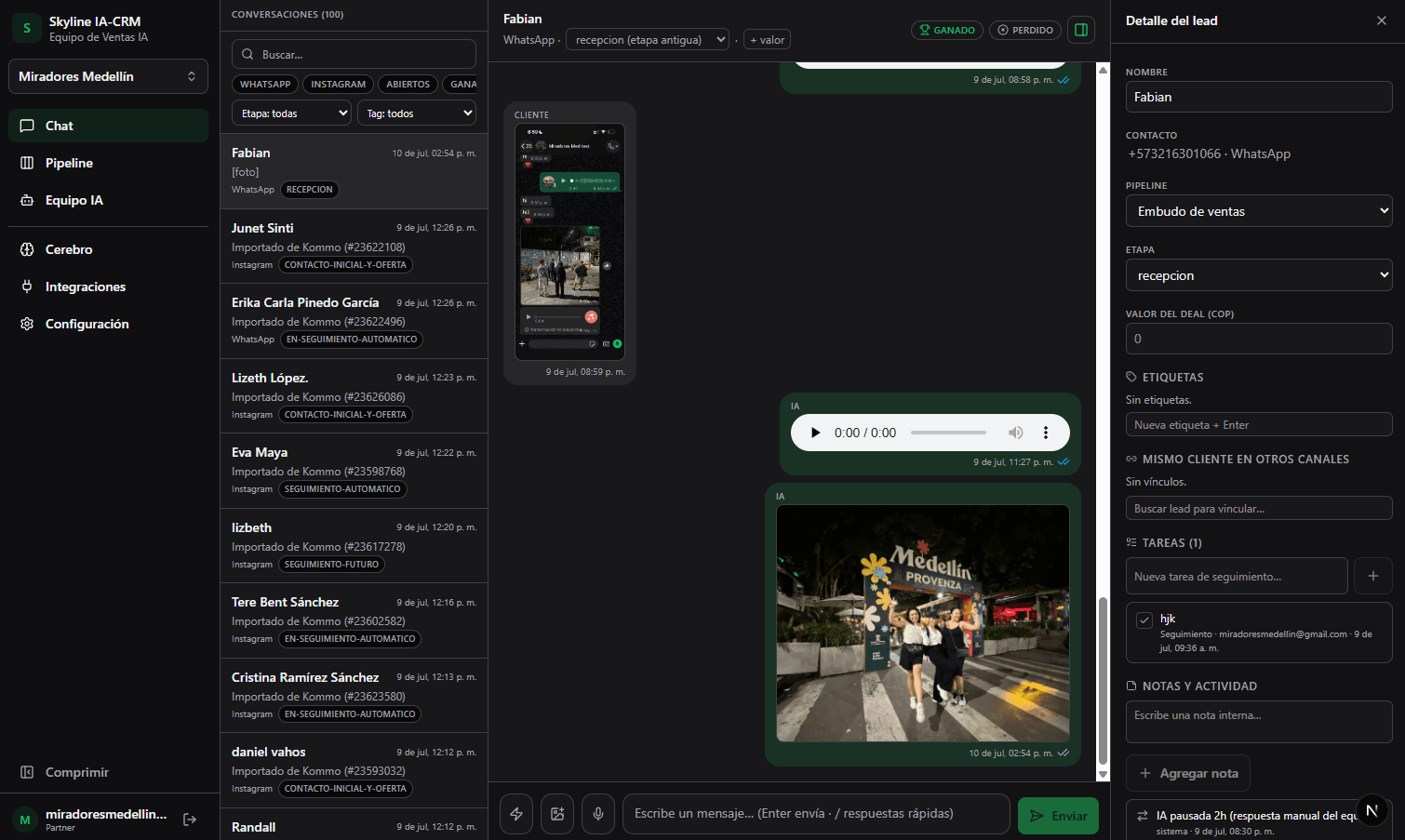
Related · Draco
How to Organize Human Team Tasks Around the AI
Draco has calendar tasks for the human team, separate from what the five AI agents do.
ReadWhat Is Copilot Mode in a Sales AI?
Copilot mode is when the AI proposes a reply and a person approves or corrects it before it's sent.
ReadHow Do I Know If My Team Handles Sales Chats Well?
Two daily metrics actually matter: first response time and unattended chats at the end of the day.
Read