Draco · Skyline Blog
How Do I Know If My Team Handles Sales Chats Well?
Fabián Alvarez6 min read
TL;DR
- Two daily metrics actually matter: first response time and unattended chats at the end of the day.
- Manual review fails because it isn't daily, isn't objective, and doesn't turn into action.
- Draco has a team of five AI agents with distinct roles, and Axel is the one that audits handling every night.
- Axel doesn't talk to customers: it turns the day's chat handling into metrics and coaching for the team and for Vega.
- The report only works if it's reviewed every morning and leads to a specific adjustment, not just archived.
To know for sure, track two things every day: first response time and how many chats were left unattended at day's end. In Draco, Skyline's AI CRM, this is done by Axel, one of its five agents, which analyzes the day's chat handling every night and delivers metrics and actionable coaching, without ever talking to customers directly.
What does "handling a sales chat well" actually mean?
Handling a sales chat well means three things at once: replying fast, not leaving conversations unattended, and doing it in a tone that converts instead of scaring people off. An agency can have a team that replies fast but poorly, or that replies well but too late. Measuring only one of these three variables gives you an incomplete picture.
The typical problem in a travel agency is that nobody measures this systematically. It gets checked "by eye" when a customer complains that nobody answered, or when an agent mentions having too many pending chats. By then, sales are already lost. The question isn't whether your team is failing, it's where and how much.
The two metrics that actually matter every day
To know if a chat sales team is working, there are two numbers that should be reviewed every day, not once a month:
- First response time: how long it takes the team to answer a new lead's first message.
- Unattended chats: how many conversations are left sitting with no reply at the end of the day.
An agency with five agents can have an acceptable average first response time and still have ten conversations abandoned for two days, because one agent went on vacation and nobody reassigned their chats. The average hides the problem. That's why looking at one general number isn't enough: you also need to look at what gets left behind.
Why isn't checking this manually enough?
Checking manually means someone on the team — usually the owner or the sales lead — logs into the WhatsApp, Instagram and Messenger inbox every so often, counts open chats, eyeballs response times and builds a report in a spreadsheet. This has three clear limits:
- It's not daily: it happens when there's time, which is almost never every day.
- It's not objective: it depends on who does it and how much time they spend on it.
- It doesn't turn into action: counting unattended chats doesn't tell the team what to fix next time.
An agency in Bogotá selling tours across several channels at once might have an agent replying well on WhatsApp while ignoring Instagram comments coming in through an automation. Without a daily, centralized analysis, that gap can last weeks.
How does Draco analyze team performance?
Draco, Skyline's AI CRM, doesn't just handle chats: it also audits them. For that, it relies on a team of five AI agents with distinct roles. One of them, Axel, has a specific function within that team: every night it reviews how the team handled chats — both the humans and Vega, the agent that sells by chat — and turns that review into metrics and concrete coaching. Axel doesn't talk to customers; its job is to look inward, not outward.
This changes the entire logic of "reviewing performance." Instead of a sales lead logging in to count chats whenever they have time, there's an analysis that runs automatically every night, without anyone having to ask for it or remember to do it.
What exactly Axel looks at
Axel analyzes the full day's handling and produces two kinds of output:
- Metrics: concrete numbers about how chats were handled, letting you see day-to-day trends instead of relying on a feeling.
- Coaching: actionable signals for the human team and for adjusting how Vega works, so handling improves session after session.
The difference from manual review is that this doesn't depend on someone having time that week. It happens every night, over the full day's conversation, across every channel that feeds into Draco's inbox.
What should you do with Axel's report the next day?
Having the data is worthless if nobody turns it into a concrete action. An agency that gets Axel's analysis every morning should follow a simple routine:
Step 1: Review the previous day's first response time
If the time went up compared to previous days, ask what changed: were there more leads than usual? was an agent missing? did a new channel bring in traffic nobody expected? The goal isn't to punish, it's to understand the cause before it happens again.
Step 2: Identify the unattended chats and why they're stuck
An unattended chat because the customer never wrote back is not the same as one that simply nobody picked up. Axel provides the basis to tell the two apart, and the human team decides what to do with each case: reassign, close or escalate.
Step 3: Turn coaching into a specific adjustment
If a pattern repeats — for example, one agent consistently taking longer than the rest on the same type of conversation — that's the moment to adjust how that person works, not to wait for an end-of-month review.
Step 4: Adjust the copilot if needed
Draco starts in copilot mode, where the AI drafts the reply and a person approves or corrects it before sending, and moves to autonomous when the team trusts the system; it can be reverted at any time. If Axel's analysis shows Vega needs more supervision in a specific funnel, that's the moment to lower the autonomy level there, without touching the rest.
An example with an agency selling San Andrés packages
Picture an agency selling San Andrés packages over WhatsApp, Instagram and TikTok. Mondays bring a wave of messages from people who saw a reel over the weekend. Without a daily analysis, those Mondays become a silent bottleneck: agents handle what they can, and the rest waits until Tuesday, when the customer's interest has already cooled off.
With Axel's nightly analysis, the agency sees every Tuesday morning how many chats were left unattended on Monday and how long the first response took during peak hours. With that data, it can decide to reinforce the team on Mondays, or turn up the intensity of Leo — the proactive follow-up agent — so those cold weekend leads don't get lost entirely.
How is this different from a generic CRM report?
Many generic CRMs show activity reports: how many messages were sent, how many chats are open. But an activity report is not the same as a quality-of-service analysis. The difference is that Axel doesn't just count, it evaluates how chats were handled and translates that into specific coaching, something a spreadsheet or an activity dashboard doesn't do on its own.
| What you need to know | Generic activity report | Axel's analysis in Draco |
|---|---|---|
| First response time | Yes, as raw data | Yes, with daily tracking |
| Unattended chats | Sometimes, if configured | Yes, automatically every night |
| Why handling failed | No | Yes, with actionable coaching |
| Automatic adjustment of the sales agent | Not applicable | Feeds back into Vega's behavior |
| Frequency | Depends on who reviews it | Every night, without being asked |
What to do next
If your agency doesn't currently know for certain how many chats were left unattended yesterday, or how long the first response took during peak hours, that's the first gap worth closing. Book a Draco demo at draco.skyln.co and see how Axel's nightly analysis would look applied to your current channels.
More about Draco: draco.skyln.co
Frequently asked questions
Does Axel replace the agency's sales lead?
No. Axel analyzes handling and delivers metrics and coaching, but decisions like reassigning chats, adjusting the team or changing strategy are made by the human in charge. Axel also doesn't talk to customers; its function is internal.
How often does Axel's analysis run?
Every night, covering the full day's chat handling by both the human team and Vega. It doesn't depend on anyone requesting it or having time to review manually.
What happens if a chat is unattended because the customer never replied?
The analysis helps distinguish a chat abandoned by the customer from one that nobody on the team picked up. With that distinction, the agency decides whether to reassign, close, or leave it in follow-up with Leo.
Can I adjust how autonomous the AI team is if I see problems in the report?
Yes. Draco starts in copilot mode, where a person approves or corrects every reply before it's sent, and moves to autonomous once the team trusts the system. That level can be raised or lowered at any time.
Does this work if I sell across several channels, not just WhatsApp?
Yes, the analysis covers team handling across every channel that feeds Draco's inbox, so an agency working through WhatsApp, Instagram and TikTok gets the same kind of report without checking each channel separately.
Draco
See Draco in action
The AI CRM for agencies and tour operators: WhatsApp, Instagram, Messenger and TikTok in one inbox, handled by five AI agents.
Try Draco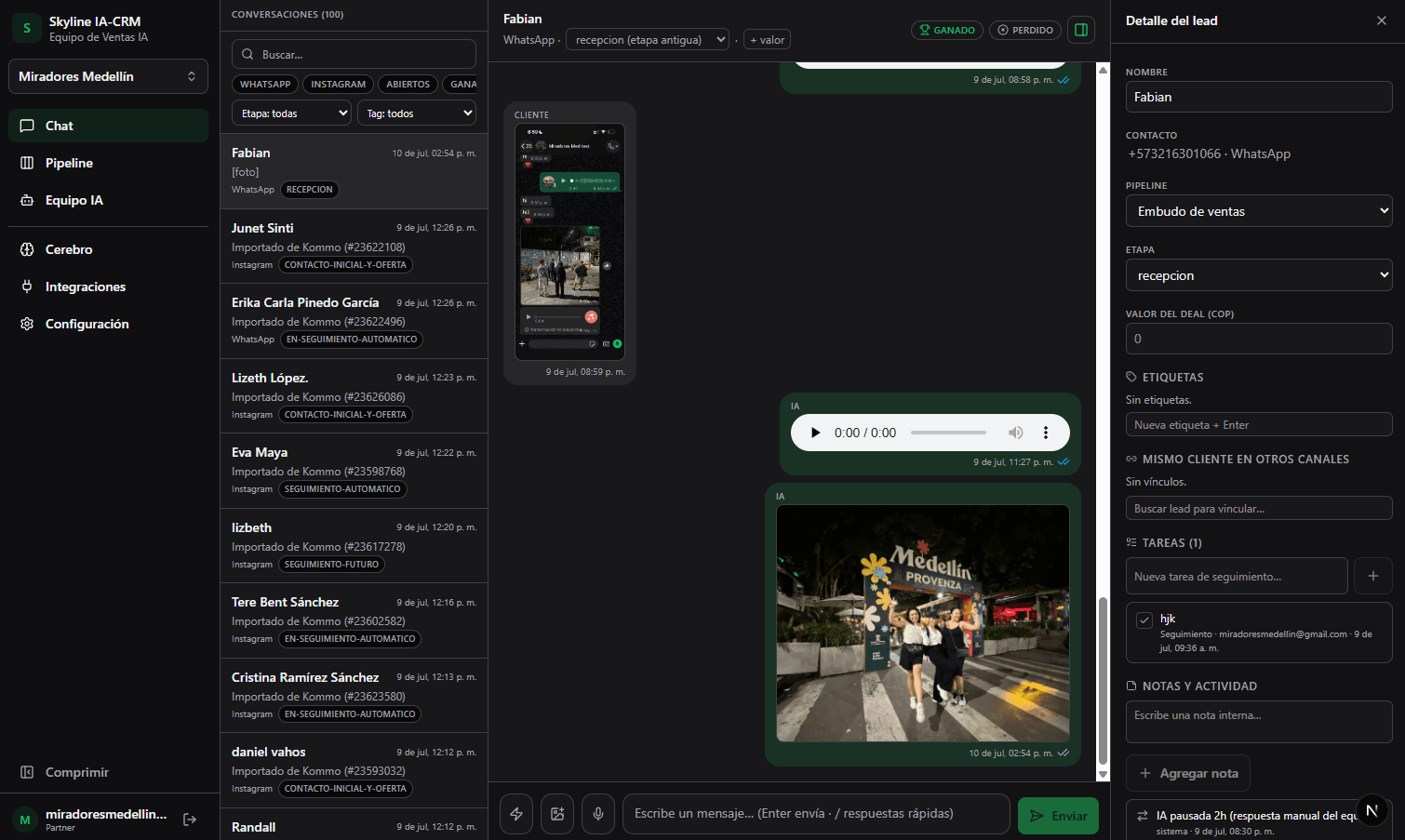
Related · Draco
Hiring a Salesperson vs AI Agents: Which and When
Draco costs COP $300,000 per month, all-inclusive, with 1,000 AI replies, against the variable cost of hiring a salesperson.
ReadHow to Organize Human Team Tasks Around the AI
Draco has calendar tasks for the human team, separate from what the five AI agents do.
ReadWhat Is Copilot Mode in a Sales AI?
Copilot mode is when the AI proposes a reply and a person approves or corrects it before it's sent.
Read