Draco · Skyline Blog
How to Organize Human Team Tasks Around the AI
Fabián Alvarez8 min read
TL;DR
- Draco has calendar tasks for the human team, separate from what the five AI agents do.
- The AI never creates tasks on leads that are already won or lost, so the calendar stays free of noise.
- The five agents (Vega, Kai, Axel, Leo and Iris) filter and prioritize, but a person executes the task.
- Splitting tasks among sellers works best by funnel, stage, lead source or simple rotation.
- Axel contributes the nightly coaching that helps adjust how work is split among the team.
Organize it by separating what the AI does from what the human team does: Draco gives calendar tasks for people, never creates them on won or lost leads, and the five agents (Vega, Kai, Axel, Leo and Iris) filter and prioritize so each seller only gets pending items that truly need a human decision.
Why does the human team need calendar tasks if there's already AI?
Because AI doesn't replace human follow-up, it organizes it. In an agency with several sellers, the problem is almost never a lack of leads: it's that nobody knows who was supposed to call whom, or when. Draco, Skyline's AI CRM, solves that part with tasks that have their own calendar for the human team, while the AI handles the day-to-day conversation. The key is understanding what belongs to each side and not mixing them up.
An agency in Cartagena selling tours through Instagram and WhatsApp might have three sellers working at the same time. Without clear rules, two of them end up messaging the same lead on the same day, and the third has no idea they had a pending task from a week ago. This guide explains how to set up that task system without it turning into a notification mess.
What exactly does the AI do, and what's left to the human team?
Draco works with a team of five AI agents with distinct roles: Vega, Kai, Axel, Leo and Iris. Each one covers a part of the process, but none of them replaces the operational tasks a human seller needs to do: calling a customer, confirming a payment outside the chat, coordinating with the operator, or resolving an exception that isn't in the script.
The practical division looks like this:
- Vega handles, pre-qualifies and closes in real time inside the chat: recommends from the catalog, quotes, builds packages and takes the sale through to payment.
- Kai does lead scoring: sets temperature, applies automatic tags and moves leads between funnel stages.
- Axel reviews every night how the team handled conversations (humans and Vega) and turns that into metrics and coaching; it doesn't talk to customers.
- Leo handles proactive follow-ups: reactivates cold leads, sends reminders and asks for reviews.
- Iris does triage on the board: reviews quiet conversations and decides whether a lead is still alive, whether it's in the wrong funnel, or whether it needs a human. Everything it does is auditable and reversible, and it never writes to customers.
None of the five agents replaces the person who has to make a decision with commercial judgment outside the chat. That's what calendar tasks are for.
What are calendar tasks in Draco?
They're pending items assigned to a person on the human team, with a date and time, visible on a shared calendar. Draco has calendar tasks for the human team, and one important point: the AI never creates tasks on leads that are already won or lost. This keeps the team from wasting time reviewing pending items on deals that already closed or will never move forward.
That restriction isn't a minor technical detail. In an agency where dozens of conversations happen every day, if the AI generated tasks on closed leads, the calendar would fill up with noise and the team would stop trusting it. By limiting tasks to leads that are still in play, every pending item that shows up has commercial sense.
Who generates the tasks, the AI or the human?
They can come from either side. A seller can create a task manually after a call ("call again on Thursday"), and the system can also suggest tasks based on what happens in the chat, always respecting the rule of never touching leads that are already closed or lost. What never changes is that executing the task — the call, the visit, the negotiation — is done by a person.
What happens if a lead is won or lost while it still has pending tasks?
The lead stops receiving new tasks from the AI once it changes to won or lost. If there were open tasks, the team decides whether to close them or reassign them, but the system doesn't keep generating work on a deal that already finished its cycle. This keeps the calendar focused on what can still move.
How do you split tasks among several sellers without stepping on each other?
This is where most agencies get tangled up as they grow. If three or four sellers work the same inbox, you need to decide on a criterion for splitting the work. Some approaches that work in practice:
- By funnel. Each seller is in charge of a specific funnel (for example, one-day tours versus multi-day packages), and tasks from that funnel always land on the same person.
- By lead stage. One seller handles hot leads that Kai already marked ready to close, and another handles cold leads that Leo is reactivating.
- By lead source. If a lead came through a specific channel (a social network, a partner, an OTA), it's always assigned to the seller who knows that type of customer.
- Simple rotation. In small agencies, it's enough to split by order of arrival and let the shared calendar show each person's load.
None of these rules are imposed by the AI: the human team defines them based on how the agency works. What Draco adds is that, once the rule is defined, tasks show up on the right person's calendar and don't get lost in an internal WhatsApp group chat or a parallel spreadsheet.
Example: an agency with three sellers in Cartagena
Suppose an agency has three sellers: one handles nautical tours, another handles city packages, and the third is dedicated only to reactivating cold leads that Leo flagged as dormant. Each morning, the first seller checks their calendar and sees only tasks from the nautical funnel. The second sees theirs. The third gets, on their calendar, the leads that Iris decided were still alive but needed a human call, not another automated message.
No seller sees tasks on leads that already paid or already said no. The result is a calendar each person can open in the morning and know exactly what they need to do, without relying on memory or on screenshots forwarded in the team group chat.
How does this integrate with the rest of Draco's funnel?
Tasks don't live in isolation: they're fed by what happens in the chat and on the board. Kai moves leads between stages based on their temperature, and that can trigger the need for a human task (for example, a hot lead that asked to talk by phone). Iris reviews quiet conversations and decides whether they need human intervention, which can also generate a task. Axel, on the other hand, doesn't interact with customer tasks directly: its job is to review every night how the team handled conversations — humans and Vega — and turn that into metrics and coaching, which help adjust how tasks get split going forward, not create pending items directly.
This connection between agents and tasks is what lets an agency avoid manually reviewing every conversation to know if something needs follow-up. The system has already filtered out what's closed, what's still cold without needing a human, and what actually requires a call or a decision from someone on the team.
How do you start organizing tasks if the team is coming from spreadsheets or scattered notes?
Step 1: define your funnels before your tasks
Before splitting work, decide how many funnels your agency has and what type of customer falls into each one. Draco allows multiple funnels per business, each with its own knowledge and mission, so this decision shapes how tasks will be split later.
Step 2: assign an owner per funnel or per criterion
Choose whether the split will be by funnel, by stage, by lead source or by rotation. You don't need a perfect rule from day one; what matters is that the whole team knows what the current rule is.
Step 3: let Kai and Iris do the filtering
Don't manually review every chat to decide if it needs human follow-up. Kai already tags and moves leads between stages; Iris already decides whether a quiet conversation is still alive or needs a person. Trust that filter before duplicating the work.
Step 4: check the calendar every morning, not the full chat inbox
Each seller's daily entry point should be their task calendar, not the full conversation inbox. That prevents someone from "checking everything just in case" and ending up messaging a lead that's already assigned to a teammate.
Step 5: use Axel's coaching to adjust the split
The metrics Axel builds every night about how the team handled conversations help spot whether a seller is overloaded or a funnel needs more hands. It's information for reorganizing how tasks get split, not for the AI to act directly on customers.
Summary table: what each side does
| Activity | Done by the AI | Done by the human team |
|---|---|---|
| Reply in the chat in real time | Vega | — |
| Set temperature and move between stages | Kai | — |
| Analyze how the team handled conversations each night | Axel | — |
| Reactivate cold leads with messages | Leo | — |
| Decide if a quiet lead is still alive | Iris | — |
| Call, negotiate or resolve an exception | — | Assigned seller |
| Create or close tasks on won/lost leads | No (the AI doesn't create tasks there) | The team decides |
| Define how tasks are split among sellers | — | Agency (team lead) |
What to do now
If your agency still splits leads through internal WhatsApp messages or a spreadsheet nobody updates on time, the next step is to define your funnels and try out how calendar tasks look in Draco with your own catalog and your own team.
Frequently asked questions
Can Draco's AI assign tasks directly to a specific seller?
The system suggests tasks based on what happens in the chat and on the board, but the rule for who gets each one is defined by the human team, usually by funnel, stage or lead source. The AI respects that assignment once it's set.
Why doesn't the AI create tasks on leads that are already won or lost?
Because it would generate work with no commercial sense on deals that already finished their cycle. Keeping that rule prevents the team's calendar from filling up with irrelevant pending items and keeps trust in what actually appears there.
Which agent decides if a lead needs human intervention?
Iris does triage on the board: it reviews quiet conversations and decides whether the lead is still alive, whether it's in the wrong funnel, or whether it needs a person. Everything it does is auditable and reversible, and it never writes directly to customers.
Does Axel interact with customers or with tasks?
No. Axel analyzes every night how the team handled conversations, both humans and Vega, and turns that into metrics and coaching. That information helps reorganize how tasks get split, but Axel doesn't talk to customers or create tasks directly.
What happens if two sellers end up with tasks on the same lead?
That depends on the split rule the agency has defined, not on the AI. If the criterion is clear (by funnel, stage or channel), that overlap rarely happens; if it does, the team resolves it by reassigning the task from the shared calendar.
Draco
See Draco in action
The AI CRM for agencies and tour operators: WhatsApp, Instagram, Messenger and TikTok in one inbox, handled by five AI agents.
Try Draco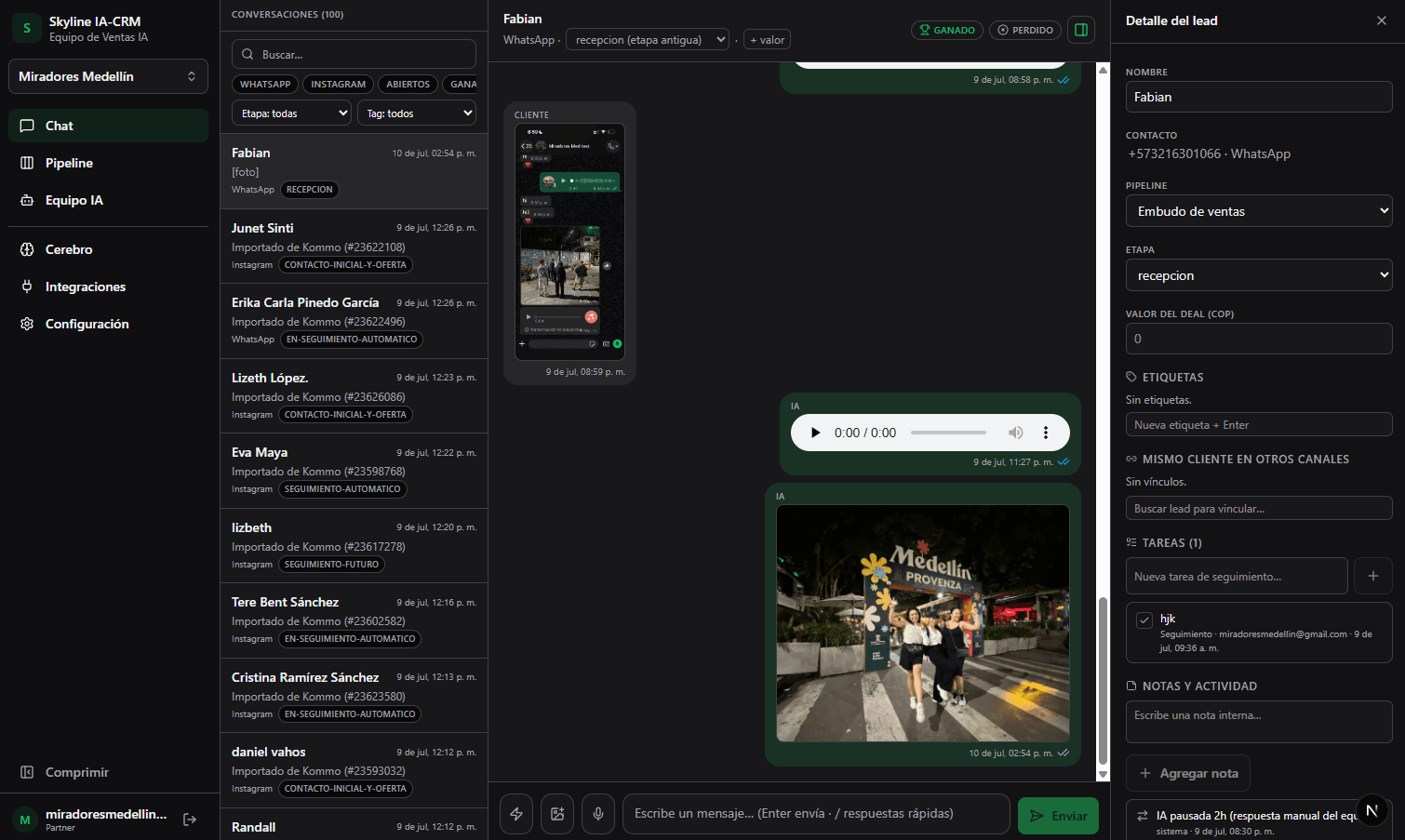
Related · Draco
Hiring a Salesperson vs AI Agents: Which and When
Draco costs COP $300,000 per month, all-inclusive, with 1,000 AI replies, against the variable cost of hiring a salesperson.
ReadWhat Is Copilot Mode in a Sales AI?
Copilot mode is when the AI proposes a reply and a person approves or corrects it before it's sent.
ReadHow Do I Know If My Team Handles Sales Chats Well?
Two daily metrics actually matter: first response time and unattended chats at the end of the day.
Read