Vórax · Skyline Blog
How to Fill a Rooftop Bar on Weekdays With Courtesies
Fabián Alvarez7 min read
TL;DR
- Publish a drink courtesy only for the slow nights and the partner network recommends it.
- Redemption happens with a QR and an optional code, with no possibility of double use.
- Attribution shows which partner brought each table, so you pay a fair commission.
- The rooftop sets and adjusts the commission it pays, based on what works for it.
A rooftop fills its weekday nights by publishing a courtesy in Vórax (for example, a free first drink Tuesday through Thursday) that the partner and creator network recommends. Redemption is controlled with a no-duplicate QR, you can see who brought each table, and the venue sets the commission it pays only when there's a verified redemption.
Why does a rooftop fill up on weekends but not on weekdays?
A rooftop lives on the view and the atmosphere, but that atmosphere only shows up when there are people. Friday and Saturday fill themselves because the city goes out looking for a plan. Tuesday, Wednesday and Thursday are a different story: demand doesn't exist unless somebody pushes it. The fix isn't lower prices or generic social ads. It's giving someone a concrete reason to recommend your rooftop on exactly those days, and paying them only when it works.
That's where Vórax, Skyline's tool for venues comes in: new customers for restaurants, rooftops and clubs, where you publish a courtesy, the partner network and local creators recommend it, and you only pay per verified redemption.
What exactly is a courtesy, and how does it fill weekday tables?
A courtesy is a perk a venue offers (a drink, an entry, a discount) to attract new customers, delivered via QR and redeemed on site. In Vórax, the rooftop publishes that courtesy and the partner network recommends it to travelers while local creators show it to people in the city. This isn't advertising paid per impression. It's a targeted recommendation that reaches someone with a real intention of going out that night.
Example: a rooftop in a nightlife district with dead nights Tuesday through Thursday
Picture a generic rooftop bar with capacity for eighty people. Fridays and Saturdays the place breathes on its own. But Tuesday there are fifteen people, Wednesday twenty, Thursday thirty. The manager decides to try something different: they publish a "first drink on the house" courtesy in Vórax, valid exclusively Tuesday through Thursday, from 6 to 9 pm, the window where they need people most.
The courtesy becomes visible across the partner network. Tour guides finishing a route nearby, ambassadors who recommend nightlife plans, and local creators looking for rooftop content for their city start sending people over. A traveler who wrapped up a tour in the late afternoon sees their guide's recommendation, heads up to the rooftop that evening, claims the free drink, and ends up staying for dinner with two more friends.
How is redemption controlled so the courtesy isn't abused?
The typical fear for a rooftop is simple: "what if I just get filled with people who come for the free drink and don't spend anything else?" Vórax addresses this with an automatic redemption flow: the traveler gets a QR, the venue scans it (with an optional 4-digit code when scanning), and the system doesn't allow double redemption. There's no way for the same person to claim the courtesy twice, and no way for someone to forward it so another person uses it instead.
After redemption, the rooftop isn't left guessing. It records people served and invoice-verified spending, and sees the real benefit behind each courtesy handed out. So the manager of the example rooftop doesn't just know that new people showed up on a weekday night: they know how much those people spent after the free drink, and they can compare that against the cost of the drink they gave away. One documented case shows the pattern at work: a restaurant in Provenza got 32 customers from 9 redemptions in a month.
How do you know who brought each table?
This is the question that really turns dead nights into full ones: attribution. Every referral shows who sent it, with a partner ranking by people and spending. The rooftop doesn't receive an anonymous group of strangers: it knows table 4 on Tuesday arrived because a tour guide recommended it, table 7 arrived because a local creator posted a story, and table 12 arrived because an ambassador with their own page of network experiences sent them.
That traceability serves two purposes. First, it lets the venue pay a fair commission: only whoever actually brought people gets paid, not whoever just posted without generating a single visit. Second, it supports decisions: if the ranking at the end of the month shows one partner clearly outperforming the rest on Tuesday tables, the rooftop knows who to strengthen the relationship with, and who to offer a special courtesy to keep them recommending.
How the example rooftop adjusted its strategy with the data
After a few weeks, the manager reviews the attribution ranking. They discover local creators bring smaller groups that spend more per person, while tour guides bring larger groups that spend less individually but fill more tables. With that information, they decide to keep the drink courtesy for tour guides (because it fills the space) and raise the level of the courtesy for creators who post content tagged with the venue's location, because that content brings new bookings the following weekends.
Who decides how much each partner gets paid?
The rooftop, not Vórax. The venue sets the commission it pays whoever brings customers. This matters for a rooftop working with different margins depending on the night: the commission that makes sense for a two-person table on a Tuesday isn't the same as for an eight-person table on a Thursday before an event. The rooftop adjusts that commission based on what works for it, without depending on a fixed rate imposed from outside.
This also allows for experimentation. The manager in the example started with a low commission while testing whether the courtesy worked. Once they saw Tuesday-to-Thursday tables starting to move, they raised the commission for the partners bringing the most people, without renegotiating contracts or signing anything new: the adjustment happens right from the venue's panel.
What about groups and advance bookings on weekdays?
A weekday courtesy works best when the rooftop can anticipate how many people are coming. While the basic flow is direct QR redemption, the same system allows requiring a minimum group to activate the courtesy, which helps if the rooftop wants to make sure a weekday night doesn't bring in a single person but a group that actually fills a table. This also connects with the traveler app's group meetups, where already-organized groups can activate the courtesy as a joint plan.
What table sums up the difference between traditional advertising and a courtesy with attribution?
| Traditional advertising | Courtesy with Vórax | |
|---|---|---|
| When you pay | When the ad runs, result or not | Only when there's a verified redemption |
| Who brought the customer | Not known for certain | Recorded per partner |
| Risk of abuse | Hard to control | No-duplicate QR, optional code |
| Commission adjustment | Fixed by the channel | Set by the rooftop, adjustable anytime |
| Data after the visit | Almost none | People served and invoice-verified spending |
How does a rooftop start testing this without committing to anything?
The first step isn't a big campaign. It's a single courtesy, in a single time window, with a conservative commission, to measure results without risking the whole week's margin. The example rooftop didn't launch the courtesy across every time slot: they limited it to Tuesday, Wednesday and Thursday between 6 and 9 pm, exactly where the tables sat empty, and adjusted from there based on what the panel showed.
A rooftop looking to fill its dead weekday nights doesn't need to reinvent its menu or drop prices all week. It needs a targeted courtesy, visible to the right network of partners, with redemption that can't be duplicated and clear data on who brought each table. From there, the commission and schedule adjustments are made by the venue, with the information in hand, night after night.
What to do now
Define a single courtesy for your slowest time window of the week, decide the commission you're willing to pay per new table, and publish it in Vórax so the partner and creator network can start recommending it right away.
Frequently asked questions
How much does it cost to start using Vórax at a rooftop?
It's free to start. The rooftop only pays when someone actually redeems the published courtesy, not for publishing it or for having it shown across the network.
What happens if someone tries to use the same courtesy twice?
The system doesn't allow double redemption: the traveler gets a QR, and once it's scanned by the venue (with an optional 4-digit code), it's marked as used.
How do I know the courtesy actually brings spending and not just people looking for something free?
After each redemption the rooftop records people served and invoice-verified spending, so it can see the real benefit behind every courtesy given out.
Can I change the commission I pay partners if I see it's not working?
Yes. The rooftop sets that commission and can adjust it anytime from its panel, without renegotiating contracts or depending on an external fixed rate.
Does this only work for travelers or also for local people?
It works for both: Skyline's partner network recommends the courtesy to travelers, and verified local creators show it to people in the city.
Vórax
See Vórax in action
New customers for restaurants, rooftops and clubs: verified-redemption perks recommended by the partner network.
Get started with Vórax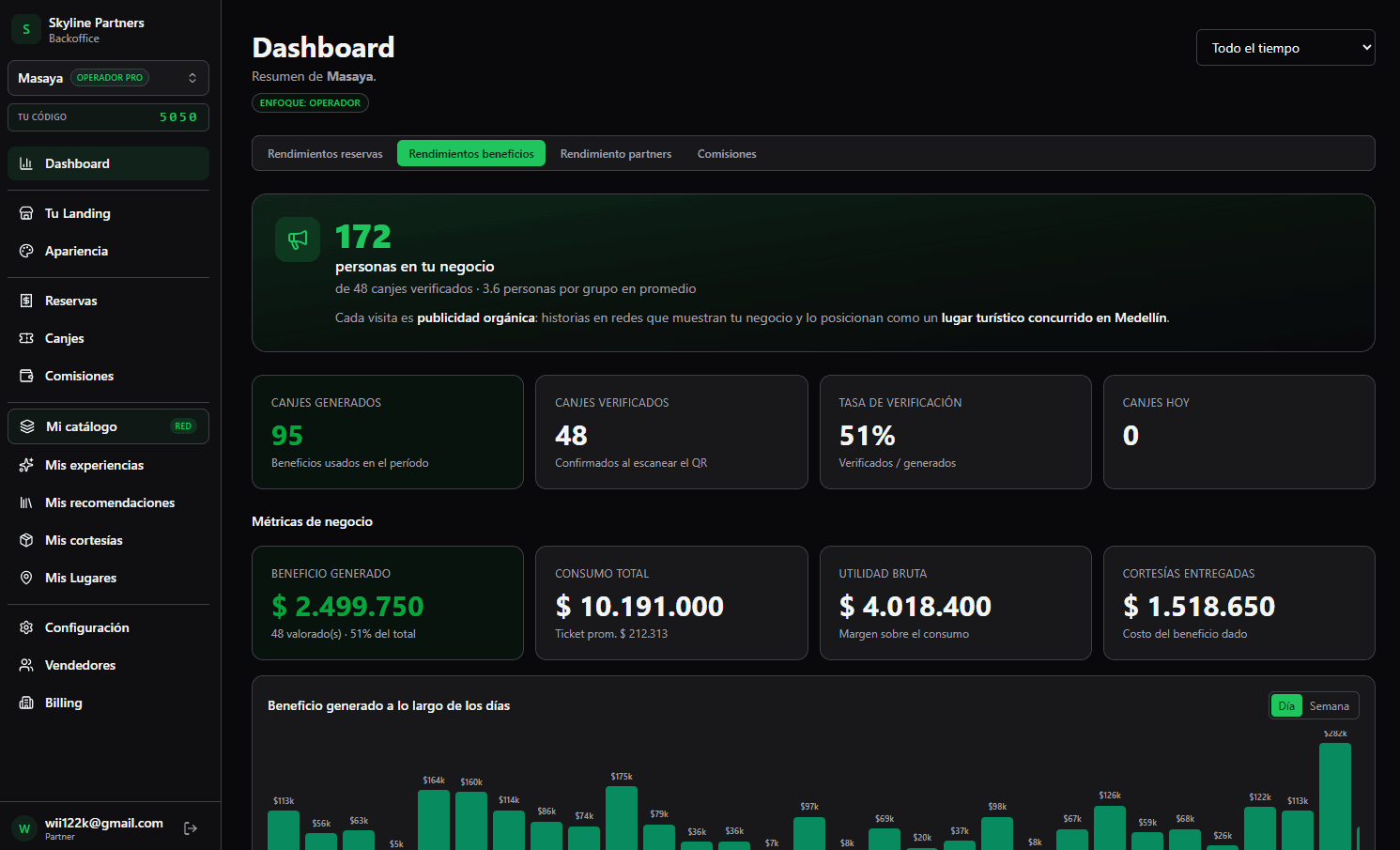
Related · Vórax
Verified-Redemption Courtesies: Guide for Restaurants
You only pay per redeemed courtesy, with no fixed cost to start.
ReadHow to Publish a Courtesy Offer for Your Restaurant
A courtesy is a concrete perk (a drink, an entry, a discount) that attracts new customers and is delivered via QR.
Read