Vórax · Skyline Blog
Bring New Customers to Your Restaurant Without Paying for Ads
Fabián Alvarez6 min read
TL;DR
- You publish a courtesy (a drink, an entry, a discount) and the partner network and local creators recommend it.
- You only pay when someone redeems it at your venue, never for views or clicks.
- Each redemption is attributed to whoever recommended it, with a partner ranking by people and spending.
- After redemption you can see people served and invoice-verified spending.
Publish a courtesy (a drink, an entry, a discount) so the partner network and local creators recommend it from their own pages. It's free to start: you only pay when someone actually redeems the courtesy at your venue, and every redemption is attributed to whoever recommended it.
The short answer: publish a courtesy and only pay if it gets redeemed
Bringing in new customers without paying for ads is possible if you change the model: instead of paying to show an ad, you pay for a customer who actually showed up and spent money. That's exactly what Vórax, Skyline's tool for venues, does.
The mechanism is simple: the venue publishes a courtesy (a drink, an entry, a discount), Skyline's partner network and local creators recommend it to travelers and to people around the city, and the restaurant only pays when someone redeems that courtesy at the venue. There's no monthly fee to appear, no payment per click, no payment per impression. If nobody redeems it, you pay nothing.
This solves a real problem for any restaurant, rooftop or club: traditional advertising charges for exposure, not for bringing people in. A restaurant can spend on ads for weeks and never know how many new tables that actually generated. With a verifiable courtesy, the venue pays strictly for results.
What exactly is a courtesy, and how does redemption work?
A courtesy is a concrete perk the venue decides to offer: it could be a welcome drink, free entry to a section of the rooftop, or a discount on the bill. The venue publishes it once, and it becomes available for the partner network (guides, accommodation hosts, drivers and content creators) to recommend from their own page or social channels.
When someone decides to redeem it, they receive a QR code. The traveler or local customer arrives at the venue, presents the QR, the venue scans it (with the option to also ask for a 4-digit code) and the system marks the courtesy as used. There's no way for the same courtesy to be redeemed twice, so there's no risk of fraud or abuse from whoever recommended it.
A concrete example
Imagine a restaurant in a touristy neighborhood that offers a welcome cocktail as a courtesy for first-time visitors. A city guide, an accommodation host and a local content creator start recommending it, each from their own channel. Over the month, some of those recommendations turn into real visits: people show up, present the QR, the waiter scans it, and the table gets served. The restaurant paid nothing to show the cocktail on social media or to appear on any page; it only pays when someone actually sits down and orders.
Why pay only per redemption instead of traditional advertising?
Advertising charges for attention: reach, clicks, views. It's a bet on whether that attention will turn into a real customer, and often there's no clear way to confirm it did. The courtesy model flips that logic.
- No entry cost: publishing a courtesy is free to start.
- Payment happens after the result: you only pay per redeemed courtesy, never for attempts or exposure.
- Lower risk: if a courtesy doesn't work, the venue can adjust or remove it without having spent money on it.
This doesn't mean traditional advertising is useless, but for a physical venue that needs people to walk through the door, paying only for the final outcome is a shift in incentives that directly favors the restaurant.
How do you know who brought in each customer?
This is the part most venues can't solve with regular advertising: knowing who brought in whom. With Vórax, every referral shows who sent it, so the venue gets a partner ranking ordered by people brought in and spending generated.
This has two practical benefits. First, the venue can clearly see which channel or which person is generating real customers, not just likes or comments. Second, if the venue decides to pay a commission to whoever brings in customers, that commission is calculated on real attribution data, not on estimates.
For a restaurant working with several guides, hosts and creators at once, this traceability avoids arguments. If a creator brings in more people than a guide in a given month, the ranking shows it without ambiguity, and settlements are based on that verified information.
What should a restaurant measure to know if the courtesy is working?
It's not enough to publish the courtesy and wait. A restaurant that wants to get real value out of this model should track a small but clear set of indicators:
- How many courtesies were redeemed in a given period, not how many times the post was viewed or shared.
- How many people arrived per redemption, because a courtesy can bring in a group, not just one person.
- Who originated each visit, using the partner ranking to identify which channels are performing best.
- Invoice-verified spending after each redemption, to understand whether those new customers are also leaving additional revenue beyond the courtesy itself.
With those four data points, a restaurant can decide whether it's worth adjusting the courtesy (changing it, making it more appealing, limiting it to certain days) or whether it's better to reinforce the work with the partners that are performing best.
Does this replace all of a venue's advertising?
Not necessarily, and it's worth being honest about that. A courtesy with pay-per-redemption works very well for attracting new customers through third-party recommendation: people who trust a guide, a host or a local creator. It's not the same as a large-scale ad campaign designed to build broad brand awareness.
What it does solve, and solve well, is the concrete problem of "I want new people in my venue without risking money on something I don't know will work." For a restaurant, rooftop or club that's starting to work with partner recommendations, this model lets you test without committing budget upfront.
What type of business benefits most from this model?
Restaurants, rooftops and clubs that depend on new people discovering them — tourists, visitors from other parts of the city, people who normally wouldn't walk by — benefit the most from this mechanism. The reason is that these venues usually depend on outside recommendations: someone who knows the city, a host who receives guests, a creator who shows places around. Turning those recommendations into something measurable, with a clear economic incentive for whoever recommends, closes the loop.
A rooftop that mostly attracts tourists, for example, can benefit from guides and accommodation hosts recommending free entry at a certain time of day, knowing precisely how many people arrived through that channel and how much they spent once inside.
What to do next
If you run a restaurant, rooftop or club and want to start bringing in new customers without committing an ad budget, the first step is to define one concrete, simple courtesy: something you can sustain and that's appealing to someone who has never been to your venue. Then publish it and let the partner network and local creators start recommending it.
Frequently asked questions
Do I have to pay anything to start publishing courtesies?
No, publishing a courtesy is free to start. You only pay when someone actually redeems that courtesy at your venue, never for publishing it or for exposure.
How do I prevent someone from using the same courtesy twice?
The traveler receives a QR code that the venue scans at the time of redemption, with the option to also ask for a 4-digit code. Once redeemed, it's marked as used and can't be repeated.
How do I know who is bringing me customers?
Every referral shows who originated it, so you get a partner ranking ordered by people brought in and spending generated. This lets you identify which guides, hosts or creators are performing best.
What type of courtesy works best?
It depends on the business, but something concrete and easy to deliver tends to work: a welcome drink, free entry, or a one-time discount. What matters is that it's sustainable for the venue and appealing to someone who has never visited.
Does this replace my entire advertising strategy?
Not necessarily. It works very well for attracting new customers through third-party recommendation, but it doesn't replace campaigns designed for large-scale brand awareness.
Vórax
See Vórax in action
New customers for restaurants, rooftops and clubs: verified-redemption perks recommended by the partner network.
Get started with Vórax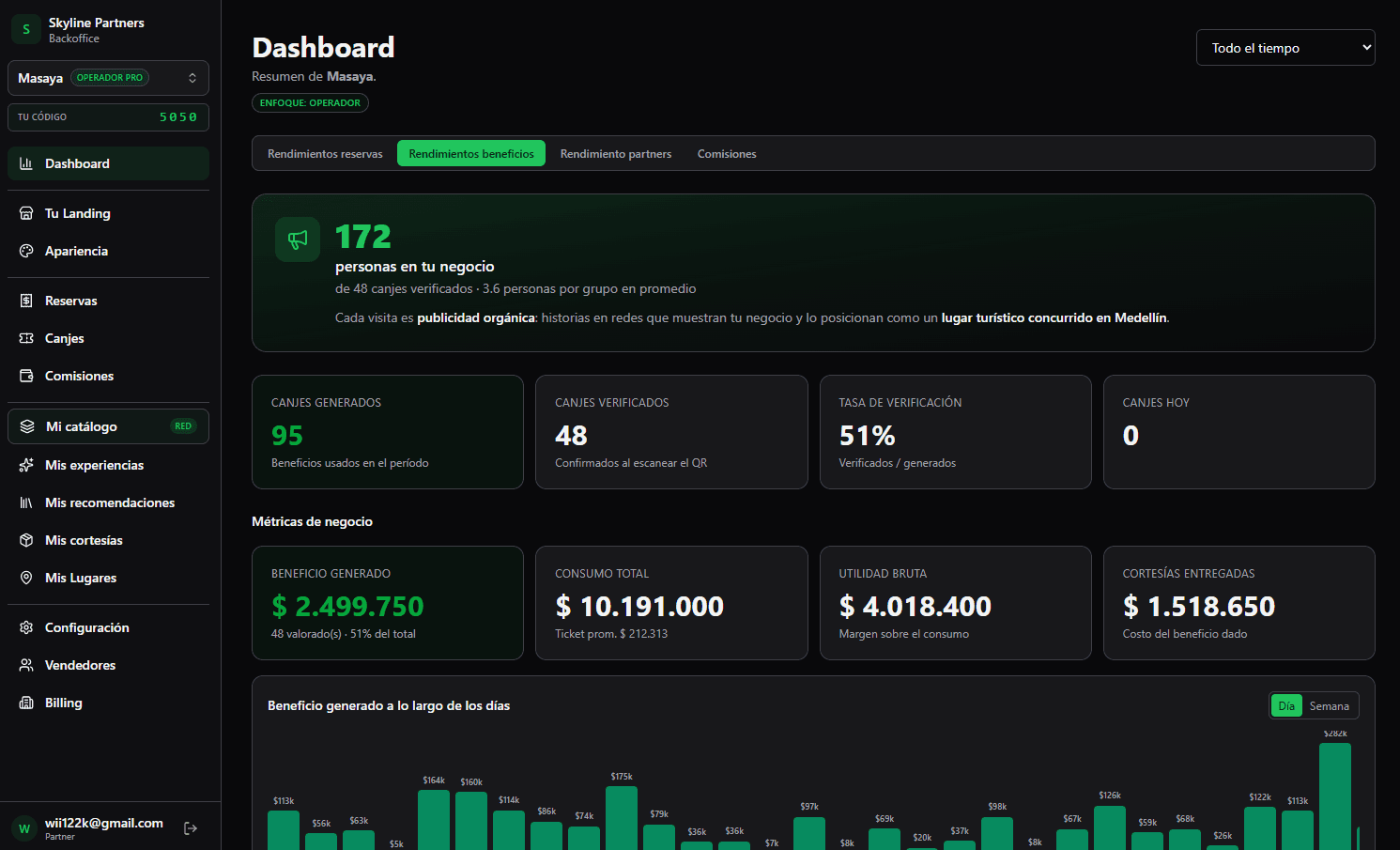
Related · Vórax
Invoice-Verified Spending in a Courtesy: What It Means
It's the record of people served and real spending a venue logs after redeeming a courtesy, backed by an invoice.
ReadHow to Take Prior Bookings for Courtesy Guests
The traveler leaves their WhatsApp and the day they plan to visit the restaurant when claiming the courtesy.
ReadVerified-Redemption Courtesies vs Discount Coupon Apps
A generic coupon doesn't say who brought the customer; a verified-redemption courtesy does.
Read