Vórax · Skyline Blog
How to Publish a Courtesy Offer for Your Restaurant
Fabián Alvarez11 min read
TL;DR
- A courtesy is a concrete perk (a drink, an entry, a discount) that attracts new customers and is delivered via QR.
- In Vórax you publish the courtesy, the partner network and local creators recommend it, and you only pay per verified redemption.
- The traveler gets a QR, your team scans it with an optional 4-digit code, and the system prevents double redemption.
- After redemption you record people served and invoice-verified spending to see the real benefit per courtesy.
- Every referral shows which partner sent it, and settlement happens without spreadsheets.
Publish one concrete, low-cost perk (a drink, an entry, a discount), define it in Vórax, Skyline's tool for venues, and let the partner network and local creators recommend it. The traveler gets a QR, your team scans it on site, and you only pay per redeemed courtesy, never for reach that never walks in.
A restaurant that is packed on Friday and empty on Tuesday does not have a food problem. It has a traffic problem. And a blanket discount usually makes it worse, because it shaves margin off the people who were already coming. The alternative is a courtesy: a perk a venue offers (a drink, an entry, a discount) to attract new customers, delivered via QR and redeemed on site.
This guide takes you from zero: what to offer, how to publish it, how the QR is issued, what the partner recommending it sees, and exactly what happens the day the customer shows up at your table.
What is a courtesy and why does it beat a blanket discount?
The difference is who receives the perk. A discount printed on your menu is taken by everyone, including the loyal guest who was happy to pay full price. A courtesy travels through a specific channel: someone recommends it to a person who does not know you yet.
In Vórax, Skyline's tool for venues, the venue publishes a courtesy that the partner network recommends to travelers and local creators show to locals. That is the whole mechanic: you supply the perk, the network supplies the distribution.
Three practical reasons this works for a restaurant:
- The cost is one item, not a percentage of the check. A welcome glass has a cost you know to the cent.
- The perk reaches someone new. The courtesy circulates through ambassador pages and creator content, not through your own menu.
- You only pay when something happens. Free to start; you only pay per redeemed courtesy.
That last point changes the internal conversation. You are not buying ads and hoping someone shows up. You are paying for a person who already sat down, ordered and spent.
Which courtesy should you publish?
This is where most venues get it wrong. The courtesy is not "the thing that hurts least to give away." It is "the thing that makes someone choose my place tonight instead of the one next door."
Criteria for choosing the perk
- It should be understandable in three words. "Welcome glass of wine" works. "Special benefit on your first visit" says nothing.
- It should have a known, low cost. One item from your menu with controlled cost, not an open percentage off the total.
- It should push spending, not replace it. A drink on arrival invites people to stay for dinner. A free main course does not.
- It should match your slow shift. If Tuesday is the problem, the courtesy has to be attractive on a Tuesday.
- It should not depend on a server's interpretation. If your team has to decide something on the spot, it will go wrong.
Three formats that work in a restaurant
- Welcome drink. The classic. Low cost, high perceived value, delivered in the first minute, and it breaks the ice.
- Starter or sharing plate. Ideal if your average ticket rises when the table is two or more.
- Category-capped discount. On one specific section of the menu, never on the full bill.
A concrete example: a seafood restaurant with a terrace notices its slump is weekday lunch. It publishes a house lemonade as a courtesy, valid Monday to Thursday. The cost is pennies, the photo looks great in a creator's content, and the traveler who redeems it ends up ordering a starter and a main.
Courtesies with a minimum group
If your venue performs better with large tables, you have another lever: a courtesy can require a minimum group and activate through the traveler app's group meetups. That suits rooftops, bars and kitchens where a table of four leaves far more than a table of one.
How do you publish the courtesy, step by step?
This is the flow from start to finish. Before you begin, get clear on three things: what perk you give, which days it applies, and what commission you are willing to pay per customer who walks in.
Step 1: create your account as a venue
Signup is self-service at admin.skyln.co/onboarding, choosing a focus: ambassador, operator or venue. Choose venue. That is where the courtesy panel lives.
Step 2: define the perk and its conditions
Write the courtesy as if it were going to be read by someone who has never set foot in your place. Be literal:
- What exactly is delivered.
- Which days and hours it applies.
- Whether it requires a minimum group.
- Whether it requires prior booking.
The number one rule of a well-written courtesy: if your server has to ask the manager something, the wording is wrong.
Step 3: set the commission you pay
In Vórax, the venue sets the commission it pays whoever brings customers. There is no imposed rate: you set it, based on your margin and on how aggressive you want to be about filling a dead slot.
Think of it this way: the commission is the acquisition cost of a new customer who is already sitting in your dining room. Compare it against what it costs you today to attract that same person through ads or a marketing agency, where you pay for reach without knowing whether anyone crossed the door.
Step 4: decide whether to require prior booking
Some courtesies are better booked in advance. Courtesies with prior booking work like this: the traveler leaves WhatsApp and a date, and the venue confirms from its panel; it gets notified by email and WhatsApp.
Use it when:
- Your capacity is limited and you do not want surprises.
- The courtesy involves preparing something.
- You want the customer's contact before they arrive.
If your operation is high volume with walk-ins, leave it without booking. Less friction, more redemptions.
Step 5: publish it and let the network distribute it
Once published, the courtesy enters the circuit: the partner network recommends it to travelers and local creators show it to locals. Behind it there is a single partner network (Skyline Partners): operators, ambassadors and venues share catalog, attribution and commissions. Today the network operates in Medellín and is designed to replicate city by city. That is a real limit and worth saying out loud.
How is the QR issued and what happens on redemption day?
This is the part that reassures restaurant owners the most, because it is usually where fraud, the "I already used it but let me use it again" conversation and the crumpled paper voucher sneak in.
Issuing, confirmation and redemption are automatic: the traveler gets a QR, the venue scans it (optional 4-digit code) and there is no double redemption.
What the customer does
- Sees the courtesy on an ambassador's page or in a local creator's content.
- Takes it and receives their QR.
- Arrives at your venue and shows it.
What your team does
- Scans the QR from the panel.
- If you turned on the extra control, asks for the optional 4-digit code when scanning.
- Delivers the perk.
That is it. The system marks the courtesy as used: redemption is the moment a customer presents their courtesy at the venue and it is marked as used, with no possibility of reuse.
What you do after redemption
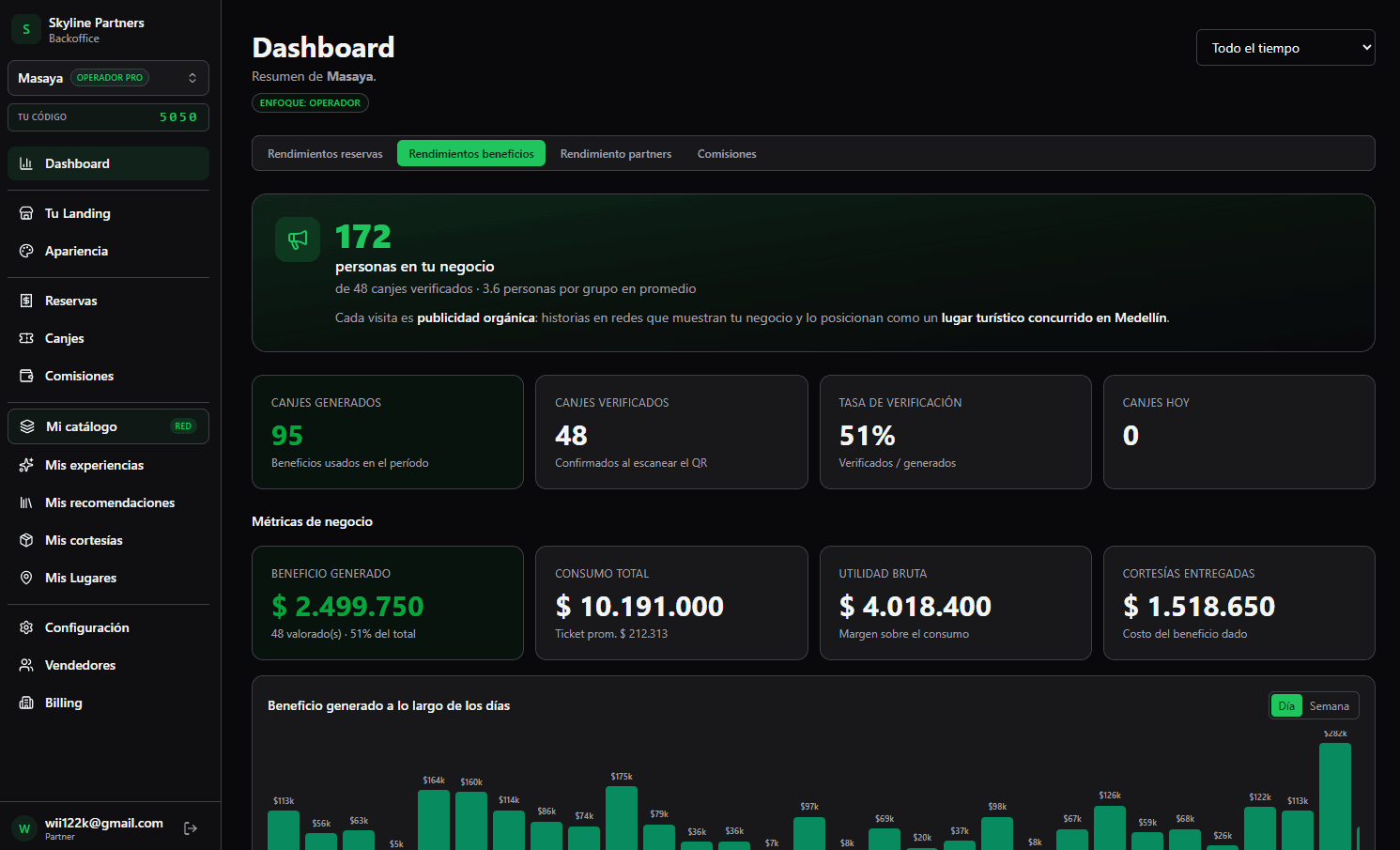
Here is the data that turns this into a business decision instead of a hunch. After redemption the venue records people served and invoice-verified spending, and sees the benefit per courtesy.
In other words: you are not measuring "how many vouchers I handed out." You are measuring how many people came in through that courtesy and how much they actually spent, with an invoice behind it. With that, you decide whether the lemonade stays, moves to a different day, or gets upgraded to a sharing starter.
To give you an order of magnitude: a restaurant in Provenza got 32 customers from 9 redemptions in a month. Nine courtesies handed out, thirty-two people seated. That is what happens because people almost never arrive alone.
What does the partner recommending your courtesy see?
Understanding the other side helps you design better. Whoever recommends your courtesy is usually an ambassador: a person or business that recommends network experiences from their own page and earns a commission on every booking or redemption they originate.
That partner sees your courtesy inside their page at yourname.skyln.co, alongside verified experiences from the network. They can share it via link or QR, and physical QRs track scans. A host might have the QR taped to the front desk; a driver, on the headrest.
And yes, they make money from it: the ambassador also earns on spending at partner restaurants and venues when the traveler redeems a courtesy the ambassador recommended. They see their earnings in a real-time panel with attributed bookings and commissions per booking and per courtesy.
Why should you care? Because a partner recommends whatever works for them. If your courtesy is clear, attractive and pays well, it will sit at the top of their list. If it is confusing, or your venue makes a fuss at the counter, they stop recommending it. This is a market, not a favor.
Today the network brings together over 110 partners in the network, including over 60 ambassadors. That is not a promise of anything: it is the size of the channel your courtesy walks into.
How do you know which partner brought each customer?
Through attribution: knowing which partner, link, QR or channel originated a booking or redemption, so the right commission gets paid.
In Vórax each referral shows who sent it, with a partner ranking by people and spending. That gives you two very concrete things:
- You identify the three or four partners who genuinely move people and take care of them.
- You stop handing out commissions blindly.
And when it is time to pay, settlement with partners happens without spreadsheets: there is a WhatsApp-ready statement and payment history. If you have ever closed a month reconciling referrals in a shared spreadsheet, you already know why this matters.
What if you also want content, not just customers?
A courtesy brings people in. Content brings people in for months. That is why Vórax Creators exists: 4 monthly visits from verified local creators of the Miradores Álbum, posts tagged with the venue's location, a Google review with photo within 72 hours and usage rights on the material.
The usage rights are not a small detail: that material stays with you for your profile, your digital menu and your paid media. On top of that, creator scheduling and reminders are automatic via WhatsApp; redemptions and spending per post show in the panel. You do not have to chase anyone through direct messages to coordinate a visit.
A rooftop that just opened can run both fronts at once: the courtesy to fill slow nights, and creators so that in two months there are posts circulating with its location tagged.
QR courtesy versus the usual alternatives
| Criterion | Menu discount | Generic affiliate program | Courtesy in Vórax |
|---|---|---|---|
| Who it reaches | Everyone, including loyal guests | Depends on the affiliate | New customers arriving on a recommendation |
| When you pay | Every time someone uses it | According to program rules | Only per redeemed courtesy |
| Fraud control | Manual | Varies | QR with optional 4-digit code and no double redemption |
| You know who sent the customer | No | Sometimes | Yes, each referral shows who sent it |
| You measure real spending | No | No | Yes, invoice-verified spending |
| Settlement with the recommender | Not applicable | Manual | WhatsApp-ready statement and payment history |
Common mistakes when publishing your first courtesy
- Offering something too big. If the courtesy covers the meal, the customer comes for the courtesy, not for you.
- Burying conditions in the fine print. The customer arrives, gets told it does not apply, and the partner tells that story to every guest.
- Not training the shift team. A server who does not know how to scan the QR turns a nice moment into an argument.
- Changing it every week. Give the network time to learn it and recommend it.
- Not recording spending after redemption. If you do not record people served and invoice-verified spending, you are flying blind again.
Your next step
Pick one low-cost item from your menu that also photographs well, decide which slow slot you want to fill, and create your account as a venue at admin.skyln.co/onboarding. Publish that first courtesy this week, teach your shift team to scan the QR, and at month's end look at the invoice-verified spending before deciding whether to keep it or change it.
Frequently asked questions
How much does it cost to publish a courtesy?
It is free to start; you only pay per redeemed courtesy. On top of that, you set the commission you pay whoever brings you customers, based on your margin. That means no upfront spend: the cost appears once someone has already walked into your venue.
Can I stop someone from using the same courtesy twice?
Yes. Issuing, confirmation and redemption are automatic: the traveler gets a QR, your team scans it and there is no double redemption. If you want an extra layer of control, you can turn on an optional 4-digit code when scanning.
Does this work if my restaurant does not get foreign tourists?
Yes. The courtesy circulates on two fronts: the partner network recommends it to travelers and local creators show it to locals. If your audience is local, the creator channel is the one that will move the needle for you.
Can I ask people to book before they come?
Yes. There are courtesies with prior booking: the traveler leaves their WhatsApp and the date, and you confirm from your panel. You get notified by email and WhatsApp. It is useful when your capacity is limited or you need to prepare something.
How do I pay the partners who sent me customers?
Each referral shows who sent it, with a partner ranking by people and spending. Settlement happens without spreadsheets: there is a WhatsApp-ready statement and payment history. You just review and pay.
Does this work outside Medellín?
Today the network operates in Medellín and is designed to replicate city by city. If your venue is in another city, the tool works the same, but the density of partners and creators is not there yet. Worth knowing before you set expectations.
Vórax
See Vórax in action
New customers for restaurants, rooftops and clubs: verified-redemption perks recommended by the partner network.
Get started with Vórax