Vórax · Skyline Blog
Invoice-Verified Spending in a Courtesy: What It Means
Fabián Alvarez5 min read
TL;DR
- It's the record of people served and real spending a venue logs after redeeming a courtesy, backed by an invoice.
- It exists to pay fair commissions: a redemption with no spending is not the same as a table that paid a full invoice.
- It's logged in the venue's panel right after the table pays its bill.
- It feeds directly into partner settlement, with no spreadsheets needed.
Invoice-verified spending is the record a venue makes, after a courtesy is redeemed, of how many people it served and how much they spent, backed by an invoice. That data, not the redemption itself, defines the real benefit of the courtesy and is the basis for calculating and paying fair commissions to the partners who brought the customer in.
What is invoice-verified spending?
Invoice-verified spending is the record a restaurant, rooftop or club makes, after a courtesy has been redeemed, of how many people it actually served and how much they spent, backed by an invoice. It is not an estimate or a guess from the customer: it is the data the venue logs once the table has already paid its bill. With that data, Vórax, Skyline's tool for venues, calculates the real benefit of each courtesy and lays the groundwork to pay a fair commission to whoever brought that person in.
For a restaurant that gets travelers and local customers through partner recommendations, this is the piece that closes the loop: first the referral arrives with their courtesy, then they redeem it, and finally the venue records how much was actually spent, invoice in hand. Without that last step, any commission calculation would be a guess.
The definition in context
Picture a rooftop in El Poblado that publishes a courtesy: a welcome drink for anyone who arrives referred by an ambassador or a local creator. The traveler gets their QR, shows it at the door, the host scans it, and that's where the redemption ends. But the redemption only confirms the person showed up. It doesn't say whether they stayed an hour or all night, or whether they ordered one drink or closed out a tab with two bottles.
That's where invoice-verified spending comes in: after that table pays, the venue records how many people it actually served and how much was spent, with the invoice as backup. That number, not the redemption itself, is what shows the real benefit the courtesy brought the venue.
Why does it matter for paying fair commissions?
It matters because the commission a venue pays its partners should be tied to a real outcome, not to a visit that didn't turn into anything. A venue sets the commission it pays whoever brings customers, and that commission makes a lot more sense when it's calculated on verified spending than when it's calculated on the redemption alone.
The problem with paying per redemption only
If a restaurant commissioned purely on every scanned QR, it would end up paying the same for a table that ran up a full invoice as for a person who walked in, drank water and left. That discourages the partners who actually bring customers who spend, because there's no difference between a valuable referral and one that wasn't. Invoice-verified spending corrects that bias: the venue sees, courtesy by courtesy, how many people showed up and how much they left behind, and uses that data to decide whether the commission it's paying makes sense against the benefit it received.
A simple example: a restaurant in Provenza publishes a free-entry courtesy for groups arriving through a partner. With plain redemptions, two groups look identical on the panel. But once invoice-verified spending is logged, the venue sees that one group left a high tab and the other almost nothing. That difference is what lets the venue prioritize the partners who genuinely drive business, and adjust its courtesy or its commission if something isn't working.
What this record prevents
- Paying commission for visits that generated no real revenue.
- Losing track of which partners bring customers who spend and which just bring foot traffic.
- Relying on a waiter's word or a rough calculation at month-end.
- Having disputes with partners over how much they're owed, with no objective data to back it up.
How is it recorded after redemption?
It's recorded in the venue's panel, right after the table closes its bill. The flow is simple: first the redemption happens (the traveler shows their QR, the venue scans it, with an optional 4-digit code to confirm), and then, once the bill is already paid, the venue goes into the panel and logs how many people it served and what the spending was, with the invoice as support. From there, Vórax shows the benefit per courtesy: how much it cost to give that discount or that free drink against what the table actually spent.
Step by step for the restaurant's team
- The traveler arrives with their courtesy and the waiter or host scans the QR at the entry point.
- The table consumes and pays its bill like any other.
- Someone at the venue (the same waiter, a supervisor, or whoever manages the panel) logs into Vórax and records people served and spending, with the invoice as backup.
- The panel updates the benefit for that courtesy and the partner ranking by people and spending, showing who brought the referral.
From verification to settlement
This record doesn't stay as just an internal metric: it feeds directly into settlement with partners. When it's time to pay whoever brought those customers in, the venue doesn't need to build a spreadsheet or reconstruct from memory which referrals showed up and how much they spent. Settlement with partners happens without spreadsheets: the system puts together a WhatsApp-ready statement along with the payment history, based precisely on that invoice-verified spending the venue logged courtesy by courtesy.
For a restaurant with several active partners (a guide, an Airbnb host, a couple of local creators) this means that at month's end there's nothing to reconstruct: the numbers are already there, backed by invoices, and the statement comes straight out of the same place where the redemption was logged.
What to do next
If your restaurant, rooftop or club already gets referrals from partners or creators, the next step is to publish a courtesy on Vórax and start logging invoice-verified spending from the first redemption, so the commission you pay is always tied to a real outcome.
Frequently asked questions
Is invoice-verified spending the same as redeeming the courtesy?
No. The redemption is just the moment the traveler shows their QR and the venue scans it. Invoice-verified spending is a later step, once the table has paid, logging people served and real spending backed by an invoice.
Who logs the invoice-verified spending?
Someone at the venue, like the waiter or whoever manages the Vórax panel, logs it right after the table closes its bill. It doesn't depend on the traveler or the partner who made the recommendation.
What happens if a venue doesn't log spending after redemption?
Without that record, the venue only knows how many courtesies were redeemed, not how much real benefit they generated. That makes it hard to decide if the commission it pays partners makes sense against what it got in return.
How does verified spending connect to paying partners?
Invoice-verified spending feeds settlement: the venue gets a WhatsApp-ready statement and a payment history, calculated on real spending data instead of estimates.
Is this only for restaurants?
It applies to any venue that publishes courtesies on Vórax, like restaurants, rooftops or clubs, whenever they want to measure the real benefit of each referral before paying a commission.
Vórax
See Vórax in action
New customers for restaurants, rooftops and clubs: verified-redemption perks recommended by the partner network.
Get started with Vórax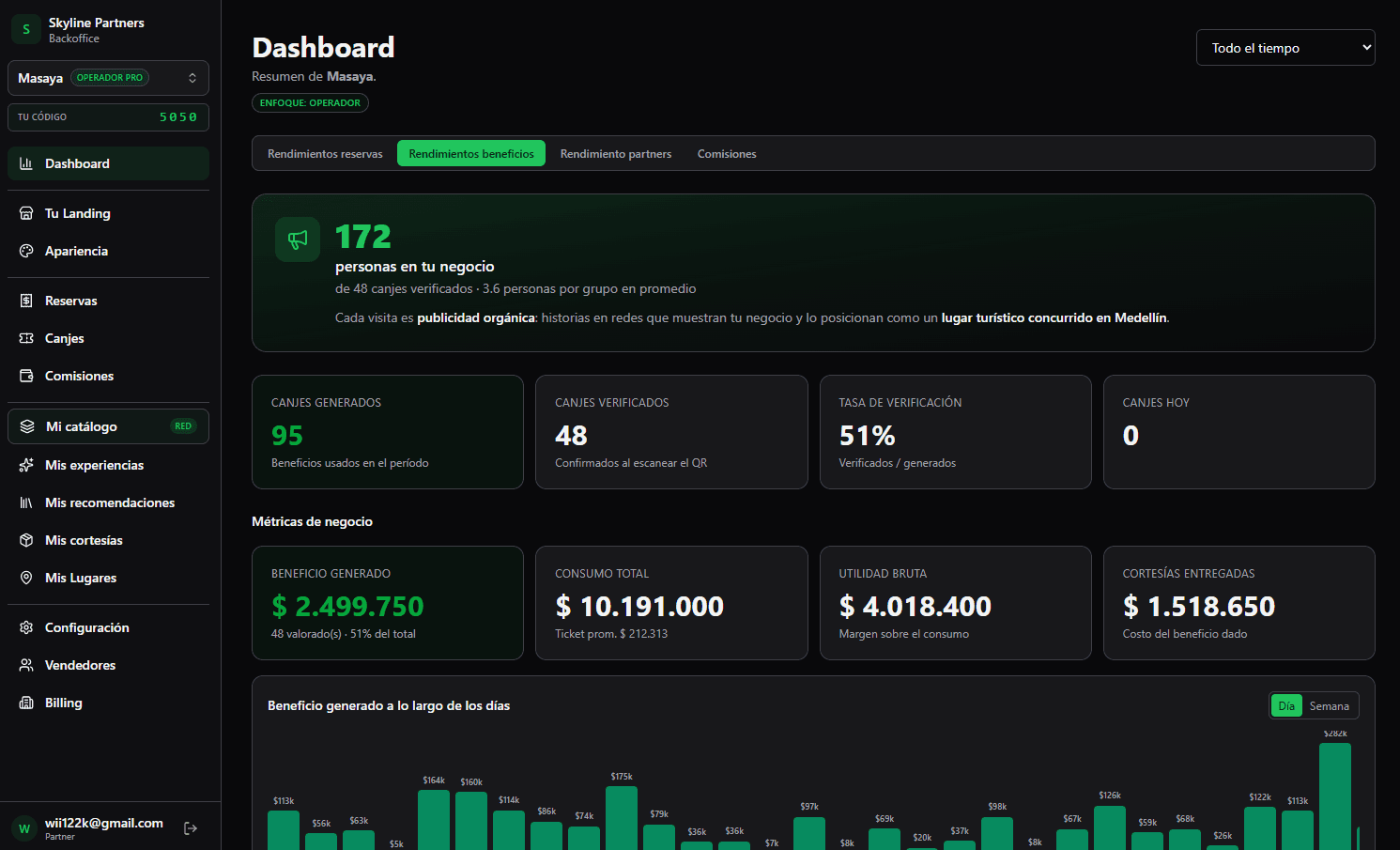
Related · Vórax
How to Take Prior Bookings for Courtesy Guests
The traveler leaves their WhatsApp and the day they plan to visit the restaurant when claiming the courtesy.
ReadVerified-Redemption Courtesies vs Discount Coupon Apps
A generic coupon doesn't say who brought the customer; a verified-redemption courtesy does.
ReadHow to Set the Commission You Pay Your Referral Partners
The venue sets the commission, not a fixed rate imposed from outside.
Read