Draco · Skyline Blog
What Is an AI CRM? Definition and the Real Difference
Fabián Alvarez5 min read
TL;DR
- An AI CRM executes complete funnel tasks, not just suggests replies for a human to copy.
- Draco unifies WhatsApp, Instagram, Messenger and TikTok in one inbox and uses five AI agents with distinct roles.
- The key difference from a CRM with 'AI features' is that the latter doesn't change the structure of human work.
- A real AI CRM must let you start in copilot mode and move to autonomous when the team trusts it, reversibly.
An AI CRM is a customer management system where artificial intelligence executes complete sales funnel tasks — replying, qualifying, following up — with adjustable human oversight, not just suggesting text. It differs from a CRM with "AI features" in that the AI operates, not just assists, across unified channels and specialized roles.
An AI CRM is a system for managing customers and sales in which artificial intelligence doesn't just suggest text, but executes complete tasks within the workflow: it replies to chats, qualifies leads, follows up and gives the team visibility, with human oversight defined by the business itself. For a travel agency this changes how sales channels get handled, because the AI stops being an accessory and becomes an operational part of the funnel.
Draco, Skyline's AI CRM, is an example of this category: it unifies WhatsApp, Instagram, Messenger and TikTok in one inbox, and that inbox is handled by a team of five AI agents with distinct roles. That combination — unified channels plus specialized agents — is what separates a real AI CRM from one that simply added a "generate reply" button to its usual interface.
What separates an AI CRM from one with "AI features"?
The difference isn't whether there's an AI logo in the menu. It's whether the AI does the work or just helps a human do it a bit faster.
A typical CRM with "AI features" offers:
- A button to draft a suggested reply that someone has to copy and send.
- An automatic summary of a long conversation.
- An AI-generated email template that gets edited by hand.
These features save minutes, but they don't change the structure of the work: a human is still reading every chat, deciding the funnel stage and writing the follow-up.
An AI CRM in the full sense, like Draco, has agents that split specific tasks from start to finish. In Draco, those five agents are Vega, Kai, Axel, Leo and Iris, each with a distinct role in the sales cycle. One handles inquiries and quotes, another qualifies leads, another reviews how the team handled the previous day, another reactivates cold conversations, and another triages what's gone quiet on the board. It's not a generic AI answering the same way for everything: it's a team with separated functions, the way an agency would have someone for sales, someone for follow-up and someone for quality.
For an agency with several active channels, this difference shows up daily. Think of an agency selling packages to a coastal island that gets inquiries via WhatsApp, comments on Instagram and messages on TikTok. With a CRM that has "AI features," someone on the team has to open each platform, copy the message, ask the AI for a suggestion, and send it by hand. With a real AI CRM, all those channels land in one place and the AI agents are already working on them before a human even has to look at the inbox.
What should an AI CRM do on its own, without a human stepping in at every step?
This is the question that really separates marketing from functionality. An AI CRM that deserves the name should be able to:
- Receive messages from multiple channels in one place. Draco unifies WhatsApp, Instagram, Messenger and TikTok in one inbox, so no one on the team has to check five different tabs to know what's happening with a customer.
- Split the work across specialized roles, not one generic AI. Draco's five agents — Vega, Kai, Axel, Leo and Iris — cover attention, qualification, analysis and follow-up as separate functions.
- Operate at a level of autonomy the business chooses and can adjust. Draco starts in copilot mode, where the AI proposes the reply and a person approves or corrects it, and moves to autonomous when the team trusts its performance; that change can be reverted at any time.
That third point is key for an agency that's just evaluating this kind of tool. It's not about handing the sales channel over to an AI overnight. Copilot mode exists precisely so the team can see how the AI responds, correct what's needed, and only let go of control once it's confident. It's the opposite of a rule-based chatbot that answers the same way regardless of context, and it's also different from a generic CRM where AI is an extra that doesn't touch the real workflow.
Comparison table: CRM with "AI features" vs. AI CRM
| Aspect | CRM with AI features | AI CRM (like Draco) |
|---|---|---|
| Channels | Usually checked separately | Unified inbox for WhatsApp, Instagram, Messenger and TikTok |
| Who executes | A human copies and sends the suggestion | Specialized AI agents execute complete tasks |
| Task distribution | One generic AI for everything | Five distinct roles: Vega, Kai, Axel, Leo, Iris |
| Level of control | Manual at every step | Copilot at first, autonomous once the team trusts it, reversible |
An example with generic names
Imagine an agency in a coastal city with three people handling sales. Before, each one checked their phone for WhatsApp, opened Instagram separately, and wrote down in a spreadsheet who had replied to whom. With an AI CRM, those three channels drop into a single inbox, and while the team reviews important quotes, the AI agents are already qualifying new leads and preparing draft replies in copilot mode, ready for someone to approve with a click. Over time, if the team sees the replies are consistent, they can move that funnel to autonomous mode and spend their time on the cases that really need human judgment.
What to ask before choosing an AI CRM
If you're evaluating tools for your agency, it's not enough to ask "does it have AI?" Ask specifically:
- Does the AI reply end-to-end, or does it just suggest text someone has to copy?
- Are there separate roles for attention, qualification and follow-up, or is it one AI doing everything without distinction?
- Can I start with human oversight and raise autonomy later, or is it all-or-nothing from day one?
- Do the channels I actually use — WhatsApp, Instagram, TikTok — land in one place, or do they stay separate?
These questions quickly filter between a CRM that says it has AI and one that actually operates with it.
If your agency is handling several channels separately and wants to see what a unified inbox with AI agents working in copilot mode looks like, the next step is to review how Draco is configured for your type of business.
Frequently asked questions
Does an AI CRM replace the agency's human team?
Not necessarily. In Draco, the AI starts in copilot mode, proposing replies that a person approves or corrects, and only moves to autonomous once the team trusts its performance. The human defines how far the autonomy goes and can revert it at any time.
Which channels should an AI CRM unify for an agency?
At minimum, the channels where your inquiries actually come in: WhatsApp, Instagram and TikTok tend to be the most used by travel agencies. Draco unifies them in one inbox along with Messenger, plus email as an additional channel.
What's the difference between lead scoring and an AI agent that qualifies leads?
Lead scoring is the concept: assigning a temperature to each conversation based on how close it is to buying. In an AI CRM like Draco, that work is done by a dedicated agent within the five-agent team, instead of someone doing it manually in a spreadsheet.
How do I know if a CRM has 'AI features' instead of real AI?
If the AI only generates a draft someone has to copy and paste, or summarizes conversations without acting on them, you're looking at AI features. A real AI CRM executes the task within the workflow, with defined roles and a configurable level of autonomy.
Draco
See Draco in action
The AI CRM for agencies and tour operators: WhatsApp, Instagram, Messenger and TikTok in one inbox, handled by five AI agents.
Try Draco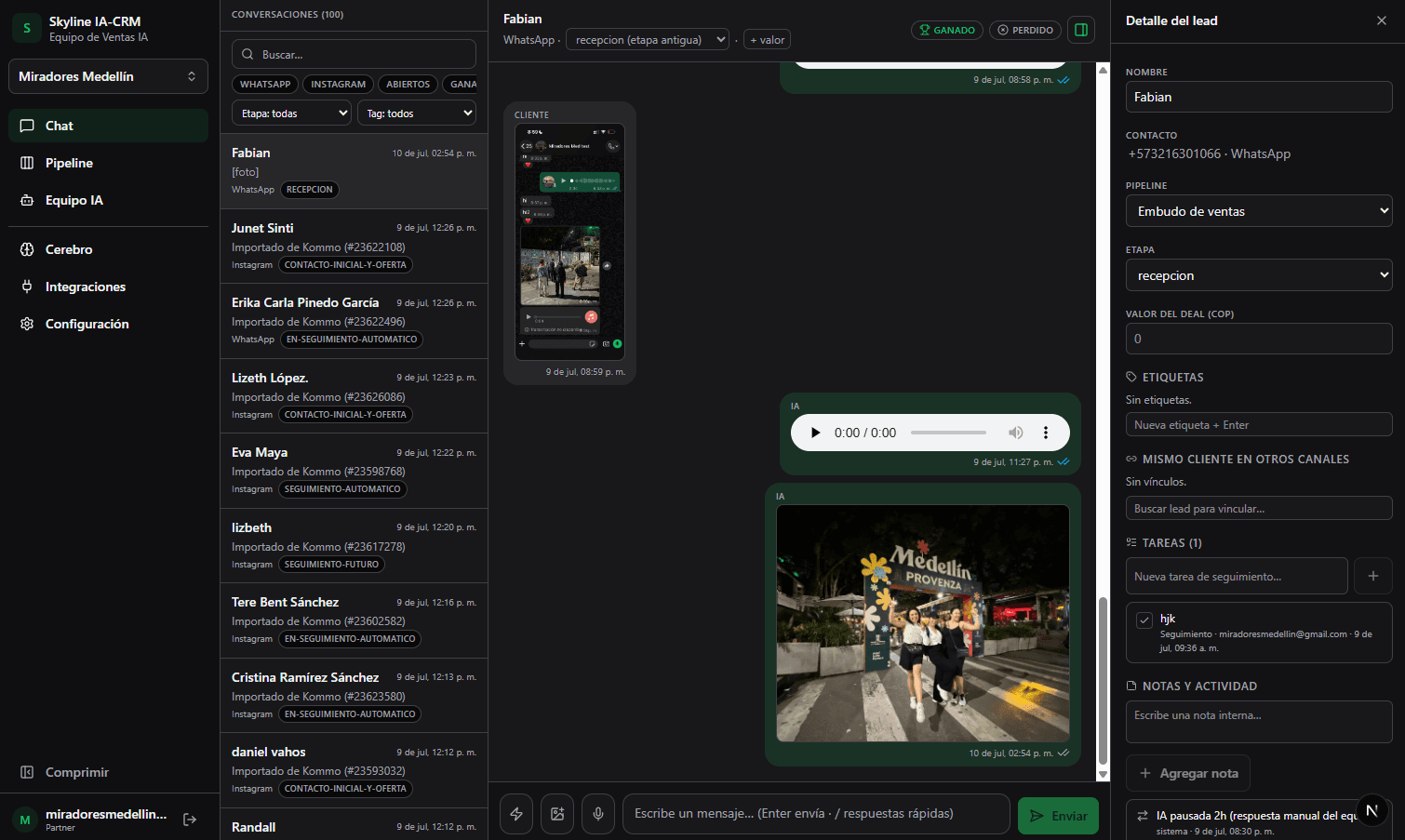
Related · Draco
WhatsApp as a Sales Channel for Agencies: Complete Guide
Meta's official coexistence API avoids the ban risk that unofficial bridges carry.
ReadAI CRM for Travel Agencies and Tour Operators
An AI CRM for travel centralizes WhatsApp, Instagram, TikTok and email, and uses AI to qualify and reply to every lead.
Read