Draco · Skyline Blog
WhatsApp as a Sales Channel for Agencies: Complete Guide
Fabián Alvarez10 min read
TL;DR
- Meta's official coexistence API avoids the ban risk that unofficial bridges carry.
- Outside the 24-hour window, a conversation can only be reopened with Meta-approved templates.
- Unifying WhatsApp, Instagram, Messenger and TikTok in one inbox keeps context when a lead switches channels.
- Charging inside the chat with a payment link cuts the friction between buying intent and a confirmed booking.
- Profiling the country and acquisition channel of each lead shows which channel actually converts.
WhatsApp works as a sales channel when it's connected through Meta's official API (not a bridge that risks the number), unified with other channels in one inbox, answered with a human tone inside the 24-hour window or with templates outside it, charged without leaving the chat, and measured by each lead's acquisition channel.
Why is WhatsApp key as a sales channel for a travel agency?
A traveler asking about a tour almost never fills out a form. They message on WhatsApp, at any hour, expecting a fast, human reply. For an agency, that makes WhatsApp the exact point where a lead either turns into a booking or goes cold in minutes.
The problem isn't having WhatsApp. It's what happens behind it: an advisor juggling five chats at once from a personal phone, no record of who asked what, no idea where the lead came from, and no way to charge without leaving the chat. This is the complete guide to turning WhatsApp into a sales channel that's organized, measurable, and doesn't depend on someone being awake at 11pm.
We'll cover the technical side (official API vs. unofficial bridges), the 24-hour window and templates, how to unify the inbox when messages also arrive via Instagram or TikTok, how to get an AI to reply with a human tone, how to charge without pulling the customer out of the chat, and how to know which acquisition channel actually brought each lead.
What does it mean to use the official WhatsApp API instead of an unofficial bridge?
This is where many agencies get it wrong without realizing it. There are two ways to connect a WhatsApp number to external software, and they are not equivalent.
The first is an unofficial bridge: tools that simulate having WhatsApp Web open to read and send messages from another platform. They work, until Meta detects the pattern and bans the number. When that happens, the agency loses the chat history, the contacts who used to reply to that number and, often, any quick way to recover it.
The second path is Meta's official coexistence API. Draco, Skyline's AI CRM, connects this way: the WhatsApp Business number keeps working in the usual app, on the team's phone, at the same time it's connected to the platform. There is no ban risk from unofficial bridges, because there is no bridge: it's the same Meta infrastructure running in two places at once.
In practice, this means an advisor can keep replying from their phone in a pinch, while the rest of the team sees the same conversation from a computer, and everything lands in the same place.
How to tell if an integration is official or a bridge
Before connecting any tool to your WhatsApp number, ask these three questions:
- Does the connection go through Meta's API, or does it simulate a WhatsApp Web session running in the background?
- Can the provider show that the number is registered as WhatsApp Business API, not as an automated personal account?
- What happens to the chat history if you switch providers? If the answer is "everything gets lost," it's probably not an official integration.
An agency in Cartagena using an unofficial bridge to automate replies might run fine for months, until a spike in messages (during high season, for example) trips Meta's alerts and the number gets banned right when it's needed most.
What is the 24-hour window and how does it affect WhatsApp sales?
The 24-hour window is the rule that governs when a business can message freely on WhatsApp. It's the period after the customer's last message during which a business can reply without restrictions; outside that window, it can only start the conversation with templates approved by Meta ( from the glossary).
For an agency, this has very concrete consequences. If a traveler asks about a tour on Monday and no one replies until Thursday, a normal message is no longer enough: an approved template is needed to reopen the conversation. Draco, Skyline's AI CRM, handles this with Meta-approved WhatsApp templates to reach out first outside the 24-hour window, so a follow-up doesn't get lost just because time passed.
This rule also explains why response speed matters so much on this channel: every hour that passes without a reply inside the window is an hour where, if the customer doesn't write again, the agency is stuck relying on templates to pick the thread back up.
What to do with leads that went cold outside the window
- Use an approved reactivation template, not a generic message Meta might reject.
- Personalize the hook based on which funnel the lead was in (someone who asked about a one-day tour doesn't need the same message as someone who already priced out a full package).
- Track how many cold leads respond to the template before pushing further; if no one replies, the message may be the problem, not the channel.
How do you unify WhatsApp, Instagram and TikTok in a single inbox?
A travel agency rarely sells through WhatsApp alone. It posts on Instagram, uploads reels to TikTok, and all that traffic eventually lands in a conversation. The risk is that each channel lives in a separate app, checked by a different advisor, with no shared visibility.
Draco unifies all of this into a unified inbox for WhatsApp, Instagram, Messenger and TikTok, with email also coming in as a channel. This means an advisor doesn't need four apps open, or to remember which one they used with which customer. A lead's entire history, no matter where they came in, stays in a single thread.
This matters especially for agencies with more than one advisor. Without a shared inbox, it's common for two people to reply to the same customer without knowing it, or for a lead who wrote on Instagram and then moved to WhatsApp to lose the context of that first conversation. With the unified inbox, that channel switch doesn't break the history.
An example: an agency with three advisors receiving leads from Instagram (via reels of a volcano tour), from TikTok (via a viral video of a night tour) and from WhatsApp (via a past customer's referral) can see all three sources on one board, without switching apps.
Can an AI reply on WhatsApp without sounding like a robot?
This is probably the most common fear an agency has before automating: that the customer will feel like a machine replied and go look for someone more human.
Draco replies with short, warm messages in the brand's tone, no robotic paragraphs and never introducing itself as a virtual assistant. The difference isn't just wording. It's a design decision: instead of one generic bot answering everyone the same way, Draco works with five AI agents with distinct roles — Vega, Kai, Axel, Leo and Iris — and the one who talks directly to the customer, Vega, is built to sound like part of the team, not like a menu of options.
The system also doesn't start in fully autonomous mode. It starts in copilot mode, where the AI drafts the reply and a person approves or corrects it before sending, and only moves to autonomous when the team trusts it; it can be reverted at any time. That gives the agency control over the tone while it learns to trust the AI, instead of letting it run unsupervised from day one.
There's another detail behind that human tone: the AI learns from every correction. The Approve/Correct buttons feed the AI, so the reply style gets refined over time based on what the human team validates.
What makes an AI reply feel robotic
- Long messages that try to cover everything at once, instead of conversing step by step.
- Repeating the same greeting and sign-off structure in every message.
- Not using the customer's name or referencing what they specifically asked.
- Introducing itself as a "virtual assistant" instead of replying as part of the team.
How do you charge inside the chat without pulling the customer out of WhatsApp?
Every extra step between "I want to book" and "I already paid" is a chance for the customer to get distracted and not come back. Pulling them out of WhatsApp to fill out a form on another page, or asking them to transfer money and wait for manual confirmation, adds friction right at the moment of highest buying intent.
Draco charges inside the chat with a payment link, or confirms via WhatsApp if the business doesn't use online payments. The customer never leaves the conversation: they get the link, pay, and the booking is done without an advisor having to copy data into another system.
This ties into the catalog: Draco is connected to the real Skyline Partner catalog, so the AI only recommends experiences that exist, with real prices and availability. There's no risk of selling a sold-out slot or quoting an outdated price inside the chat.
For an agency selling packages of several experiences, this simplifies the close considerably: instead of coordinating over chat, email and a bank transfer, the whole process stays inside the same WhatsApp thread where the conversation started.
An example: a traveler who writes asking about a kayak tour and ends up adding an airport transfer can get a single payment link for the whole package, without the advisor having to build the charge by hand.
How do you know where each lead who writes on WhatsApp came from?
Without this information, an agency investing in ads, in content creators or in its partner network can't know what's actually working. Every lead ends up looking the same once it lands in the chat.
Draco profiles each lead automatically: country and acquisition channel, whether TikTok, a Meta ad, the web storefront, a partner, or an OTA or tour marketplace. This means that when a lead comes in through WhatsApp, the system already knows whether it came from a reel, a paid ad or a referral from a network partner, without the advisor having to ask.
This traceability matters for two concrete decisions. First, knowing which acquisition channel is bringing leads who actually buy, not just leads who ask and disappear. Second, paying correct commissions when a partner or ambassador brings in a sale: if the origin is recorded automatically, no one has to reconstruct it by hand at the end of the month.
What to look at in lead origin
| Question | Why it matters |
|---|---|
| Which channel brings the most leads? | Shows where attention is, not necessarily where sales are. |
| Which channel brings the most leads who buy? | The metric that should guide where to invest time or budget. |
| Which country dominates each channel? | Helps adjust tone and currency in quotes. |
| How many leads come through network partners? | Helps decide whether that channel is worth investing in further. |
How to set up WhatsApp as a sales channel: a roadmap
Putting all of this together, here's a reasonable sequence for an agency that currently handles WhatsApp from a phone with no system behind it.
- Connect the number through the official API, not an unofficial bridge, so you don't risk the history or the number itself.
- Unify the channels you already use (Instagram, TikTok, email) into a single inbox, so context isn't lost when a lead jumps platforms.
- Define funnels for the types of sales the agency handles (day tours, multi-day packages, transfers), each with its own knowledge and mission.
- Start in copilot mode so the team can review how the AI replies before letting it operate on its own.
- Turn on in-chat payments so the booking closes without pulling the customer out of WhatsApp.
- Review lead origin every week to know which acquisition channel actually converts.
What are the limits of automating WhatsApp with AI?
It's worth being honest about this: an AI replying on WhatsApp doesn't replace human judgment in complex cases, like a delicate complaint or a negotiation outside the standard. That's why Draco starts in copilot mode and keeps a fixed stance of never chasing the customer, with a configurable cap on messages per reply depending on how aggressive a funnel wants to be. Automation speeds up the repetitive work; sensitive decisions still need a person.
Next step
If your agency currently handles WhatsApp from an advisor's personal phone, with no shared inbox and no record of lead origin, the first step is simple: check whether your number is connected through Meta's official API before connecting any external tool. From there, organizing the inbox, defining funnels and turning on in-chat payments are steps you can take one at a time, without rebuilding everything at once.
Frequently asked questions
What happens if my agency uses an unofficial bridge to connect WhatsApp to a CRM?
The number can get banned if Meta detects the pattern, risking the loss of chat history and associated contacts. The official coexistence API avoids that risk because the number keeps working normally in the usual app.
Can I message a customer after 24 hours if they haven't replied?
Yes, but only using a Meta-approved template; outside the 24-hour window a free-form message can't be sent. Draco includes approved templates for this case.
Does Draco's AI replace the human advisor on WhatsApp?
Not from the start: it begins in copilot mode, where the AI drafts the reply and a person approves or corrects it, and only moves to autonomous once the team trusts it. It can be reverted at any time.
How do I know if a WhatsApp lead came from an ad or from a partner?
Draco profiles each lead automatically with their country and acquisition channel, whether social media, an ad, the web storefront, a partner or an OTA. This removes the need to ask manually.
Can a booking be charged without leaving WhatsApp?
Yes, Draco generates a payment link inside the same chat, or confirms via WhatsApp if the business doesn't use online payments. The customer doesn't need to leave the conversation to complete the purchase.
What if my agency also sells through Instagram and TikTok?
Draco unifies WhatsApp, Instagram, Messenger, TikTok and email into a single inbox, so a lead's history isn't lost when they switch channels.
Draco
See Draco in action
The AI CRM for agencies and tour operators: WhatsApp, Instagram, Messenger and TikTok in one inbox, handled by five AI agents.
Try Draco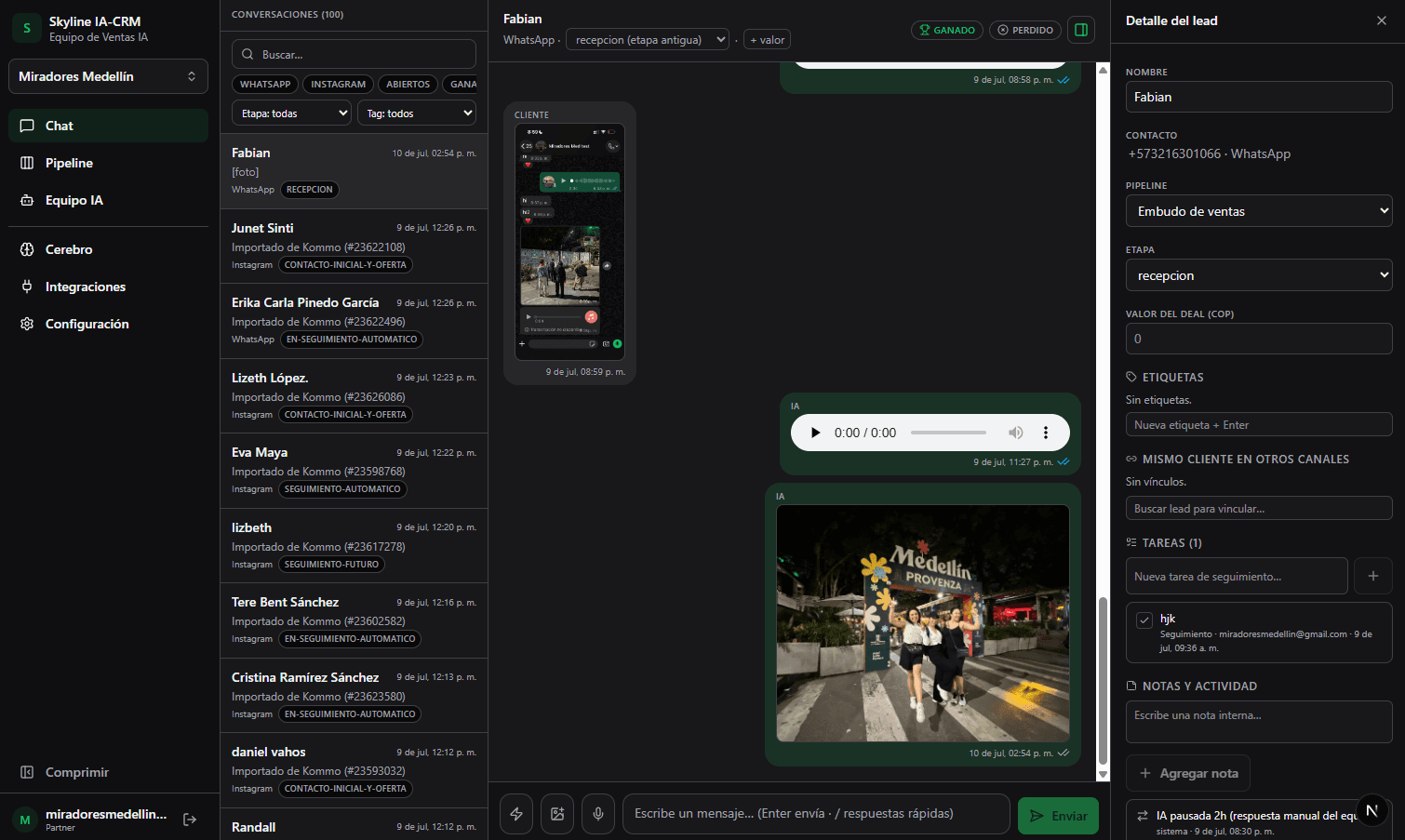
Related · Draco
What Is an AI CRM? Definition and the Real Difference
An AI CRM executes complete funnel tasks, not just suggests replies for a human to copy.
ReadAI CRM for Travel Agencies and Tour Operators
An AI CRM for travel centralizes WhatsApp, Instagram, TikTok and email, and uses AI to qualify and reply to every lead.
Read