Terra · Skyline Blog
AI Booking Engine for Tour Operators: Full Guide
Fabián Alvarez9 min read
TL;DR
- An AI booking engine handles bookings, itineraries, packages, payments and operations in one place, operable by chat.
- It differs from a traditional booking engine because it understands natural language, builds dynamic plans and connects to external AI assistants.
- Prices must always be computed from the system's catalog, never invented by the AI.
- With MCP, an operator connects their booking engine to Claude, ChatGPT or Gemini and operates from there.
- Terra is an example of this category, with 11 tools exposed via MCP.
An AI booking engine for tour operators is a system that brings together bookings, itineraries, packages, payments and operations in one place, and can be run by chat instead of only forms. Unlike a traditional booking engine, it builds personalized plans, charges through a single link, and connects to assistants like Claude, ChatGPT or Gemini via MCP. Terra is an example of this category.
What is an AI booking engine?
A booking engine is the system that lets a customer book and pay for an experience online, and the operator manage availability, dates and confirmations. That is the base definition, the one any operator who has used a traditional platform already knows.
An AI booking engine does the same, but it also understands natural language, operates by chat, and automates tasks that used to require someone to open a spreadsheet or copy data between systems. It's not a chatbot that answers FAQs: it's a full operating system you can run by talking to it.
Terra, Skyline's AI booking engine, is an example of this category: bookings, itineraries, packages, payments and operations in one place, operable by chat. Throughout this guide you'll see it applied to every piece of the process, from the moment a traveler asks about a tour to the moment a guide settles the departure.
Concrete example: a coffee-tour operator in Colombia's coffee region gets dozens of WhatsApp messages every week asking about availability, prices and activity combinations. With a traditional booking engine, someone on the team has to check the calendar, calculate the price manually and send a separate link for payment. With an AI booking engine, that same flow gets resolved inside the conversation.
What changes compared to a traditional booking engine?
Traditional booking engines work well for what they were built for: showing a calendar, charging a card and generating a voucher. The problem shows up when the operator needs something outside that linear flow: a custom-built itinerary, a package with several experiences, or simply a fast reply without opening three different tabs.
These are the differences that matter most day to day:
- Chat interaction instead of forms. In a traditional engine, the customer fills out a step-by-step form. In an AI one, the operator (or their connected AI assistant) describes what they need in a sentence and the system executes it.
- Dynamic itineraries and packages, not static catalogs. A traditional engine shows individual experiences. An AI one can combine several into a day-by-day plan or a package with a single payment link.
- Price calculation without human intervention or AI margin of error. In Terra, prices are computed server-side from the catalog; the AI cannot make up a price. This matters: the convenience of chat can't come at the cost of the AI "hallucinating" a rate.
- Full operations, not just sales. A traditional engine's job ends when the booking is confirmed. An AI one keeps supporting the operation: calendar, guides, settlements and accounting.
- Direct connection to external AI assistants. This is perhaps the newest difference: the operator doesn't just use a web interface, they can operate from Claude, ChatGPT or Gemini.
The table below summarizes the contrast:
| Capability | Traditional booking engine | AI booking engine (example: Terra) |
|---|---|---|
| Way of operating | Fixed forms and dashboards | Natural-language chat + dashboard |
| Personalized itineraries | Usually not, or manual | Yes, day-by-day, with an editable public link |
| Multi-experience packages | Limited or nonexistent | Yes, with a per-experience breakdown and a single payment link |
| Price calculation | From the loaded catalog | From the catalog, computed server-side (not by the AI) |
| Confirmation without online payment | Depends on the provider | Via WhatsApp with the same link |
| Daily operations (calendar, guides, settlement) | Separate or absent modules | Integrated in the same system |
| Connection to external assistants | No | Yes, via MCP |
What should an AI booking engine be able to do?
It's not enough for something to have "AI" in the name. To actually be useful to an operator, an AI booking engine needs to cover four fronts: itineraries, packages, payments and operations. If one is missing, the operator ends up filling the gap with a spreadsheet or a separate chat, which is exactly what they're trying to avoid.
Custom-built itineraries
An itinerary is the day-by-day travel plan with experiences, places and times. It's the first thing a traveler asks for when they don't know exactly what to book, they just know how many days they have and what interests them.
Terra builds day-by-day itineraries tailored to a traveler, with a public shareable link, and edits them keeping the same link. This solves a real problem: when the operator adjusts the plan after a call or a message, they don't have to generate a new document or send another link. The traveler always checks the same address, updated.
Concrete example: an agency in Cartagena gets a request from a couple arriving for three days who want a mix of history and beach. The operator builds the itinerary, shares the link, the couple asks to swap the second day for an island tour, and the operator edits the same plan without breaking the link they'd already saved.
Packages with a single charge
When the itinerary turns into something the traveler wants to buy, it becomes a package: several experiences sold together with a single payment link and a per-experience breakdown. Terra builds custom packages with a per-experience breakdown and a single payment link.
This simplifies something that becomes tedious in traditional operations: charging each activity separately, or sending three different links and hoping the customer pays all three. With a package, the traveler sees exactly what they're paying for each experience, but completes payment in a single step.
Payments that don't depend on being in front of a screen
An AI booking engine has to resolve payment without friction, whether the operator uses their own checkout or prefers to confirm through another channel. Terra offers online payments with its own checkout, with a 30% deposit option and balance paid later.
The deposit is key for operators who don't want to ask for full payment upfront, especially on high-value packages or bookings made well in advance. The traveler confirms with a partial payment and pays the rest closer to the date, without the operator having to manually chase that second payment.
Full operations, not just sales
This is where an AI booking engine differs most from a simple payment gateway with a calendar attached. Terra puts bookings, guides, departures, travelers and payments in a single operations calendar, multi-user.
This means the same system that generated the itinerary and charged the package is the one the team uses to know which guide is out tomorrow, how many travelers confirmed, and which payments are pending. Nothing has to be exported to another tool to see the full picture of the day.
Concrete example: a kayak operator with three regular guides and daily departures needs to know every morning who's going out with whom, how many travelers are on each departure, and whether any payment is still pending. With everything centralized in one operations calendar, that check takes minutes instead of cross-referencing three different files.
How does an AI booking engine connect to an assistant like ChatGPT or Claude?
This is the part operators who already use AI elsewhere in their business ask about most: can I just ask my assistant to check my calendar or create a booking?
The short answer is yes, if the booking engine is built on MCP (Model Context Protocol): an open standard that lets an AI assistant (such as Claude, ChatGPT or Gemini) connect to external tools and data through a server that exposes actions with defined permissions.
How it works in practice
Terra connects to Claude, ChatGPT or Gemini via MCP: the operator generates a URL in Terra → Integrations, pastes it into their assistant and operates by chat. There's nothing complex to install and no code to write. The process is three steps:
- The operator goes to Terra → Integrations and generates their connection URL.
- They paste that URL into their AI assistant's settings (Claude, ChatGPT or Gemini).
- From there, they ask the assistant things like "create me a three-day itinerary in Guatapé" or "show me this week's bookings," and the assistant executes the real action inside Terra.
What the connected assistant can do
This isn't a shallow connection that only "reads" data. The MCP exposes 11 tools: list experiences, create quickpay, list/get/create/update itineraries, get recommendations, create package, list/get/update bookings.
This means the operator can ask their assistant to build a full package, create a quickpay booking to send by chat, or check the status of an existing booking, all without leaving the conversation with their assistant of choice.
Why this matters for an operator
Many operators already use ChatGPT or Claude to write messages, plan content or answer day-to-day questions. Connecting the booking engine to that same assistant removes the jump between "thinking about what I need" and "opening the system to do it." An operator who already has the habit of asking their AI things can now ask it to run their business too.
What risks should you watch when AI is involved in bookings?
Delegating operational tasks to an AI raises a logical question: what happens if it gets a price or an availability slot wrong? It's the most reasonable concern any operator has before taking this step.
Terra's design answer is clear: prices are computed server-side from the catalog; the AI cannot make up a price. The AI interprets intent from the operator or the traveler ("I want a tour for 4 people on Saturday"), but the final number — the actual price charged — always comes from the catalog, not from a calculation made by the language model.
This separation is the difference between a reliable AI booking engine and a chatbot that "guesses" answers. The AI makes the conversation smoother and executes actions, but critical data — price, capacity, availability — always comes from the system's source of truth.
How do I choose an AI booking engine if I have a small team?
An operator with two or three people on the team doesn't need a complex system with fifteen modules nobody will fully use. They need the basics — selling, charging, operating — connected to each other without someone having to act as a manual bridge between systems.
When evaluating options, it's worth checking:
- Can it build itineraries and packages, or does it only sell individual experiences? If the operator combines activities often, this makes a real difference in the time saved.
- Does payment support a deposit, or only full charge? For bookings made weeks in advance, the deposit option reduces friction.
- Does daily operations live in the same system, or does it need exporting elsewhere? A calendar that brings together bookings, guides and payments avoids duplicate work.
- Can it be operated by chat, or only from a web dashboard? For teams already working heavily from WhatsApp or an AI assistant, this changes the speed of day-to-day work.
- How does it handle prices when AI is involved? It's worth explicitly asking whether price calculation depends on the system's catalog or on what the AI "thinks."
What to do next
If you run a tour operator and want to see an itinerary, a package and an MCP connection working together, go to terra.skyln.co and check the Integrations section to generate your own connection URL with your AI assistant.
Frequently asked questions
Does an AI booking engine replace my support team?
No, it supports it. The AI speeds up tasks like building itineraries, calculating packages or generating payment links, but the operator's judgment still guides what gets offered to each traveler.
What happens if the AI gets a price wrong?
In Terra this can't happen because prices are computed server-side from the catalog; the AI cannot make up a price. The AI interprets the request, but the final number always comes from the real catalog.
Do I need to know how to code to connect my AI assistant to the booking engine?
No. In Terra the process is generating a URL in Terra → Integrations and pasting it into the assistant's settings (Claude, ChatGPT or Gemini). No code is required.
What's the difference between an itinerary and a package?
An itinerary is a day-by-day plan with experiences, places and times, meant to show the traveler a proposal. A package is the sellable version of that plan, with several experiences bundled together and a single payment link.
Can I confirm a booking without using online payments?
Yes. When the operator doesn't use online payments, the booking is confirmed via WhatsApp with the same link, without forcing the traveler to pay upfront inside the system.
Terra
See Terra in action
The AI booking engine for tour operators: bookings, itineraries, packages and payments, operated by chat via MCP.
Request a Terra demo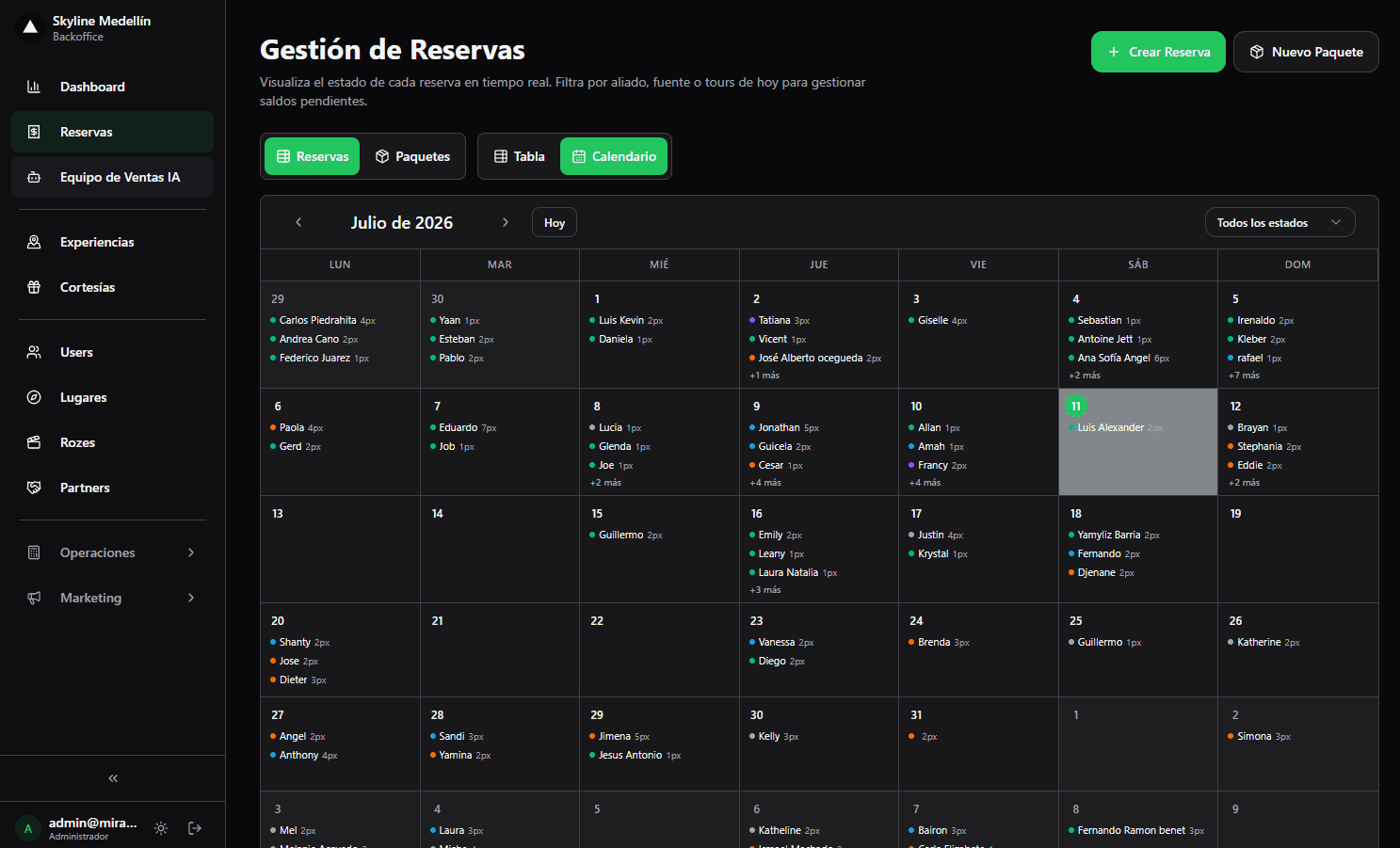
Related · Terra
What Is a Booking Engine and What Tours Need
A booking engine manages availability, dates, payments and confirmations, not just charges.
ReadHow to Charge Tour Bookings Online: Deposits & Links
A payment link is the base of any charge; in Terra it's born directly from the booking with its own checkout.
Read