Vórax · Skyline Blog
Verified-Redemption Courtesies vs Discount Coupon Apps
Fabián Alvarez6 min read
TL;DR
- A generic coupon doesn't say who brought the customer; a verified-redemption courtesy does.
- With verified redemption you only pay per redeemed courtesy, not a flat subscription.
- The single-use redemption QR prevents the double-use that happens with shared codes.
- After redemption, verified spending backed by an invoice gets recorded, not an estimate.
A verified-redemption courtesy records who brought the customer, how much they spent with an invoice on file, and the venue only pays per actual redemption, using a QR that prevents double use. A generic discount coupon doesn't track origin or real spending, and is often paid for whether anyone uses it or not.
What's the difference between a verified-redemption courtesy and a discount coupon?
The difference isn't in the discount the customer gets. It's in what happens before and after that visit: who brought the customer, how sure you are it was that person, and what you pay for it.
A generic discount coupon (from a coupon app or a mass promo code) reaches anyone, with no record of who recommended it. A verified-redemption courtesy, on the other hand, comes from a specific partner — a guide, a host, a content creator — and that origin is recorded from the first click.
For a restaurant, a rooftop or a club, that traceability isn't a technical detail. It's the difference between spending on marketing blind and paying only when someone actually sat down at your table.
The question almost nobody asks before handing out coupons
When a venue distributes coupons through a generic app, it almost never asks: who brought this customer in? The coupon app doesn't know, and neither do you. The customer showed up, showed the code on their phone, and that's it. There's no partner behind it to thank or pay a commission to, because nobody assumes it was a specific recommendation — it was a mass promotion.
With Vórax, Skyline's tool for venues, the logic is different by design. Each referral shows who sent it: there's a partner ranking by people and by spending, so at any point you can see which guide, host or creator is actually bringing you people, and how much they're leaving in your register.
Picture a rooftop that hands out a courtesy — a two-for-one entry, say — both through a coupon app and through Vórax's partner network. At the end of the month, the coupon app tells it how many codes got used. Vórax tells it how many each specific partner used, how much spending each group left, and who deserves a higher commission next month.
How is double redemption controlled in each model?
This is where many venues get burned with traditional coupons: the same code circulates via screenshot, gets shared in group chats, and ends up redeemed multiple times without anyone noticing until they check the books at month's end.
A courtesy in Vórax is issued, confirmed and redeemed automatically: the traveler receives a QR, the venue scans it (with an optional 4-digit code when scanning, if you want an extra layer of control), and the system blocks a repeat redemption. There's no way for the same QR to be used twice.
This matters especially for a restaurant with high table turnover, where nobody has time to manually check whether a code was already used before. Control is automated, and the floor team just needs to scan.
What actually gets measured after the visit?
A discount coupon measures one thing: that someone used it. Full stop. It doesn't know if that person ordered a single appetizer or closed out a high tab, or whether they came back for dessert.
With Vórax, after redemption the venue records people served and invoice-verified spending, and sees the actual benefit per courtesy. That means you're not guessing whether the promotion was worth it: you have the exact number of people each courtesy brought and how much they spent, backed by the venue's real invoice, not an estimate.
For a restaurant, this changes the conversation with the partner team. It's no longer "I think this courtesy works," it's "this courtesy brought in this many people this month and left this much verified spending." With that information you can decide, with data, whether to keep the courtesy, adjust it, or drop it.
Who pays, and when, in each model?
This is probably the most sensitive difference for a restaurant's cash flow.
Coupon apps and many generic affiliate programs tend to charge a flat fee, a subscription, or a percentage for the listing, regardless of whether the coupon got used or not. You published the promo, you paid to be there.
Vórax works differently: free to start, and you only pay per redeemed courtesy. If nobody redeems the courtesy that month, you pay nothing. The venue sets the commission it pays whoever brings customers, so what you pay scales with what the courtesy actually generates, not with a flat monthly subscription running on its own.
This is especially useful for a venue that's testing whether partner recommendations work for it, without wanting to commit to a fixed budget from the first month.
Comparison table: verified-redemption courtesy vs generic discount coupon
| Criterion | Generic discount coupon | Verified-redemption courtesy (Vórax) |
|---|---|---|
| Who brings the customer? | Unknown; mass promotion | Each referral shows who sent it, with a partner ranking |
| What do you pay? | Flat subscription or fee, used or not | Only pay per redeemed courtesy; free to start |
| What gets measured? | Code usage, nothing more | People served and invoice-verified spending |
| Double-redemption control | Manual, prone to failure (screenshots, shared codes) | Automatic single-use QR, optional 4-digit code |
| Relationship with the referrer | None or indirect | Direct: commission set by the venue for the partner |
When does each option make sense?
Neither category is bad on its own; it helps to understand what each is good for.
A mass discount coupon can make sense if your goal is pure visibility: showing up in front of a lot of people, unfiltered, accepting that you won't know the exact origin of each customer. It's a reach tool, not an attribution tool.
A verified-redemption courtesy makes sense when what you're after is building (and sustaining) relationships with specific partners — guides, hosts, local creators — who bring you customers on a recurring basis and deserve to be paid in proportion to what they actually generate. If you also want to know whether that courtesy converts into real spending, and not just people walking in and out, verified redemption backed by an invoice gives you that answer.
A typical example: a restaurant in a touristy downtown area that today hands out discount flyers on the street. It has no idea how many of those flyers actually turned into an occupied table. If it swaps that flyer for a verified-redemption QR and puts it in the hands of two or three trusted local guides, within a month it has a clear ranking of which guide brought the most people and how much they spent, invoice included.
What to do next
If your restaurant, rooftop or club is currently handing out coupons without knowing who brings them in or how much they actually leave in the register, the first step is to publish a verifiable courtesy and let the partner network recommend it, paying only when someone actually redeems it.
Frequently asked questions
Can a restaurant use verified-redemption courtesies without paying anything upfront?
Yes, getting started is free. The venue only pays when a courtesy actually gets redeemed, so there's no fixed cost to try it out.
How do you prevent someone from using the same courtesy twice?
The courtesy is delivered as a QR and the venue scans it at the moment of redemption, with an optional 4-digit code as an extra layer. The system marks the redemption and won't allow a repeat.
What information does the restaurant keep after someone redeems a courtesy?
It keeps a record of people served and invoice-verified spending from that visit, plus knowing which partner originated that referral.
Does a traditional discount coupon also track who recommended the customer?
Generally not. Most coupon apps record that the code was used, but they don't attribute that visit to a specific partner or show how much that person spent.
Does it make sense to combine mass coupons with verified-redemption courtesies?
It depends on the goal: if you want unfiltered mass reach, a generic coupon serves that purpose. If you want to build partner relationships and measure real spending, verified redemption gives you that traceability.
Vórax
See Vórax in action
New customers for restaurants, rooftops and clubs: verified-redemption perks recommended by the partner network.
Get started with Vórax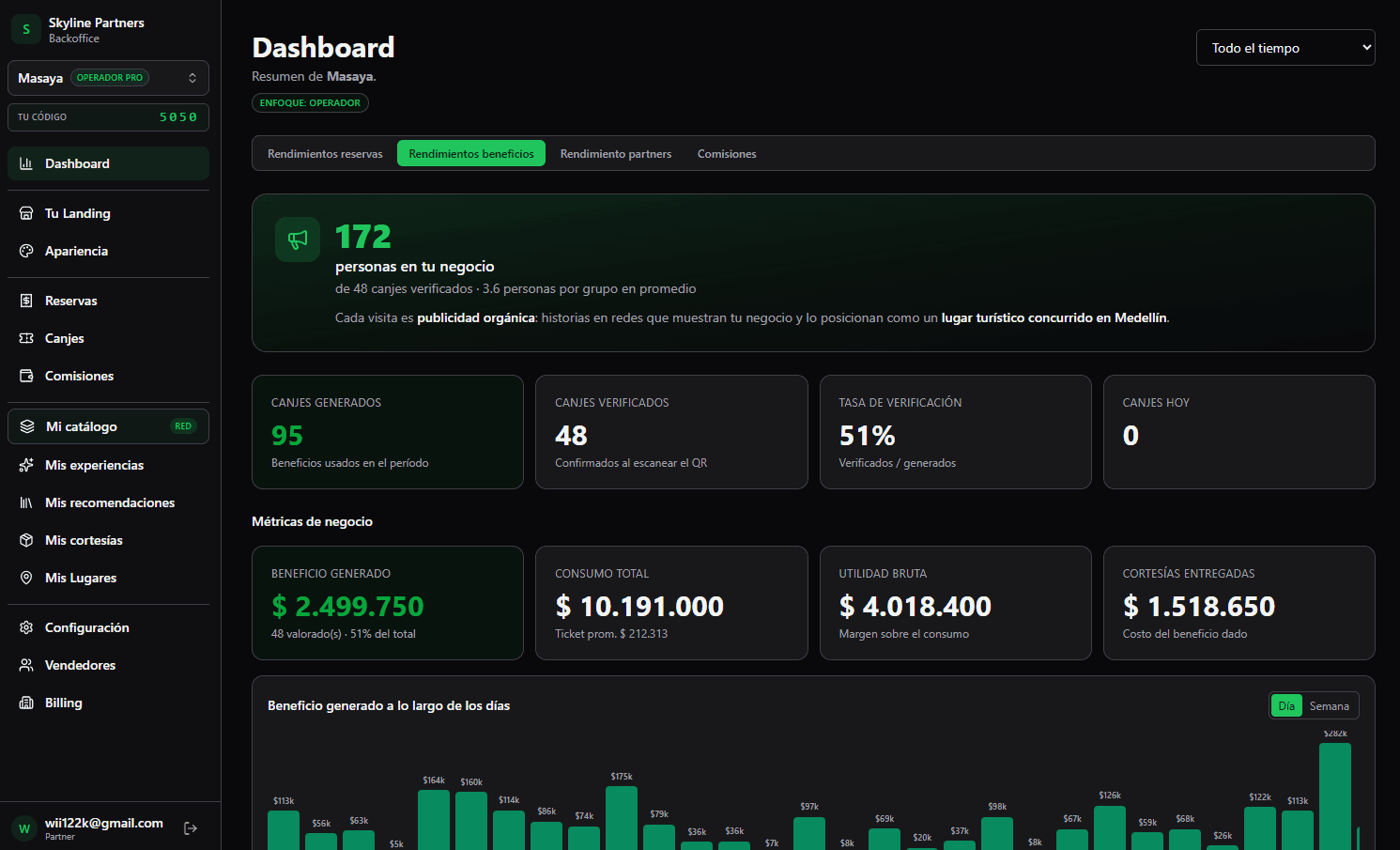
Related · Vórax
How to Set the Commission You Pay Your Referral Partners
The venue sets the commission, not a fixed rate imposed from outside.
ReadHow to Fill a Rooftop Bar on Weekdays With Courtesies
Publish a drink courtesy only for the slow nights and the partner network recommends it.
ReadVerified-Redemption Courtesies: Guide for Restaurants
You only pay per redeemed courtesy, with no fixed cost to start.
Read