Terra · Skyline Blog
Connected Tour Operations: Bookings, Guides and Cash as One
Fabián Alvarez6 min read
TL;DR
- Separating sales from operations forces manual reconciliation on every tour departure.
- That reconciliation costs administrative time, slot errors and unclear finances.
- A single calendar with bookings, guides, departures and payments eliminates data duplication.
- The per-departure settlement panel builds automatic drafts from the same booking.
- Operations accounting connects the daily close with commissions and collaborator accounts.
Connected tour operations means the booking, the guide, the slot and the departure's cash are the same record, not separate ones someone has to reconcile by hand. This avoids hours of manual matching, slot errors, and unclear visibility into how much each tour departure actually earns.
What does it mean for tour operations to be "connected"?
A connected operation is one where the booking, the assigned guide, the available slots and the departure's cash record live as the same data, not as separate records someone has to reconcile by hand. When an agency sells on one side (a spreadsheet, WhatsApp, a form) and operates on another (another spreadsheet, another WhatsApp group, the guide's notebook), every tour departure requires a manual reconciliation: someone has to compare who paid, who showed up, how much the guide spent and how much is left. That reconciliation isn't free. It costs hours, and it costs mistakes.
This article is part of the Run a Tour Company in High Season: Calendar to Settlement cluster on operating tours in high season, when the volume of departures multiplies every friction point that went unnoticed in low season.
Why does separating sales from operations cost money?
Because every time a piece of data exists in two places, someone has to keep it in sync by hand, and that person isn't selling or looking after travelers while doing it. In practice, separating sales from operations produces three kinds of cost:
- Invisible administrative time: matching bookings against payments, payments against the guide's cash, and the guide's cash against commissions, departure by departure.
- Slot errors: a booking that didn't make it into the guide's calendar in time, and a tour that leaves with more or fewer people than it should.
- Financial opacity: when a departure's cash isn't tied to the booking that originated it, it's hard to know whether a departure was profitable without running separate numbers.
A concrete example: a kayak operator in Guatapé sells over WhatsApp, logs bookings in a shared spreadsheet, and the guide keeps their own notebook of expenses (gas, life vests, tips). At the close of each departure, someone from the office has to call the guide, ask for photos of the notebook, compare them against the booking sheet and put together a report. If the season has two or three departures a day, that task alone can occupy a person full time, and gaps still remain: a deposit that didn't get logged, an expense the guide forgot to report.
What changes when the booking already carries the guide, the slot and the settlement?
What changes is that the whole departure has a single place to check anything: who booked, who's handling it, how many slots are left, and how much money is coming in and going out. With Terra, Skyline's AI booking engine, bookings, guides, departures, travelers and payments live in a single operations calendar, multi-user, so the whole team sees the same thing at the same time without having to wonder whether the version they have is the latest one.
That solves the first cost: nobody has to copy a booking from one place to another just so the guide knows it exists. The booking, once created, is already assigned to a departure with its guide and its slots.
The calendar as the single source of truth
Terra's operations calendar isn't just a list of bookings. It groups bookings, guides, departures, travelers and payments into a single view, and being multi-user, it lets a sales person, an operations coordinator and the business owner see the same information without duplicating the work of keeping it current. If a booking changes date, the change shows up for everyone who depends on that departure, not just for whoever made the sale.
The settlement that's already born from the booking
The second cost (matching cash against bookings) is solved by Terra's per-departure settlement panel. Each tour has its own cash record, with automatic drafts that start from what's already known about that departure, associated receipts, and an AI reading of the guide's report, instead of someone having to transcribe by hand what the guide wrote down. This means the settlement isn't a separate exercise put together afterward: it's born from the same booking and departure data.
For the kayak operator in the example, this turns the task of "call the guide and reconcile accounts" into reviewing a draft that already has most of the information ready, and correcting only what's missing.
The accounting that connects the departure to the whole business
The third cost (financial opacity) is solved by Terra's operations accounting, which goes beyond a single departure: it includes the daily close, accounts with collaborators (advances, loans, bonuses), commissions and payments between partners. This matters because an operation with several guides, several sellers and several partners doesn't just need to know how much a departure made; it needs to know how much it owes or is owed by each person involved in the business, without keeping a parallel spreadsheet for that.
What table sums up the difference between operating separately and operating connected?
| Moment in the operation | Sales and operations separated | Booking, guide, slot and cash connected |
|---|---|---|
| At booking time | The booking sits in one record; someone has to notify the guide separately | The booking is already on the calendar with guide and slots assigned |
| During the departure | The guide keeps their own cash and expense tracking | The departure's cash is ready to settle using what's already known about the booking |
| At settlement | Someone manually compares bookings, payments and the guide's report | The settlement panel builds an automatic draft per departure |
| At month close | Commissions and collaborator accounts are calculated separately | Operations accounting integrates the daily close, commissions and payments between partners |
Does this apply equally to a one-guide operator and a multi-guide one?
Yes, though the benefit grows with volume. An operator with one guide can survive with a spreadsheet because the reconciliation is simple. But in high season, when departures multiply and seasonal or subcontracted guides come in, every extra departure without a connected system adds the same manual work again, and slot or cash errors become more frequent exactly when there's less time to fix them.
What position is worth taking on this?
The position is simple: if your business still separates where it sells from where it operates, high season will expose that seam before anything else does. It's not a problem of missing people; it's that the information lives in two places and someone has to be the bridge between them. Connecting booking, guide, slot and settlement doesn't remove the work of running a tour, but it does remove the work of making the data agree with itself.
What to do next
Look at your next high-volume departure and count how many times someone has to manually copy or compare a piece of data between the booking, the guide and the cash record. That number is the cost worth solving before high season starts.
Frequently asked questions
What happens if I keep operating with spreadsheets?
It works while volume is low, but every extra departure in high season multiplies the manual work of comparing bookings, slots and cash. The risk of errors grows exactly when there's less time to fix them.
Does the settlement panel replace the guide's report?
No, it builds on it: Terra's per-departure settlement panel uses AI to read the guide's report and build an automatic draft, instead of someone transcribing it by hand.
Does this work for an operator with a single guide?
Yes, though the benefit is larger with several guides and simultaneous departures, since that's where manual reconciliation grows faster than the team available to do it.
Where does the money between guides, partners and the business get recorded?
In Terra's operations accounting, which integrates the daily close, accounts with collaborators (advances, loans, bonuses), commissions and payments between partners.
Can the whole team use Terra's calendar at the same time?
Yes, the operations calendar is multi-user, so sales, coordination and the business owner see the same up-to-date information without duplicating the work of keeping it current.
Terra
See Terra in action
The AI booking engine for tour operators: bookings, itineraries, packages and payments, operated by chat via MCP.
Request a Terra demo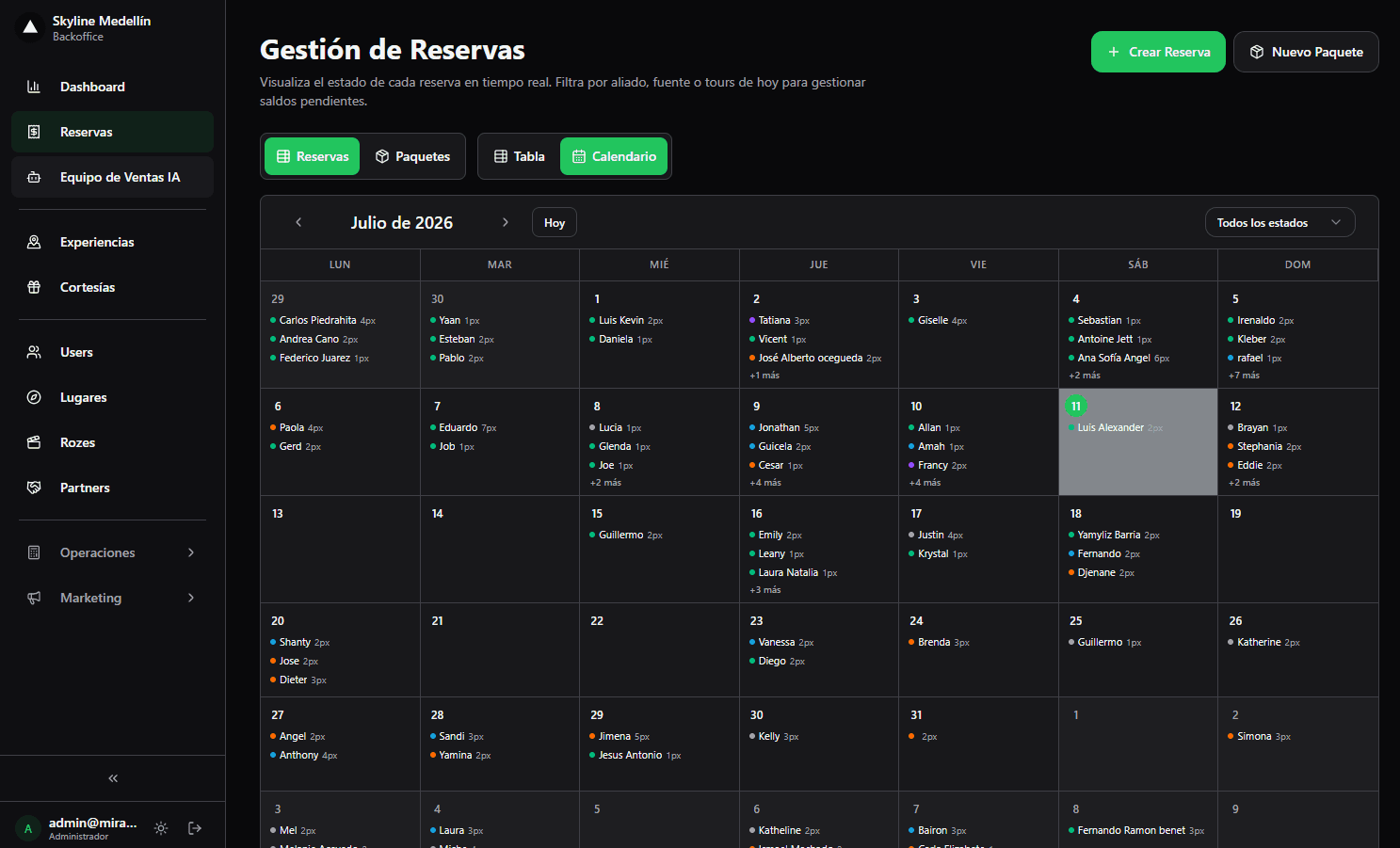
Related · Terra
How to Give Each Seller Their Own Sales URL
Each seller gets their own URL inside the same storefront and catalog as the operator.
ReadHow to Create a Booking by Pasting a WhatsApp Chat
You paste the customer's WhatsApp chat into Terra and the AI pre-fills name, date, people and experience.
ReadSoftware for a Coffee-Tour Operator with Transport Included
Terra charges transfers per vehicle, not per person, airport↔hotel.
Read