Terra · Skyline Blog
Run a Tour Company in High Season: Calendar to Settlement
Fabián Alvarez9 min read
TL;DR
- One calendar holds bookings, guides, departures, travelers and payments together.
- Automatic WhatsApp reminders prevent no-shows across multiple daily departures.
- Per-departure settlement builds each tour's cash drawer with AI, no manual typing.
- Operations accounting organizes accounts with guides, partners and the daily close.
- Online payments with a deposit option cut collection friction compared to manual transfers.
Running a tour company in high season requires one calendar with bookings, guides, departures and payments; automatic WhatsApp reminders; per-departure cash settlement reading the guide's report; and operations accounting with collaborator accounts and a daily close. Terra, Skyline's AI booking engine, brings all five steps into one place.
What does "running it well" mean in high season?
High season isn't just more bookings. It's more guides rotating, more departures on the same day, more money moving between cash, transfers and online payments, and more chances for something to slip through the cracks: a slot double-booked, a guide who never got the reminder, a cash drawer that doesn't add up at the end of the day.
An operator with five guides and three daily departures in December doesn't need more people to keep up the pace. They need the calendar, the guides, the availability, the reminders, the collection and the settlement of each departure to live in one place, without anyone having to cross-reference a spreadsheet against WhatsApp screenshots at eleven at night.
This guide walks through that full flow: from the moment a booking comes in to the moment you close the day's cash. At every step, you'll see how Terra, Skyline's AI booking engine, the Skyline product built for tour operators, solves it.
Why does high season break manual methods?
Because manual methods (a spreadsheet, a WhatsApp group, a cash notebook) work at low volume and collapse at high volume. With ten bookings a week, a spreadsheet holds up. With sixty bookings and eight different departures over a long weekend, every manual layer adds a chance for error: a miscopied date, a guide who missed the time change, a payment nobody recorded.
The problem isn't the team not working hard enough. It's that information lives scattered: bookings in one chat, guides in another, cash in a notebook, payments on someone's phone. When everything lives in different places, nobody has the full picture at the same time, and decisions (do we have room? who's going tomorrow? how much did this departure bring in?) get made with incomplete information.
The fix isn't working faster inside the same method. It's bringing bookings, guides, departures, travelers and payments together into a single operations calendar.
What does an operations calendar that actually works in high season look like?
A useful operations calendar shows, in one view, everything you need to decide without asking anyone else: what's going out today, who's leading it, how many spots are left and what's been collected.
Terra puts bookings, guides, departures, travelers and payments in a single operations calendar, with multi-user access so the whole team sees the same thing at the same time. That means if the person handling bookings by chat uses Terra, the person assigning guides also uses Terra, and the person closing the cash drawer at the end of the day also uses Terra, nobody is looking at a different version of reality.
What your calendar should answer at a glance
- What's going out today and at what time? Every departure of the day, without digging through separate chats.
- Who's leading each departure? The assigned guide, visible next to the departure, not on a separate list.
- How many spots are left? So you don't oversell or leave spots empty that could have been filled.
- What's been paid and what's still owed? Each traveler's payment status, without cross-checking another tool.
A kayak operator in Guatapé running three daily departures over a long weekend doesn't have time to build that picture by hand every morning. With Terra's calendar, that picture is already built before the first guide shows up.
How do you keep a guide from showing up without knowing they have a departure?
By automating the reminder, not relying on someone remembering to send it. Terra sends automatic WhatsApp reminders the day before and the day of the tour, along with confirmation templates via WhatsApp and email. This applies both to the traveler and to internal coordination: the departure gets confirmed without a team member having to message people one by one.
In low season, an operator can afford to confirm each departure manually because there are few of them. In high season, with multiple departures the same day and guides rotating between them, relying on the team's memory is the most common way for something to fail: a traveler who never confirmed, a guide who missed the meeting point change, a departure that starts without half the group.
Where the automatic reminder matters most
- The night before, when the traveler gets the reminder and confirms or cancels in time, not thirty minutes before departure.
- The morning of the tour, when the reminder works as a last filter before the guide heads out.
- In last-minute changes, when a confirmation template replaces the need to write the message from scratch every time.
An agency in Cartagena selling a sunset catamaran tour knows that the biggest source of no-shows is lack of confirmation, not lack of interest. The automatic reminder doesn't sell more: it keeps what's already sold from being lost to forgetfulness.
How do you close the cash drawer for each departure without fighting the guide's receipts?
With a per-departure settlement panel, not a notebook the guide hands over at the end of the day full of loose receipts. Terra has a per-departure settlement panel that builds each tour's cash drawer, generates automatic drafts, stores receipts and reads the guide's report with AI.
This flips the order of the work. Instead of the operator receiving the guide's report and having to type it manually into a spreadsheet to figure out what came in, what the guide spent and what's left, the draft is already built by the time the guide finishes reporting. The person in charge of the cash drawer reviews and adjusts, instead of building it from zero.
What goes into a departure settlement
| Element | What it solves |
|---|---|
| Departure cash drawer | How much came in from that specific departure, not the whole day |
| Automatic draft | The settlement builds itself from the report, no manual typing |
| Receipts | Stored alongside the settlement, not scattered across a chat |
| AI reading of the guide's report | The report the guide sends gets interpreted automatically, without anyone transcribing it |
An operator with three guides rotating across five daily departures in high season can't afford to wait until night to know whether a departure made or lost money. With per-departure settlement, that number exists as soon as the guide reports, not at month's end when it's too late to fix anything.
How do you manage money between guides, partners and the daily cash drawer?
With operations accounting that understands not all the money coming in is yours yet. Terra includes operations accounting: daily close, accounts with collaborators (advances, loans, bonuses), commissions and payments between partners.
This matters especially in high season because money moves faster and through more hands. A guide may receive an advance before a departure. A partner who brought the booking has a commission pending. Another guide has a loan being deducted from their next payment. If each of those movements lives in someone's memory or a different notebook, month-end close turns into a forensic reconstruction.
What an orderly daily close should show you
- How much came in today, adding up every departure and every payment channel.
- What you owe each collaborator, including pending advances, loans and bonuses.
- What commission each partner is owed, calculated on what was actually sold.
- What's left clean for the operator, after deducting all of the above.
An operator in San Andrés paying commission to three different partners for bookings that came through their links doesn't have to wait until month's end to know how much is owed to each one. The daily close already has it calculated.
How do you collect on each booking without chasing the traveler on WhatsApp?
With online payments built into the booking flow, not transfers that need to be confirmed by hand. Terra has online payments with its own checkout, with a 30% deposit option and the balance paid later. When the operator doesn't use online payments, the booking is confirmed via WhatsApp with the same link.
In high season, payment collection is where the most friction gets lost if it isn't solved upfront. A traveler who has to type "I already transferred, here's the receipt" and wait for someone on the team to confirm manually is a traveler who can change their mind in that dead time. The 30% deposit solves something specific: it lets the traveler confirm with a partial payment and pay the rest later, instead of demanding the full amount upfront and losing bookings to collection friction.
The two ways to collect payment in Terra
- Online payment with its own checkout: the traveler pays directly, with the option to leave only the 30% deposit and pay the balance later.
- WhatsApp confirmation: if the operator doesn't use online payments yet, the booking still gets confirmed via WhatsApp with the same link, with no separate extra step.
A food tour operator in Medellín starting the season with dozens of bookings has no margin to chase payment receipts one by one. The own checkout with a deposit option solves that collection in the moment the traveler is still committed to booking.
How does all of this connect into one flow?
Here's the full journey of a booking in high season, start to finish:
- The booking comes in and lands on the operations calendar, alongside guides, departures and travelers.
- The traveler pays online (with a 30% deposit if they choose) or confirms via WhatsApp with the same link.
- The automatic reminder goes out the night before and the day of the tour, via WhatsApp and email.
- The guide runs the departure and reports; the settlement panel builds that departure's draft with AI.
- Operations accounting adds that departure to the daily close, with commissions and collaborator accounts already calculated.
No step depends on someone remembering to copy something from one place to another. That's the real difference between surviving high season and running it with control.
Next step
If your operation still splits bookings, guides and cash between a chat, a spreadsheet and a notebook, the first move isn't to change everything at once: it's to bring the next full departure (booking, reminder, payment and settlement) into one calendar and see how much team time stops getting lost there.
Frequently asked questions
What happens if an operator doesn't use online payments during high season?
The booking still gets confirmed via WhatsApp with the same link that would otherwise be used to pay online. No separate process or extra tool is needed for that case.
How do I avoid two guides getting assigned to the same departure by mistake?
With bookings, guides and departures in a single multi-user calendar, the whole team sees the same assignment in real time, instead of relying on scattered messages that can go out of date.
Does per-departure settlement replace the full daily close?
No, they're complementary. The settlement panel builds the cash drawer for each individual departure with automatic drafts and AI reading of the guide's report; the daily close adds up all those departures together with commissions and collaborator accounts.
How often do reminders go out to travelers?
Automatic reminders go out the day before the tour and the day itself, via WhatsApp, plus confirmation templates also available by email.
What happens with guide advances or loans during high season?
They get recorded as collaborator accounts within operations accounting, alongside bonuses and commissions, so the daily close reflects what actually remains for the operator.
Terra
See Terra in action
The AI booking engine for tour operators: bookings, itineraries, packages and payments, operated by chat via MCP.
Request a Terra demo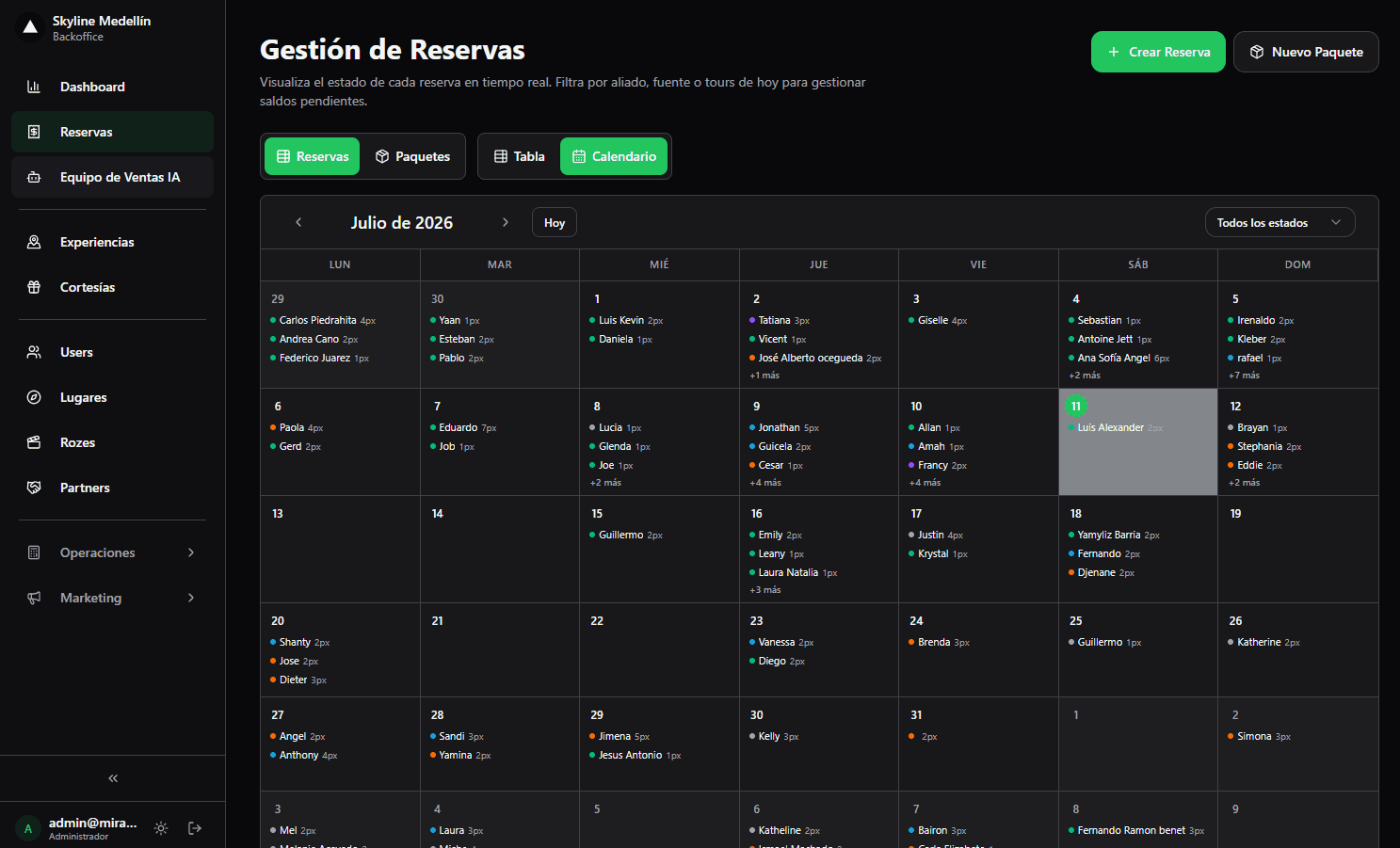
Related · Terra
Booking Software for a Paragliding Company with Limited Seats
Terra organizes bookings, pilots, departures and payments in a single multi-user operations calendar.
ReadPartial Payments and Chat Confirmation: Where Tour Payments Go
Inbound tourism buys in minutes, inside chat, not through web forms built for weeks-ahead planning.
ReadHow to Settle a Tour Departure Without Spreadsheets
Departure settlement is the cash close of a tour: income, guide expenses, commissions and what remains for the operator.
Read