Draco · Skyline Blog
Copilot to Autonomous in Draco: A Safe Step-by-Step Plan
Fabián Alvarez7 min read
TL;DR
- Draco starts in copilot mode: the AI drafts a reply and a person approves or corrects it before sending.
- The move to autonomous happens funnel by funnel, not all at once for the whole business.
- The first autonomous funnel should be low-risk and set to low intensity on Vega.
- Every correction the team makes trains the AI, so copilot time is never wasted.
- You can revert to copilot at any moment if corrections repeat or complaints show up.
Moving from copilot to autonomous in Draco is gradual: first approve and correct every reply, then enable autonomous on a single low-risk funnel with low intensity, adjust supervision hours, and only later raise intensity or add more funnels. Advance with few recent corrections; step back if errors repeat or complaints appear.
What does moving from copilot to autonomous mean in Draco?
Draco, Skyline's AI CRM, starts in copilot mode: the AI drafts a reply and a person on the team approves or corrects it before it reaches the customer. Moving to autonomous means that, for certain funnels and certain hours, the AI sends the reply without anyone reviewing it first. This isn't a single switch for the whole business — it's a decision made funnel by funnel, and it can be reversed at any time.
For an agency selling packages across multiple destinations, this matters because not all funnels carry the same weight. A lead asking about availability for an all-inclusive plan is not the same as one who already paid and needs the final itinerary. This guide's plan is built exactly for that: move fast where the risk is low, and stay in copilot where a bad reply costs a sale or, worse, a public complaint.
Why not jump straight to autonomous?
Because trust isn't declared, it's built with evidence. Draco learns from every correction: the Approve/Correct buttons feed the AI, so every time the team adjusts a reply, the system gets a little sharper for the next one. If you jump straight to autonomous without enough corrections logged for that funnel, you're asking the AI to answer on its own without ever showing it what your agency expects.
On top of that, Draco lets you set up multiple funnels per business, each with its own knowledge, mission and buyer persona; the AI answers according to the funnel the conversation is in. That means "autonomous" isn't a property of the whole CRM — it's a property of each funnel separately. A general-inquiries funnel can run autonomous while the complaints or corporate-quotes funnel stays in copilot indefinitely, if that's the agency's call.
The stages: from full copilot to autonomous by funnel
Stage 1: full copilot, every funnel
When you activate Draco, everything goes through human review. At this stage the goal isn't speed, it's training. The team approves what's right and corrects what isn't, and every correction gets logged. An agency with three advisors can split up funnels: one reviews "first contact," another "quote," another "after-sale." The key is not to release anything yet, not even the funnel that looks the simplest.
Suggested duration: until the team notices the AI's drafts barely need correction in one specific funnel — not across all of them at once.
Stage 2: autonomous in a single funnel, low intensity
The first candidate for autonomous should be the lowest-risk funnel: usually first contact or frequently asked questions, where an imperfect reply doesn't make or break a sale. This is where intensity settings come in: Vega's intensity (low, medium, high) and Leo's (soft, medium, hard) are set per funnel, with a hard cap of messages per reply and a fixed stance of never chasing the customer.
For this first autonomous funnel, the recommendation is to start at low intensity. That limits how many messages the AI sends per reply and stops it from pushing more than necessary. It's the most conservative version of autonomous: it replies, but it doesn't push.
An example: an agency selling day tours to a nearby lake activates autonomous only on the "availability inquiries" funnel, with low intensity on Vega. The team still sees every conversation, but no longer has to approve each message before it goes out.
Stage 3: adjust supervision hours
With one funnel running autonomous, the next step isn't to release more funnels right away. It's to observe which hours have high volume with the human team available to review closely, and which hours the AI is on its own. Many agencies concentrate active review during office hours and let the AI work autonomously at night and on weekends, when no one would be replying live anyway. This doesn't change the funnel or the intensity setting — it's an operational call about when the team watches closely and when it trusts what's already been tested.
Stage 4: raise intensity, then add a second funnel
Only after several cycles without surprises in the first autonomous funnel does it make sense to raise Vega's intensity to medium, and consider adding a second funnel to autonomous. Order matters: first raise intensity on the funnel you already know, then expand to a new one. Changing two variables at once (more funnels and more intensity) makes it harder to know what caused a problem if one appears.
Stage 5: sensitive funnels, the last frontier
Funnels for large quotes, corporate groups or complaints are the last ones to go autonomous, if they ever do. Nothing forces an agency to release every funnel. It's perfectly reasonable to operate permanently with some funnels autonomous and others in copilot, depending on the risk of each type of conversation.
Summary table: what to check at each stage
| Stage | Funnels autonomous | Vega/Leo intensity | What the team watches |
|---|---|---|---|
| 1. Full copilot | None | Not applicable | Every reply before sending |
| 2. First autonomous | One (low-risk) | Low / soft | All conversations in that funnel |
| 3. Hours | One | Low / soft | Only outside office hours |
| 4. Expansion | One or two | Medium | New conversations and prior corrections |
| 5. Sensitive funnels | Case by case | Depends on the funnel | Large quotes and complaints, always |
What signals say it's time to move forward?
- Few recent corrections: if in the last few cycles the team rarely uses the Correct button in that funnel, the AI is already calibrated for that type of conversation.
- Replies consistent with the brand: the drafts sound like your agency, not generic.
- No customer complaints tied to that funnel: no one has said a reply felt confusing or pushy.
- The team has spare review time: if approving became a mechanical step with nothing to correct, that's a sign supervision no longer adds value at that point.
What signals say it's time to step back?
- Corrections that repeat: if the team fixes the same type of mistake several times in an autonomous funnel, it's time to return that funnel to copilot and let corrections keep training the AI.
- A customer complains about feeling pressured: check Leo's intensity; it may be set to medium or hard when it should be soft.
- Changes to the catalog or pricing: if you launch a new promotion or change a package, go back to copilot in the affected funnels until you confirm the AI answers correctly with the updated information.
- Unusual volume spikes: high season with different-than-usual leads is a good moment to watch closely again, even if only temporarily.
Draco lets you revert at any time with no penalty and no lengthy process: stepping back isn't a failure, it's a normal part of operating with AI.
Frequently asked questions about moving from copilot to autonomous
Can some funnels be autonomous while others stay in copilot at the same time? Yes. Each funnel has its own intensity and mode configuration, so an agency can leave the general-inquiries funnel autonomous while keeping the corporate-quotes funnel in copilot indefinitely.
How long does it take to move from copilot to autonomous? There's no fixed timeline: it depends on how many corrections each funnel needs before the team notices the AI already answers well without help. Some simple funnels move fast, more complex ones take longer.
What happens if I raise intensity and it doesn't work well? You can lower it again at any time; Vega and Leo's intensity settings are adjusted per funnel and have no lock-in or complicated reversal process.
Does the AI keep learning even after a funnel is fully autonomous? Learning comes from the corrections the team makes when reviewing conversations; if a funnel is fully autonomous and no one corrects anything, that funnel stops generating new corrections until someone looks at it closely again.
Does this plan work for a small agency with a single advisor? Yes, the same order of stages applies regardless of team size; with a single advisor it may take longer to review each funnel, but the logic of advancing by evidence, not by calendar, is the same.
What to do now
Before touching any intensity setting, open your funnels in Draco and confirm which one, today, gets the fewest corrections from the team: that's your candidate for the first step to autonomous. If you want to understand how the rest of the CRM works before taking that leap, check out AI CRM for Travel Agencies and Tour Operators.
More about Draco: draco.skyln.co
Frequently asked questions
Can some funnels be autonomous while others stay in copilot at the same time?
Yes. Each funnel has its own intensity and mode configuration, so an agency can leave the general-inquiries funnel autonomous while keeping the corporate-quotes funnel in copilot indefinitely.
How long does it take to move from copilot to autonomous?
There's no fixed timeline: it depends on how many corrections each funnel needs before the team notices the AI already answers well without help. Some simple funnels move fast, more complex ones take longer.
What happens if I raise intensity and it doesn't work well?
You can lower it again at any time; Vega and Leo's intensity settings are adjusted per funnel and have no lock-in or complicated reversal process.
Does the AI keep learning even after a funnel is fully autonomous?
Learning comes from the corrections the team makes when reviewing conversations; if a funnel is fully autonomous and no one corrects anything, that funnel stops generating new corrections until someone looks at it closely again.
Does this plan work for a small agency with a single advisor?
Yes, the same order of stages applies regardless of team size; with a single advisor it may take longer to review each funnel, but the logic of advancing by evidence, not by calendar, is the same.
Draco
See Draco in action
The AI CRM for agencies and tour operators: WhatsApp, Instagram, Messenger and TikTok in one inbox, handled by five AI agents.
Try Draco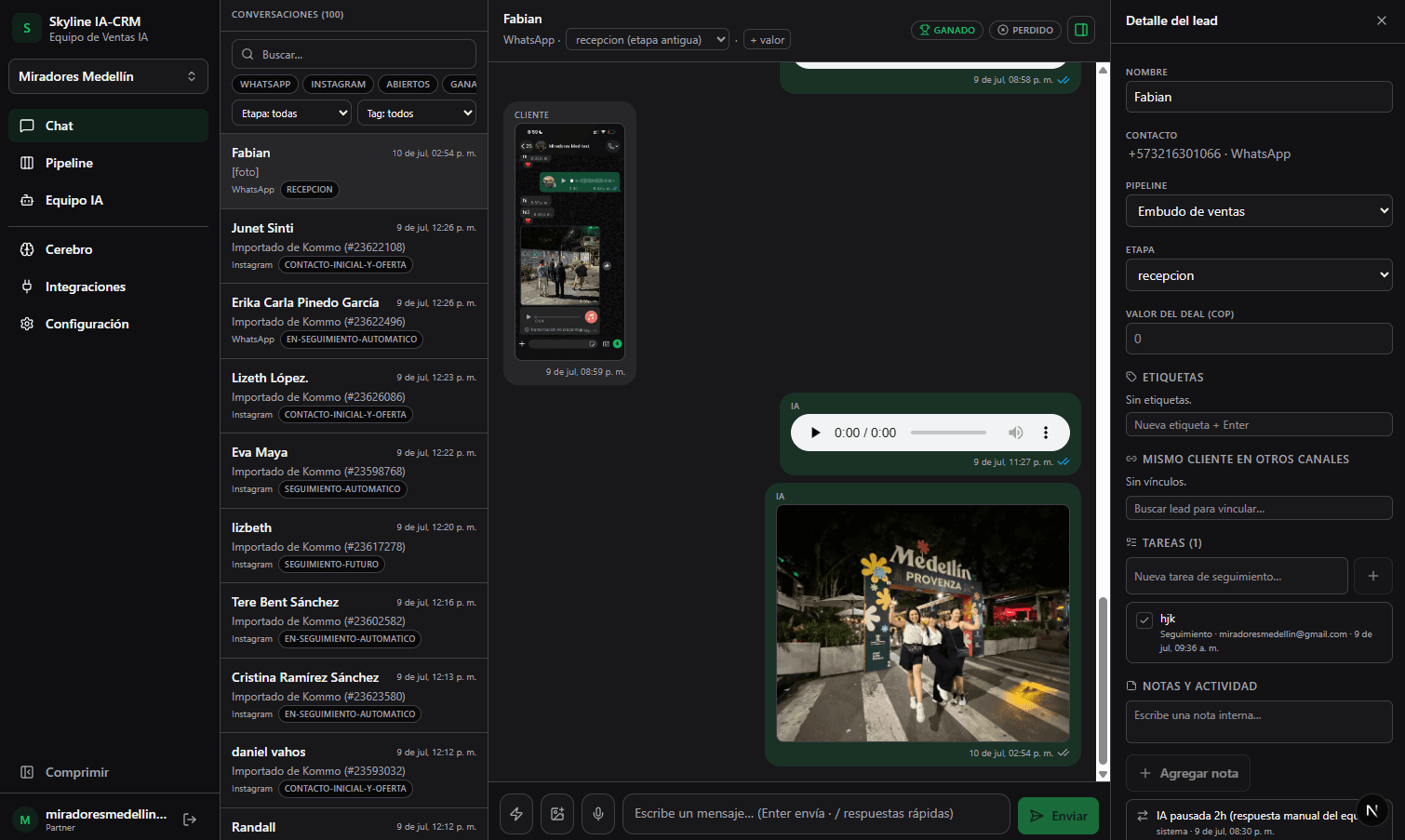
Related · Draco
CRM for a Small Travel Agency With Reps and Chats
Rep chats scattered across different phones get lost, and night replies come too late.
ReadWhat Is Lead Scoring and How It Works With AI
Lead scoring means giving each conversation a temperature (cold, warm, hot) based on how close it is to buying.
ReadGeneric CRM vs AI CRM for Tourism: The Differences
A generic CRM doesn't know your catalog; an AI CRM for tourism quotes with real prices and availability.
Read