Draco · Skyline Blog
Generic CRM vs AI CRM for Tourism: The Differences
Fabián Alvarez5 min read
TL;DR
- A generic CRM doesn't know your catalog; an AI CRM for tourism quotes with real prices and availability.
- A unified inbox across channels stops you from chasing leads on multiple screens.
- Charging inside the chat cuts the friction between quoting and confirming a booking.
- The AI's warm, short tone matters as much as the automation itself.
- For simple catalogs and low volume, a generic CRM can be enough.
A generic CRM organizes contacts without knowing your catalog; an AI CRM for tourism, like Draco, quotes with real prices and availability, unifies WhatsApp, Instagram, Messenger and TikTok in one inbox, charges inside the chat and replies with a warm brand tone. The difference shows once your catalog changes often or channels multiply.
What's the difference between a generic CRM and an AI CRM for tourism?
A generic CRM organizes contacts, stages and reminders: it works for almost any business because it knows nothing about your catalog. An AI CRM for tourism, on the other hand, knows your agency's real experiences, prices and availability, and answers with that information without anyone having to copy and paste availability by hand.
Draco, Skyline's AI CRM, is an example of this second category. It's connected to the real Skyline Partner catalog, so the AI only recommends experiences that exist, with real prices and availability. A generic CRM doesn't have that link: someone on your team has to check a spreadsheet or the operator's system to confirm availability before replying.
That difference looks small until the agency grows. Picture an agency in Cartagena selling boat trips, city tours and an island excursion. With a generic CRM, every time a lead comes in through Instagram, an advisor has to open another tab, check the operator's calendar and go back to the chat to type in the price. With an AI CRM for tourism connected to the catalog, the reply with price and availability comes out on its own.
Why does having every channel in one place matter?
Because an agency's leads don't arrive through a single channel, and chasing them across several screens costs time and leads. Draco has a unified inbox for WhatsApp, Instagram, Messenger and TikTok, and email also comes in as a channel. A generic CRM almost always needs external integrations, third-party connectors or checking each network separately to achieve something similar.
For an agency with two or three advisors, keeping four or five tabs open all day isn't just uncomfortable: it's the reason a TikTok lead gets answered twelve hours late and ends up booking somewhere else. When the inbox is unified, it doesn't matter whether the traveler wrote on Instagram at 11pm or on WhatsApp the next day: everything lands in the same place, with the same history.
This connects to a point we cover in depth in AI CRM for Travel Agencies and Tour Operators: a unified inbox isn't a cosmetic luxury, it's the foundation for any sales automation to work well.
Can a generic CRM charge inside the chat?
Generally not natively, or it requires additional integrations to generate a payment link and confirm the booking without leaving the conversation. Draco charges inside the chat with a payment link, or confirms via WhatsApp if the business doesn't use online payments. That means a traveler can go from asking about a tour to having a confirmed booking without the advisor opening a third tool.
For an agency selling several packages a day, this difference shows up in the friction of every sale. A generic CRM might remind you that "the payment link needs to be sent," but someone still has to generate it in another system, copy it and paste it. An AI CRM for tourism with this capability removes those manual steps, which are exactly where sales get lost to delay or human error.
Does the AI's tone feel robotic?
It depends on the system, but it's a real risk with poorly configured generic automations: long messages, rigid templates or replies that break the natural rhythm of a sales conversation. Draco replies with short, warm messages in the brand's tone, with no robotic paragraphs.
This matters especially in tourism, where the buying decision runs through trust. A human advisor doesn't write a formal paragraph to someone asking "do you have room on Saturday?"; they answer fast, short, with the warmth of someone who already knows the destination. A typical rule-based chatbot can't hit that nuance: it follows fixed scripts and gets stuck the moment a lead strays from them. A well-trained AI CRM for tourism, tuned to the brand's voice, keeps that naturalness even when the conversation drifts from the expected script.
When is a generic CRM enough?
Not every agency needs an AI CRM for tourism from day one. If your operation is small, you sell one or two fixed products and lead volume is low, a well-organized generic CRM can be enough to keep track of contacts and reminders.
The table below sums up where each category makes sense:
| Agency situation | Generic CRM | AI CRM for tourism |
|---|---|---|
| Few leads per month, fixed and simple catalog | Enough | May be more than needed |
| Several active channels (WhatsApp, Instagram, TikTok) | Needs integrations or manual checks per channel | Unified inbox by default |
| Catalog with prices and availability that change often | Risk of misquoting if not updated by hand | Connected to the real catalog, no made-up prices |
| Closing the sale without leaving the chat | Usually needs another tool for payment | Charges with a payment link inside the chat |
| High volume with a small team | Bottlenecks at peak hours | Helps sustain response speed |
An agency with a single destination and few packages can run well on a spreadsheet and a generic CRM for a while. The breaking point usually comes when the catalog grows, channels multiply or lead volume outgrows what a small team can handle by hand without response quality dropping.
What should you ask before choosing one or the other?
Before deciding, it's worth asking three concrete questions:
- Does my catalog change often? If prices, availability or dates change frequently, a system connected to the real catalog avoids outdated quotes.
- How many channels do my leads come from? If it's more than two, a unified inbox saves real time for your team.
- Do I want to close sales without leaving the chat? If yes, you need payments built into the conversation, not in a separate tool.
An agency that answers yes to all three is usually ready to move from a generic CRM to an AI CRM for tourism. If it answers no to all of them, it probably has time before needing that change, and it's worth saying so honestly.
If your agency already feels the bottleneck at one of these points, the next step is reviewing in detail how the unified inbox and the connected catalog work in Draco's documentation.
Frequently asked questions
Can a generic CRM connect to a tour catalog?
Almost always it needs extra integrations or manual updates, since it wasn't built for experience inventories with changing availability and dates. An AI CRM for tourism like Draco already comes connected to the real Skyline Partner catalog.
Is an AI CRM for tourism more expensive than a generic one?
It depends on the provider and how many conversations your agency handles. What matters is comparing how much team time you save quoting, unifying channels and closing payments, not just the subscription price.
Does Draco replace my team of advisors?
No. Draco starts in copilot mode, where the AI proposes and a person approves or corrects, moving to autonomous only when the team trusts the answers.
What if my agency only uses WhatsApp?
If all your leads arrive through a single channel and your catalog is simple, a well-organized generic CRM can be enough for now. Moving to an AI CRM for tourism makes more sense once channels multiply or the catalog becomes dynamic.
Can the AI's tone match my brand's voice?
Yes, Draco replies with short, warm messages aligned to the brand's tone, avoiding robotic paragraphs that tend to push leads away mid-conversation.
Draco
See Draco in action
The AI CRM for agencies and tour operators: WhatsApp, Instagram, Messenger and TikTok in one inbox, handled by five AI agents.
Try Draco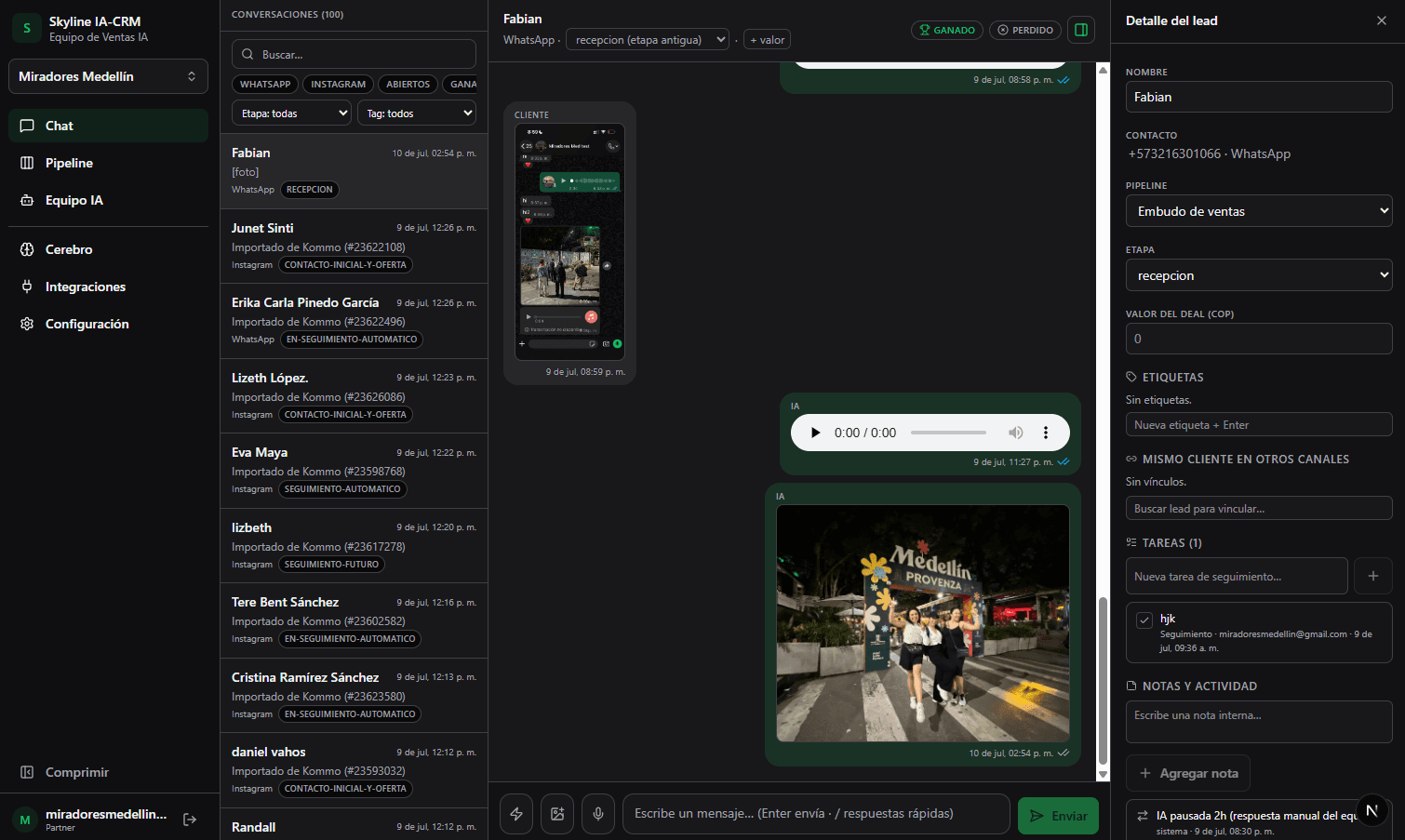
Related · Draco
How to Set Up a Team of AI Agents for Your Agency
Draco has five AI agents with fixed roles: Vega, Kai, Axel, Leo and Iris.
ReadCan My WhatsApp Get Banned If an AI Replies?
The ban risk depends on how the AI connects to WhatsApp, not on whether an AI replies at all.
ReadWhat Is an AI CRM? Definition and the Real Difference
An AI CRM executes complete funnel tasks, not just suggests replies for a human to copy.
Read