Luxor · Skyline Blog
How to Build an Affiliate Network to Sell Tours: Full Guide
Fabián Alvarez9 min read
TL;DR
- An affiliate network for tours pays a commission to whoever recommends from their own channel, without you having to sell it yourself.
- The best partners are receptionists, drivers, hosts, creators and agencies with real contact with travelers.
- An ambassador can invite other partners from their console and have sellers with their own URL under their account.
- Every booking or redemption is attributed to its origin, and commissions are computed automatically.
- A partner earns a commission per booking and also on spending when a traveler redeems a courtesy at a partner venue.
To build an affiliate network for tours, invite people with real contact with travelers (receptionists, drivers, hosts, creators, agencies) from your Luxor console, give them their own page and link or QR, and let the system attribute every booking or redemption to its origin to compute the commission automatically.
What is an affiliate network for selling tours?
An affiliate network for selling tours is a group of people and businesses who recommend your experiences from their own channel, in exchange for a commission on every booking or redemption they originate. In Skyline, the tourism software ecosystem, that network is built with Luxor, Skyline's ambassador program: each partner gets their own page, a link or QR, and earns a commission automatically when someone books or redeems thanks to their recommendation.
If you run tours, hotels, restaurants, or work as an agency, this guide walks you through it step by step: who to invite, who not to invite, how to send the invitation from the console, what it means to have sellers with their own URL, and how commissions get calculated and paid without you having to chase anyone with a spreadsheet.
Why does an agency or reseller need an affiliate network?
If you resell third-party experiences or build packages for other operators, your business depends on more people recommending what you sell without you having to be behind every conversation. An affiliate network solves exactly that: it multiplies your points of sale without multiplying your payroll.
Think of an agency in Cartagena that builds packages with three local operators. Without an affiliate network, its only channel is its own sales team. With a network, it can add receptionists at partner hotels, drivers who move tourists every day, and content creators who already talk to their audience about what to do in the city. Each of them sells from their own page, with their own link, and the agency just checks the panel to see what came in.
The difference with a generic affiliate program is that here attribution, catalog and commissions live in the same system you use to operate, not in a separate spreadsheet that someone has to update by hand.
Who should you invite to your affiliate network?
Not everyone with contacts is a good ambassador. It's worth inviting people who have recurring contact with travelers at the moment they decide what to do. These are the profiles that work best:
- Hotel or Airbnb receptionists and staff: they talk to the guest right when they are planning their day, and the recommendation lands at the moment of highest purchase intent.
- Drivers and transport operators: they spend hours with the traveler on the ride from the airport to the hotel or between destinations, a natural space to suggest an experience.
- Hosts of accommodations: they already build trust because the traveler depends on them to resolve trip questions. Valentina Calle, an Airbnb host in Medellín, is a real example of an ambassador who runs her own recommendations page.
- Local content creators: they have an audience that already searches for what to do in the city, and can combine content with their sales link.
- Smaller agencies and operators: they can resell your catalog alongside their own without you having to negotiate a separate contract with each one.
The common criterion: all of them have their own channel and a genuine reason for the traveler to listen to them. That's what makes the recommendation convert, not just exist.
Who should you NOT invite?
Just as important as knowing who to add is knowing who not to. Avoid building your network with:
- People with no channel or real contact with travelers, who just want a link to share in mass groups without context.
- Profiles that promise high volume without being able to explain where that traffic would come from.
- Any attempt to inflate the network with fake accounts or bots: attribution turns into noise and you lose visibility into which partner is actually bringing people.
A smaller network with real partners who have genuine contact with travelers performs better than a large network full of links nobody uses. The goal isn't to add names, it's to add channels that are actually talking to people who are about to decide what to do.
How do you invite partners from the console?
Once you've identified the right profiles, inviting them is a simple operational step: you can invite other partners to the network from your console, without going through external forms or manual processes.
Step by step to invite a new partner
- Log into your Luxor console with your ambassador or operator account.
- Look for the option to invite partners.
- Send the invitation to the person or business you want to add.
- The invitee activates their role and their own page is ready in minutes, free to start.
- From that moment, any booking or redemption that comes from their link is automatically attributed to their name.
A kayak operator in Guatapé, for example, can invite the owner of the guesthouse where their customers stay. The owner activates their role, gets their link, and from there every guest who books the kayak tour from that link is recorded as a booking attributed to the guesthouse.
What does it mean to have "sellers with their own URL"?
Here's one of the points that confuses people most when building a network for the first time: an ambassador doesn't have to sell alone. An ambassador can have sellers with their own URL under their account, which lets them scale their own internal network without losing control over what comes into their account.
This is especially useful for agencies and resellers who already have a sales team or a network of informal collaborators. Instead of everyone sharing the same generic link (which makes it impossible to know who sold what), each seller has their own URL inside the main ambassador's account.
A concrete example
Imagine an agency in Medellín that operates as a Luxor ambassador and has three freelance sellers promoting tours in different neighborhoods of the city. Each seller gets their own URL. When one of them closes a sale, the booking is attributed to their specific URL, not to the agency's generic account. That way, the agency can see exactly which seller is generating bookings and which isn't, without having to ask each one individually.
This structure solves a classic problem of generic affiliate programs: the lack of traceability when there are several layers of people selling the same thing. With a dedicated URL per seller, each layer stays identified.
How is a sale attributed to a partner?
Attribution is the heart of any affiliate network: if you don't know with certainty who originated a sale, you can't pay the right commission or trust the numbers. In the Skyline ecosystem, every booking and redemption is attributed to its origin, whether it's a link, a QR, a partner or a specific channel, and commissions are computed automatically from that attribution.
This means you don't need a manual process to "check who brought whom." The system records the origin of each sale as it happens, and that data is available both to the partner (who sees their own sales in their panel) and to you (who see the full picture of the network).
How attribution works via link or QR
Each ambassador shares their recommendation via link or QR, and physical QRs track scans. This matters for partners who don't operate only digitally: a driver can have a printed QR in the vehicle, a receptionist can have one at the front desk, and the system still knows how many times it was scanned and what resulted from it.
The combination of digital link and physical QR covers the two most common scenarios in tourism: the recommendation that happens through a chat or social network, and the recommendation that happens through an in-person contact.
How is a partner's commission calculated and paid?
This is where many generic affiliate networks fail: they calculate the commission fine, but the payout becomes a manual, slow, error-prone process. In Luxor, the commission is calculated automatically, and there are two ways a partner can earn.
Commission per booking
The partner earns a commission on every booking that comes from their link, and the booking is recorded under their name. This applies when the ambassador recommends a tour experience, a transfer, or any product from the network's catalog, and the traveler completes the booking.
Commission on spending at partner venues
The partner also earns on spending at partner restaurants and venues when the traveler redeems a courtesy the ambassador recommended. This opens a second income stream that doesn't depend on selling a full tour: it's enough for the ambassador to recommend, say, a courtesy at a rooftop, and for the traveler to redeem it.
Comparison table of the two commission types
| Commission type | What triggers it | What the partner sees |
|---|---|---|
| Per booking | The traveler books an experience from the ambassador's link | The booking recorded under their name in their panel |
| On spending | The traveler redeems a courtesy the ambassador recommended at a partner venue | The redemption and corresponding commission reflected in their panel |
Both commission types show up in the same ambassador panel, letting them see at a glance how much each type of recommendation is generating without cross-checking different reports.
How does an affiliate network integrate with the rest of the ecosystem?
An affiliate network doesn't live in isolation: in Skyline, the tourism software ecosystem, Luxor shares the same partner network used by Terra, Skyline's AI booking engine, and Vórax, Skyline's tool for venues. This means the ambassadors you recruit to sell tours are, in many cases, the same channels that can recommend restaurant courtesies or bring traffic to an operator using Terra.
For a reseller, this has a practical implication: you're not building a network from scratch every time you add a new product or category. The partner network, attribution and commissions live on the same infrastructure, so the work of recruiting and onboarding partners pays off across every front where you operate.
What mistakes should you avoid when building your affiliate network?
Having seen how the system works, it's worth naming the most common mistakes when building it:
- Inviting for volume instead of relevance. A partner with no real contact with travelers doesn't convert, no matter how many followers they have.
- Not checking the panel regularly. Attribution is automatic, but tracking which partners perform and which don't is still your job.
- Treating every partner the same. A driver and an agency have different dynamics; adjust your communication depending on the type of partner.
- Forgetting the venue side. If you only think about selling tours, you leave the commission on spending at partner restaurants and rooftops on the table, which is an extra income stream for your ambassadors and one more incentive for them to stay active.
What to do now
If you already have a tour operation or a catalog to resell, the first concrete step is to activate your ambassador role on Luxor and generate your own link or QR. From there, identify two or three partners with the right profile (a receptionist, a driver, a local creator) and invite them from your console to start seeing real attribution in your panel.
Frequently asked questions
How much does it cost to join as an ambassador in a tour affiliate network?
On Luxor, the ambassador role is free and your own link or QR is ready in minutes. There is no upfront investment to start recommending experiences and earning a commission.
Can I have my own team of sellers inside my ambassador account?
Yes. An ambassador can have sellers with their own URL under their account, which lets them scale without losing traceability of who sold what.
How do I know who originated a booking if several partners share the same catalog?
Every booking and redemption is attributed to its origin, whether it's a link, QR, partner or channel, and commissions are computed automatically from that data.
Does a partner only earn a commission if they sell a full tour?
No. They also earn on spending at partner restaurants and venues when a traveler redeems a courtesy the ambassador recommended, in addition to the per-booking commission.
Can physical QR codes also be tracked?
Yes, physical QRs track scans, so a driver or receptionist who shares a printed QR also shows up in the system's attribution.
Luxor
See Luxor in action
The ambassador program: hosts, guides and creators earn commission for recommending experiences from their own page.
Get started with Luxor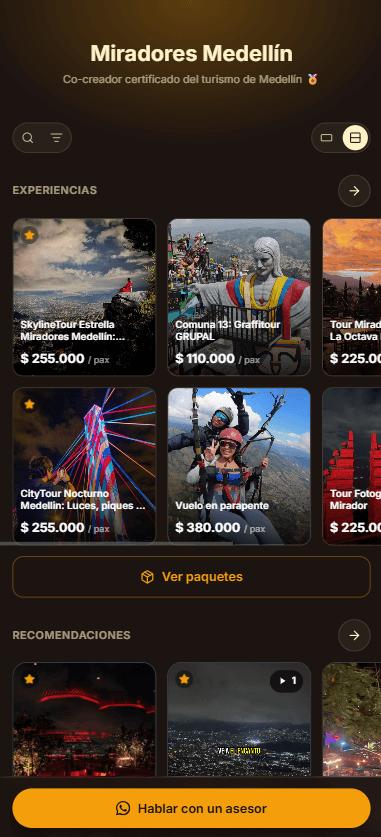
Related · Luxor
Build a Reseller Agency Page in Luxor with Several Operators
Luxor gives every ambassador their own page with verified experiences from the whole network.
ReadHow a Boutique Hotel Turns Its Front Desk Into Sellers
Each front-desk person can have their own sales link under the hotel's root account.
ReadWhich Experiences to Show Each Type of Guest
Your ambassador page can be reordered and have highlights adjusted based on who's arriving: couple, family, business or group.
Read