Vórax · Skyline Blog
How to Set the Commission You Pay Your Referral Partners
Fabián Alvarez7 min read
TL;DR
- The venue sets the commission, not a fixed rate imposed from outside.
- Three criteria support it: average ticket, margin and frequency.
- Every redemption is attributed to the partner who originated it, with a ranking by people and spending.
- Settlement is generated automatically: a chat-ready statement and payment history, no spreadsheets.
Set your commission by crossing your average ticket, your real margin and the expected frequency of referrals. In Vórax the venue fixes that commission, every redemption is attributed to whoever brought it with a partner ranking by people and spending, and settlement is generated without spreadsheets, ready to send over chat with payment history.
Why is setting the commission the most important decision in your referral program?
A restaurant that starts working with partners — guides, ambassadors, local creators — eventually runs into the same question: how much do you pay for each customer they bring you? Set it too low and nobody bothers to recommend you. Set it too high and every new table gets expensive. The good news is this isn't a blind guess: there are three numbers from your own business that, combined, give you a defensible commission.
With Vórax, Skyline's tool for venues, that calculation doesn't live in a separate spreadsheet. Vórax brings new customers to restaurants, rooftops and clubs: you publish a courtesy, the partner network and local creators recommend it, and you only pay per verified redemption. And within that logic, the venue sets the commission it pays whoever brings customers, not a fixed rate imposed from outside.
This guide is for the owner or manager of a restaurant that already has (or is about to launch) a courtesy program with partners, and wants to set a commission with criteria, not by instinct.
What does it mean that "you set the commission" in Vórax?
In Vórax, the venue sets the commission it pays whoever brings it customers. This is different from a generic affiliate program where the platform fixes a single percentage for every business. Here, a restaurant in one neighborhood can pay a different commission than a rooftop in another, because each one knows its own margin and its own average ticket.
This also means the commission doesn't have to stay the same forever. You can adjust it by season, by courtesy type, or by the volume of people coming your way. What matters is that you decide it, using your own numbers as the base.
What three criteria should you use to calculate the commission?
Before landing on a number, it's worth looking at three variables in your business. These aren't magic formulas — they're the same questions any restaurant owner already asks when calculating profitability.
1. Average ticket
How much does a person or group that comes in through a courtesy spend on average? A "free drink" courtesy that draws someone who then orders a main course is not the same as a "free entry" courtesy at an event where the extra spending is more uncertain. Estimating the average ticket of a redemption gives you the ceiling of what you can pay in commission without losing money on that table.
Example: a restaurant in a nightlife district calculates that each group coming in through a courtesy leaves a certain average spend on food and drinks. That number is the starting point for everything else.
2. Margin
The average ticket isn't what ends up in your pocket. You have to subtract the cost of ingredients, staff and other operating expenses to know the real margin on that sale. A commission paid on the gross ticket may look reasonable, but if your margin is tight, that same commission can eat up a large part of the profit. Knowing your margin tells you how much you can give up without the redemption turning negative.
3. Frequency
How many times per week or month do you expect a partner to bring you people? A more generous commission makes sense if the volume is low and you want to encourage more activity. If you already have a steady flow of referrals, you can set the commission at a more conservative level, because the partner already has a clear reason to keep recommending you: it's working for them.
Crossing these three criteria — average ticket, margin, frequency — gets you to a number that doesn't depend on what's "standard" at another business, but on what your restaurant can actually sustain.
How do you configure the commission step by step?
Step 1: Define your courtesy
Before thinking about commission, decide what you're going to offer: a drink, an entry, a discount. The courtesy is the hook that the partner network and local creators will recommend.
Step 2: Calculate your number using the three criteria
With average ticket, margin and frequency on the table, define what percentage or fixed amount you're willing to pay per verified redemption. This is the number you'll load into your Vórax setup.
Step 3: Enter the commission in your panel
The venue sets the commission it pays whoever brings it customers directly from its account. There's no need to negotiate with each partner separately or send a rate over chat: the number gets configured once and applies consistently to every referral.
Step 4: Let attribution do its job
Each referral shows who sent it, with a partner ranking by people and spending. This means you don't have to manually track who brought whom: the system already knows which partner originated each redemption, and that's what makes it possible to pay commission with confidence.
Step 5: Review the ranking and adjust if needed
Over time you'll see which partners bring more people, which bring higher spending, and which barely generate any movement. That ranking is information you can use to adjust your commission: maybe it's worth raising it for the partners who contribute the most, or reviewing the courtesy if almost nobody is redeeming it.
How do you settle the commission with partners?
One of the most common pain points for a restaurant working with several guides, ambassadors or creators is closing accounts at the end of the month: adding up redemptions, calculating commissions, sending the breakdown over chat, and hoping nobody flags an error. Vórax solves this with settlement with partners without spreadsheets: a chat-ready statement and a payment history.
This means you don't need to build a separate spreadsheet to figure out how much you owe each partner. The system already has the record of every redemption, attributed to whoever originated it, and from there it generates the statement ready to share. The payment history also comes in handy for settling any doubts without digging through old messages.
Example: a rooftop in a downtown area works with five different partners between guides and creators. Instead of building five manual statements every month, it reviews the panel, confirms each partner's redemptions, and sends the automatically generated statement.
What does the partner ranking look like in practice?
The partner ranking by people and spending isn't just a vanity number. It's the tool that tells you, with real data, which of your partners is working and which isn't. One partner might bring few people but high spending (for example, large groups that order a lot), while another might bring more people but a lower ticket. Both data points matter when deciding whether to adjust the commission.
The table below summarizes how the three commission criteria connect to what you see in the ranking:
| Criterion | What it measures | What the ranking tells you |
|---|---|---|
| Average ticket | How much a redemption leaves on average | Which partners bring higher spending |
| Margin | How much you keep after costs | Whether the commission remains sustainable per partner |
| Frequency | How many redemptions a partner brings over time | Which partners are more consistent |
With this reading you can make specific decisions: raise the commission for a high-ticket partner to retain them, or review the courtesy if a partner brings a lot of people but low spending.
What mistakes should you avoid when setting the commission?
- Copying another business's percentage without looking at your own margin. What works for a rooftop with a high ticket may not work for a lunch-focused restaurant.
- Setting the commission once and never revisiting it. The partner ranking exists exactly for that: adjusting with data, not setting it once and forgetting about it.
- Not distinguishing between volume and quality of redemption. A partner who brings few redemptions but high spending can be worth more than one who brings many low-ticket ones.
- Running settlement in parallel, outside the system. If you stop using the automatically generated statement and recorded commissions, you lose the history that helps you resolve doubts or disputes.
What to do next
If you already have an average ticket and a margin figured out in your head, the next step is to log into your Vórax account, set up your first courtesy, and define the commission using those numbers as the base.
Frequently asked questions
Can I change the commission after setting it up?
Yes. Since the venue sets the commission it pays whoever brings it customers, you can adjust it anytime based on what you see in the partner ranking or your real margin.
Do I need a different commission for each type of partner?
It's not mandatory, but it's common to do over time. Reviewing the partner ranking by people and spending lets you decide if some partners deserve a different commission based on what they contribute.
How do I know who originated each redemption if I have several partners working at once?
Each referral shows who sent it, so there's no ambiguity about which partner the commission for each redemption belongs to, even with several partners active at the same time.
Do I have to build the statement myself for each partner?
No. Settlement with partners is done without spreadsheets: the system generates a chat-ready statement together with payment history, so you don't have to build it from scratch every month.
What happens if a partner brings a lot of customers but with low spending?
That's exactly what the partner ranking by people and spending lets you see, so you can decide whether to adjust that partner's commission or rethink the type of courtesy you're offering them.
Vórax
See Vórax in action
New customers for restaurants, rooftops and clubs: verified-redemption perks recommended by the partner network.
Get started with Vórax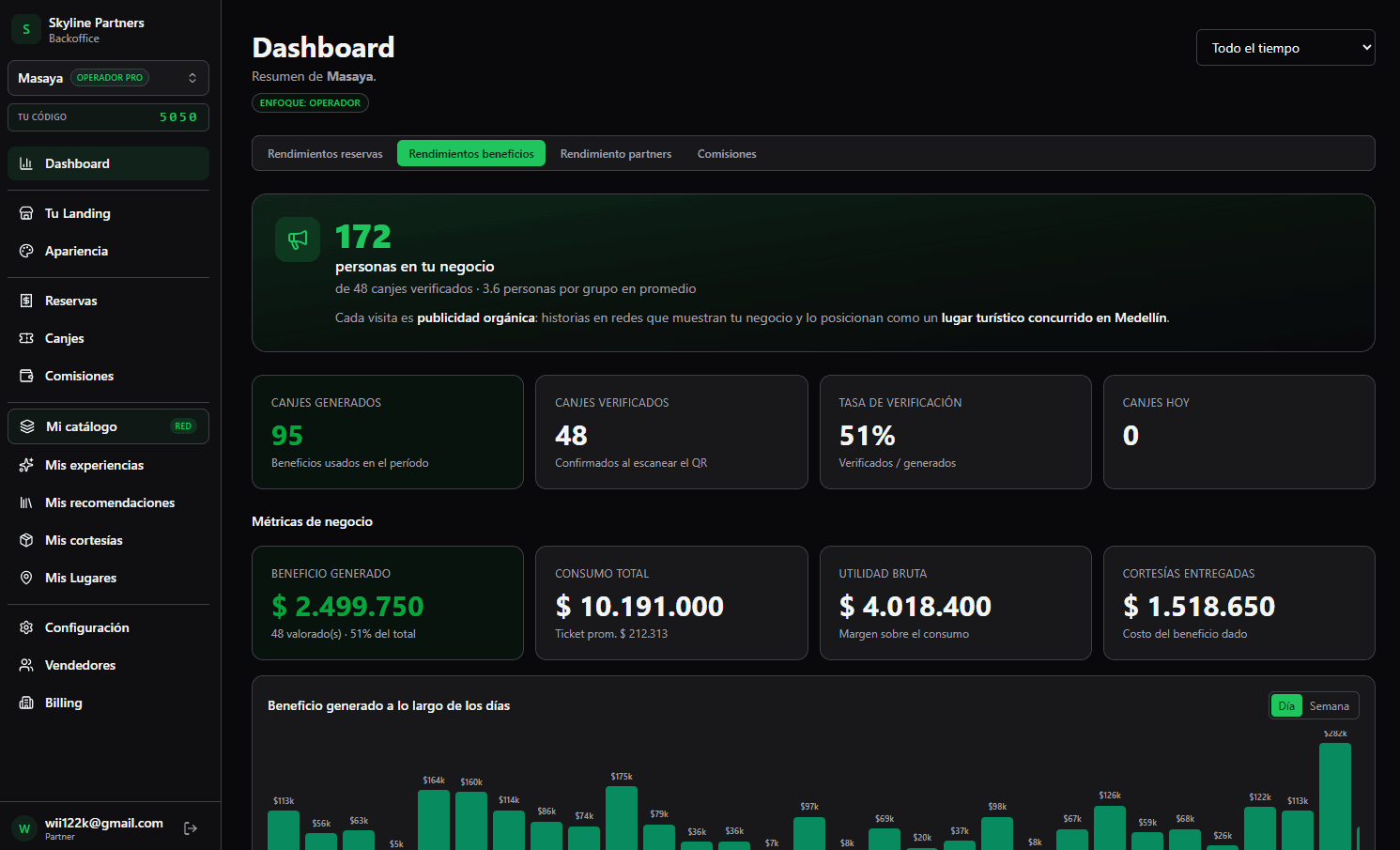
Related · Vórax
How to Fill a Rooftop Bar on Weekdays With Courtesies
Publish a drink courtesy only for the slow nights and the partner network recommends it.
ReadVerified-Redemption Courtesies: Guide for Restaurants
You only pay per redeemed courtesy, with no fixed cost to start.
ReadHow to Publish a Courtesy Offer for Your Restaurant
A courtesy is a concrete perk (a drink, an entry, a discount) that attracts new customers and is delivered via QR.
Read