Terra · Skyline Blog
What Is a Booking Engine and What Tours Need
Fabián Alvarez5 min read
TL;DR
- A booking engine manages availability, dates, payments and confirmations, not just charges.
- For tours, the minimum is per-departure availability control, deposit payments and an operational view with guides and travelers.
- AI adds chat access via MCP, without making up prices since those are computed server-side from the catalog.
- A traditional booking engine can sell, but it often leaves daily operations outside the system.
A booking engine is the system that lets a customer book and pay for an experience online, and lets the operator manage availability, dates and confirmations. For tours it must add, at minimum, per-departure availability control, deposit payments and an operational view with guides, travelers and a calendar in one place.
What is a booking engine?
A booking engine is the system that lets a customer book and pay for an experience online, and lets the operator manage availability, dates and confirmations. That's the literal definition, and it's worth holding onto because many operators confuse a booking engine with a simple payment gateway or a contact form. It isn't either of those. A real booking engine closes the full loop: the traveler sees real availability, pays, and the operator sees that booking reflected immediately in their operation.
For a tour operator, this isn't a technical detail. It's the difference between selling manually over chat, copying and pasting data between WhatsApp, a spreadsheet and a guides group chat, or having a system that does that work for you.
What does a booking engine need, at minimum, for tours?
Not every booking engine works for experience-based tourism. A generic hotel or appointment booking engine doesn't understand per-departure availability, assigned guides or partial payments. For a tour operator, the bare minimum is:
1. Availability and departure control
Every tour has a date, a time and a limited number of spots. The engine must know how many spots remain on each departure and stop selling once they're full. Without this, a kayak operator in Guatapé ends up with overbooking: two different bookings for the same spot, a guide who doesn't know who to expect, and a furious customer on the shore.
2. Flexible payments, not just payments
Charging online is only the starting point. Terra, Skyline's AI booking engine, solves this with online payments with its own checkout, with a 30% deposit option and balance paid later. This matters because not every traveler wants to commit full payment weeks before traveling, and not every operator wants to lose a sale by requiring it. The deposit confirms the spot; the balance gets charged later, without chasing the customer over WhatsApp.
3. An operational view, not just a sales one
A booking engine that only sells but doesn't organize the operation falls short. Terra puts bookings, guides, departures, travelers and payments in a single, multi-user operations calendar. This is key for a team with several guides and several departures on the same day: instead of cross-checking three different files, the whole team sees the same calendar, in real time, from any device.
4. Confirmations and reminders that don't depend on someone remembering
A tour with a 7 a.m. departure can't depend on someone from the team remembering to message the traveler the night before. This falls into the operations category, not just sales, and it's where many traditional booking engines fall short: they record the sale but don't stay with the traveler until they board the bus or the boat.
What does AI add to a booking engine?
This is where a modern booking engine separates itself from a traditional one. AI doesn't replace availability and payment controls: it makes them accessible from wherever the operator already works, which is almost always the chat.
Terra connects to Claude, ChatGPT or Gemini via MCP (Model Context Protocol): the operator generates a URL in Terra → Integrations, pastes it into their assistant and operates by chat. MCP is an open standard that lets an AI assistant connect to external tools and data through a server that exposes actions with defined permissions. In practice, this means an operator can ask their AI assistant to check availability, create a booking or review an itinerary, without opening a separate admin panel for each task.
Think of an agency in Cartagena with three people handling WhatsApp, Instagram and in-person sales. Instead of each of them logging into a different system to check availability, anyone can ask their AI assistant "how many spots are left for Saturday's mangrove tour?" and get the real answer, because prices are computed server-side from the catalog and the AI cannot make up a price. That's what separates an AI booking engine from a rule-based chatbot: the chatbot repeats scripts, the AI-powered engine operates on real data.
Traditional booking engine vs. AI booking engine for tours
| Feature | Traditional booking engine | AI booking engine (Terra) |
|---|---|---|
| Availability and departures | Usually yes | Yes, with a multi-user calendar view |
| Partial payments | Depends on the provider | 30% deposit and balance paid later |
| Chat access | No | Yes, via MCP with Claude, ChatGPT or Gemini |
| Daily operations (guides, travelers) | Often left out, in spreadsheets | Integrated into the same calendar |
| Source of prices | Manual configuration | Computed server-side from the catalog |
How do you know if your business's booking engine is falling short?
If your team still cross-checks a spreadsheet with the guide's WhatsApp to know who's on tomorrow's departure, or if collecting a pending balance depends on someone remembering to write, the booking engine you use today is probably solving only the sales part and leaving the operation out. A booking engine for tours needs to cover both: the sale and the operation, in the same place.
The question worth asking isn't just "can I charge online?" but "what happens after someone pays?" If the answer involves copying data by hand between three tools, that's the gap.
What to do now
Check how you currently confirm a deposit booking and how your guide finds out about tomorrow's departure. If that process still runs through copying and pasting between WhatsApp and a spreadsheet, go to terra.skyln.co and see what an operations calendar with availability, payments and guides in one place looks like.
Frequently asked questions
Are a booking engine and a payment gateway the same thing?
No. A payment gateway only collects money. A booking engine manages availability, dates, confirmations and the whole operation around that sale, not just the charge.
Why does the deposit matter in a booking engine for tours?
Because it confirms the spot with a partial payment and lets you collect the balance later, without losing the sale or pressuring the traveler. Terra offers a 30% deposit with the balance paid later.
What is MCP and why does it come up next to a booking engine?
MCP (Model Context Protocol) is an open standard that lets an AI assistant connect to external tools and data through a server with defined permissions. Terra uses it so an operator can check and create bookings from Claude, ChatGPT or Gemini.
Can AI make up prices in a booking engine?
Not in Terra: prices are computed server-side from the catalog, and the AI cannot make up a price. This avoids incorrect quotes when operating by chat.
What sets a traditional booking engine apart from an AI one?
A traditional one usually solves only the sale and leaves daily operations (guides, calendar, travelers) in separate tools. An AI-powered one like Terra integrates that operation into a single calendar and lets you check it by chat.
Terra
See Terra in action
The AI booking engine for tour operators: bookings, itineraries, packages and payments, operated by chat via MCP.
Request a Terra demo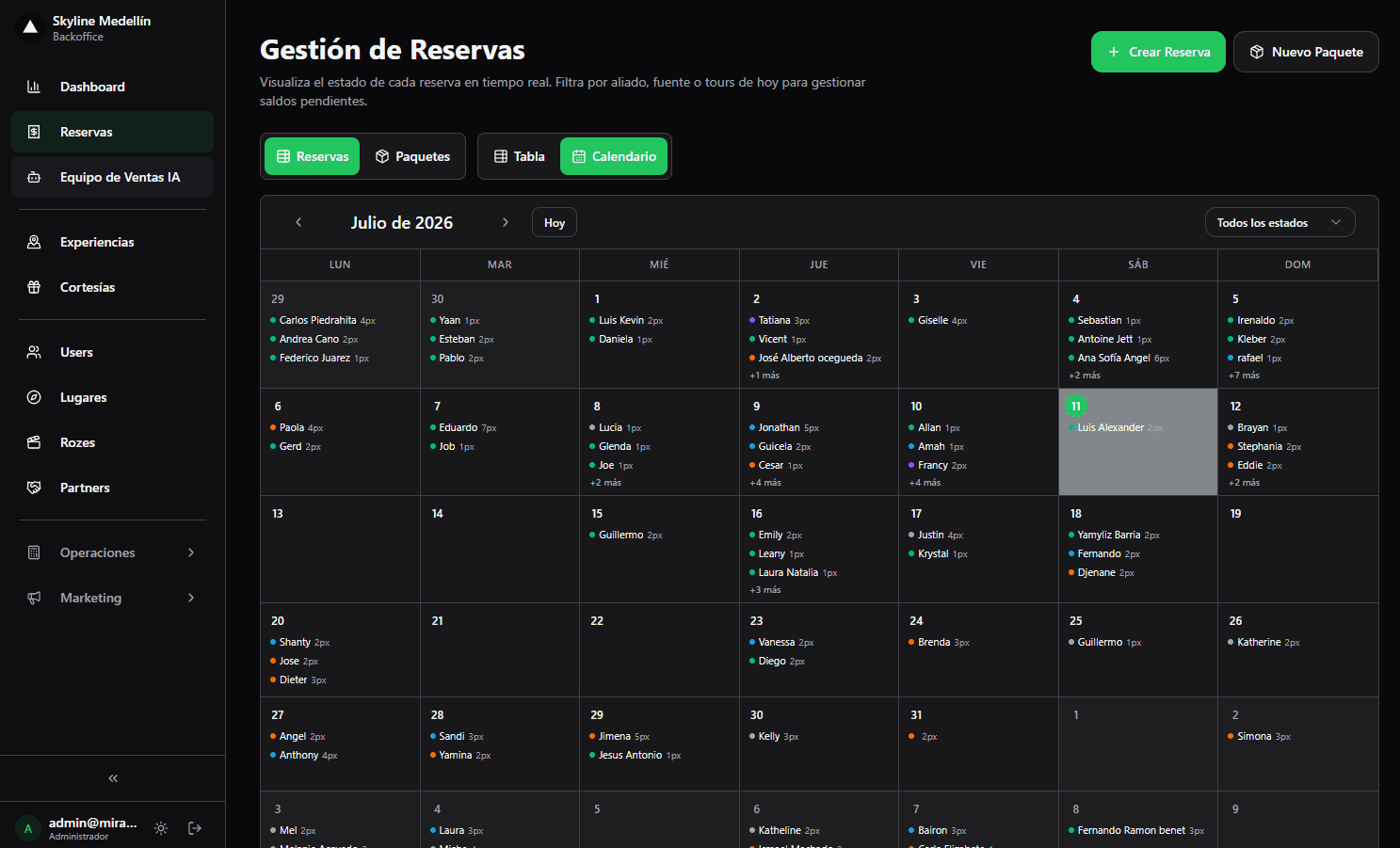
Related · Terra
How to Charge Tour Bookings Online: Deposits & Links
A payment link is the base of any charge; in Terra it's born directly from the booking with its own checkout.
ReadAI Booking Engine for Tour Operators: Full Guide
An AI booking engine handles bookings, itineraries, packages, payments and operations in one place, operable by chat.
Read